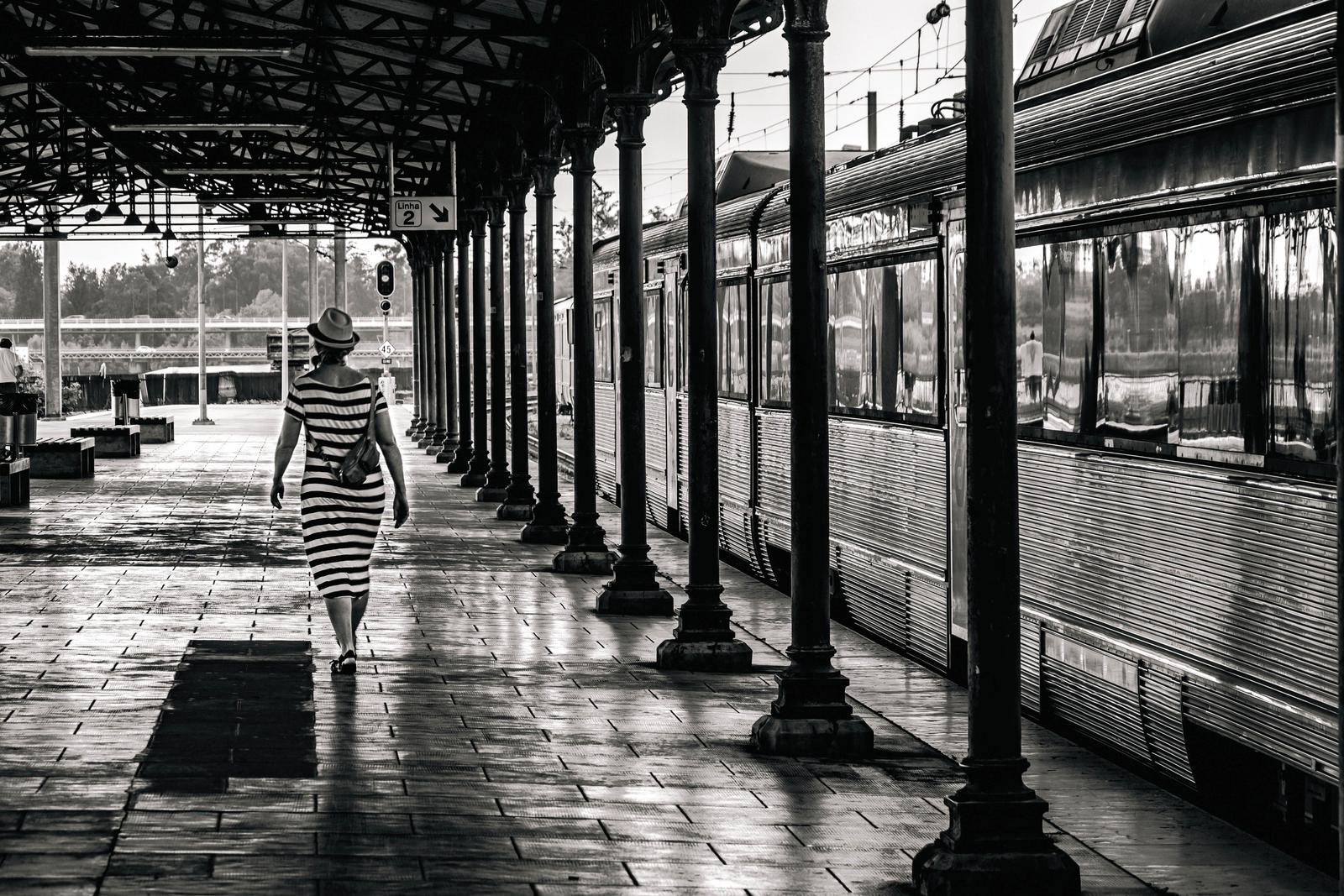
Clean geometry and a quiet travel moment held together by strong monochrome tones.
You’ve succeeded at exactly that—the pillars, roof trusses and train panels give you a tidy set of lines to play with, and the wet platform gives the shadows some bite. This sits comfortably between street and travel: a human figure animates an architectural space. The striped dress echoing the train’s ribbed metal is a smart visual rhyme. What emotion about travel were you hoping to convey—solitude, anticipation, or a pure graphic study? Clarifying that will help you decide where to place the walker and how long to wait for the right stride or patch of light.
TECHNICAL EXECUTION ★★★★
The monochrome conversion is controlled, with a healthy tonal range from deep blacks in the pillars to clean mid‑tones on the platform. Detail holds in the train’s reflective surfaces without nasty halos, suggesting careful contrast work. The figure is acceptably sharp for a walking subject; if anything, a touch more shutter speed would guarantee crispness in the limbs. There’s no obvious noise or artefacts, and the reflections read naturally. To reach five stars I’d want absolute bite on the subject and slightly more separation from the background via local contrast on the traveller.
COMPOSITION ★★★★
The perspective is well chosen: pillars and train pull the eye down the platform to a clean vanishing point, and the traveller is placed on the left third. Her stripes echo the train and lead the eye back to the right—nice. The heavy column on the far right edge, however, acts like a visual door frame slammed shut; trimming it or stepping half a metre left would release the scene and strengthen the run of columns. Consider waiting until the subject occupies a gap between columns to avoid partial merges. Five stars would need that right‑edge tension resolved and a slightly cleaner relationship between the figure and the supports.
LIGHTING ★★★★
Backlight gives you sheen on the train and a glossy floor—perfect for your “lines, light and shadow” aim. The roof provides soft top light that stops the figure from becoming a pure silhouette while still keeping drama. A small lift to the mid‑tones on the walker would separate her more from the bright reflections opposite. Highlights on the train are close to clipping in places but still controlled. Absolute top marks would need a stronger shaft of light across the subject or a moment when she steps into one of those brighter tiles.
STORY ★★★
The lone traveller walking toward a waiting train hints at departure, but the moment itself is middling rather than decisive. There’s no gesture beyond the walk—no glance to the doors, no bag being lifted, no interaction that locks a narrative. The environment does a lot of heavy lifting while the human element feels secondary. If you’d waited for a longer stride, a look back, or the doors opening, the scene would carry more tension. What tiny action could define the mood you want—hesitation, hurry, or calm routine?
IMPACT ★★★★
The graphic control and tasteful monochrome give the image presence; it reads instantly and holds together well. The repeating columns and the reflective train skin are memorable. Impact is tempered only by the near‑miss on the story and that blocked right edge. Still, it’s a strong, publishable frame that shows a confident eye for structure. To hit five stars, pair this geometry with a tighter human moment or a cleaner edge treatment.
CONSTRUCTIVE NEXT STEPS
✓ From the same spot, step left and rotate slightly right (or crop a sliver) to remove the thick pillar on the far right and let the column rhythm run cleanly to the vanishing point.
✓ Work the moment: use burst mode around 1/250–1/500s and wait for a committed stride, a head turn toward the carriage, or the subject entering a bright patch between columns.
✓ Post‑processing: gently dodge the traveller (mid‑tones only) and burn the bright hotspots on the train; add a subtle local contrast boost to the floor tiles near the shadow to deepen the graphic feel.
AI Version 1.22