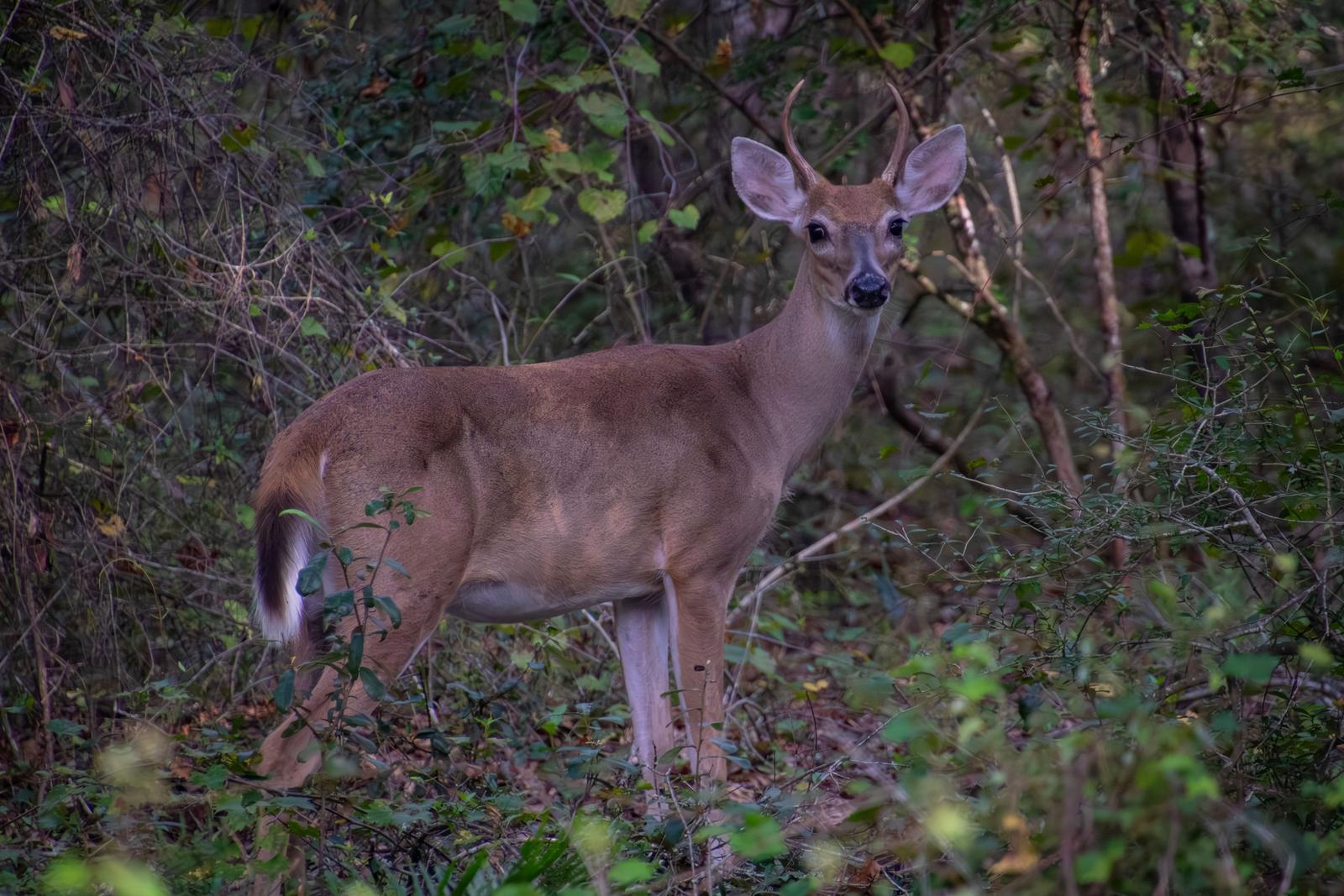
A calm, alert moment with a young buck, rendered with gentle woodland light.
You’ve succeeded in placing the animal in its true home — the vines and scrub do communicate Florida woodland. This sits squarely in wildlife portraiture. The sideways body with the head turned to camera gives us connection without spooking him, and the soft, shaded light keeps colour and fur detail natural. The challenge is balance: how much of that tangle supports the subject before it starts competing with him? Consider whether the story is stronger when the habitat “frames” the buck rather than sharing equal visual weight.
TECHNICAL EXECUTION ★★★★
Focus looks solid on the eye and muzzle, with good detail in the coat and antlers. Exposure is well controlled — no blown whites on the tail and no crushed shadow in the body. Colour feels believable and restrained, which suits this scene. I can’t see problematic noise or heavy processing artefacts. A touch more subject isolation (either via a wider aperture or longer focal length) would move this toward five stars by softening the busy background even further.
COMPOSITION ★★★
The buck is well-sized in the frame and fully included, which is a good foundation. However, the background is very busy; bright leaf spots and intersecting twigs around the neck and head pull the eye away from the face. There’s modest space ahead of where he’s facing; a little more breathing room to the right would feel more natural and less cramped. A lower position or small sidestep to place the head against a cleaner, darker patch would help separation while still showing habitat. How might the image read if the face sat in the open gap just above the shoulder rather than against the tangle?
LIGHTING ★★★
The soft forest shade is kind and even, preserving detail and natural colour. There’s a faint catchlight that adds life to the eye, but overall the light is relatively flat and doesn’t sculpt the form strongly. A slight angle where light grazes the face would add dimension and help the subject pop from the foliage. Timing for early or late light filtering through the trees could provide that subtle rim or modelling without becoming harsh. As it stands, the lighting is safe and serviceable rather than expressive.
STORY ★★★
This is a clean portrait of a young buck at alert — ears forward, eyes on you. It communicates place and species honestly, fulfilling your intent to include environment. What it lacks is a small behavioural note to elevate it: a step through the vines, a nibble at a leaf, or a tail flick would add narrative energy. The static pose and dense background keep it in the realm of a good record rather than a memorable encounter. What specific behaviour were you hoping for, and how long did you wait for it?
IMPACT ★★★
The image is pleasing and competent, and deer lovers will appreciate it. The busyness of the scene and the safe light reduce that instant “wow” factor and make it less distinctive among similar woodland deer portraits. Stronger separation or a more telling moment would push it higher. With cleaner background placement and a touch more gesture, this could become a standout frame.
CONSTRUCTIVE NEXT STEPS
✓ When you have an alert, stationary subject, open the lens (e.g., f/4–f/5.6) and, if possible, add 50–100mm more focal length to compress and blur the vine tangle; keep shutter ≥1/500s to hold sharpness.
✓ Reposition subtly: crouch lower or sidestep 30–60cm to place the buck’s head against the cleanest, darkest patch of background; leave extra space in the direction he’s facing.
✓ Wait for a small behaviour: a step forward, sniffing a leaf, or an ear twitch — keep shooting short bursts to catch that micro‑gesture that adds story.
✓ In post, brush down the brightest leaf spots and stray light twigs around the head by about 0.3–0.5 stops and reduce clarity/texture slightly behind the face to de-emphasise clutter while staying honest.
AI Version 2.0