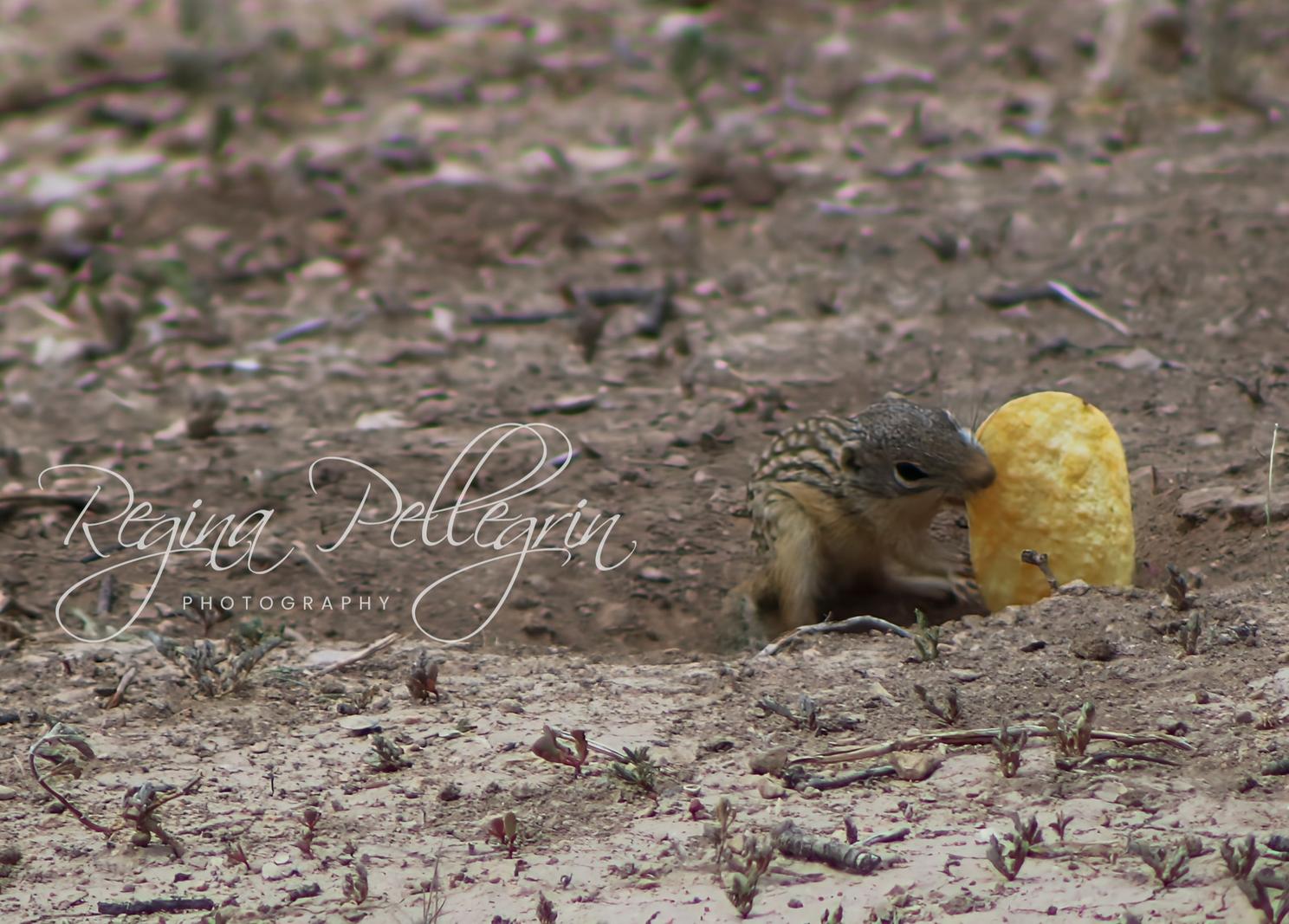
A fun, cheeky moment—yet held back by soft focus, flat light, and an intrusive watermark.
You’ve caught a humorous wildlife moment: a small ground‑squirrel/prairie‑dog inspecting a bright yellow chip in dusty habitat. The behavioural contrast is clear and relatable, and your low angle helps put us at the animal’s level. To your question: no, this isn’t National Geographic‑level, and I wouldn’t put it in a serious portfolio yet. Nat Geo work demands tack‑sharp eyes, clean composition, strong light, and a decisive behaviour; this frame feels like a candid snapshot with technical and storytelling compromises. If your intent is to show the human impact on wildlife (litter/food), the scene would need clearer context and a cleaner execution. What story did you want the viewer to leave with—cute theft, or commentary on human presence—and how might you frame differently to make that unambiguous?
TECHNICAL EXECUTION ★★
Focus on the animal’s eye is soft, likely from a modest shutter speed or slight misfocus; there’s no crisp detail in the fur. The light is flat and gives you no catchlight, so the eye lacks life. Processing looks restrained, but the oversized watermark across the foreground is highly distracting and, for publication, a non‑starter. Noise and colour are acceptable, yet the yellow chip dominates due to luminance and saturation. To reach five stars you’d need pin‑sharp focus on the eye, a faster shutter (around 1/1000s), a clean file, and no watermark intruding on the image area.
COMPOSITION ★★
The subject is crowded against the right edge with very little space in the direction of its gaze and the chip; meanwhile there’s a large expanse of empty earth on the left that doesn’t add meaning. The chip is taller and brighter than the animal, so it steals attention rather than supporting the story. Small sticks and sprigs near the foreground add clutter, and the animal’s body is partly hidden by the burrow lip, reducing presence. A tighter, right‑weighted crop with breathing room ahead of the nose would help, as would a slightly higher or lower position to simplify the background plane. A portfolio frame would place the animal cleanly with intentional negative space and no mergers.
LIGHTING ★★
This appears to be harsh or overcast mid‑day light—flat and low on contrast—which gives little shape and no sparkle to the eye. The ground is bright while the animal is comparatively dull, so the subject doesn’t pop. Early or late light would add warmth, texture, and separation. Even open shade with a brighter background could create a pleasing rim and help the eye read. For five stars, aim for golden-hour side light and an angle that yields a catchlight.
STORY ★★★
There’s a clear, amusing narrative: a wild animal inspecting human junk food. However, the exact moment is pre‑action—the animal is merely sniffing—so the frame lacks a peak gesture (holding, biting, tugging). Without wider context (table, bin, feet), it sits between a wildlife portrait and environmental commentary and doesn’t fully commit to either. Consider also the ethics: avoid chasing or encouraging habituation; stronger work shows behaviour without stressing or altering it. What would this look like if you waited for a definite action or framed to include an unmistakable hint of the picnic area?
IMPACT ★★
Cute and shareable, but not memorable. The soft focus, tight edge on the right, and oversized watermark undermine any potential wow factor. The chip’s colour becomes the headline instead of the animal’s character. A decisive behavioural moment, cleaner frame, and better light would raise this into portfolio territory. As it stands, it’s a pleasant outtake rather than a signature image.
CONSTRUCTIVE NEXT STEPS
✓ Prioritise eye sharpness and separation: use AF‑C/AI‑Servo with a single point on the eye, shutter around 1/1000s, aperture f/4–f/5.6, and get lower/closer (or use a longer lens) to blur the background and fill the frame.
✓ Compose for the gaze: leave space on the side the animal is looking/moving toward; avoid crowding the subject against the edge, and pre‑frame so the chip or action doesn’t outsize the animal.
✓ Wait for the moment: hands/paws on the chip, a bite, or a look to camera with a catchlight will transform the narrative. If your aim is commentary on human impact, include a clear environmental cue (table leg, bin) rather than just bare dirt.
✓ Post‑processing: remove the large watermark, clone the bright twig near the chip, apply a subtle radial dodge to the eye/face, and slightly reduce the chip’s luminance so the animal remains the hero.
AI Version 2.0