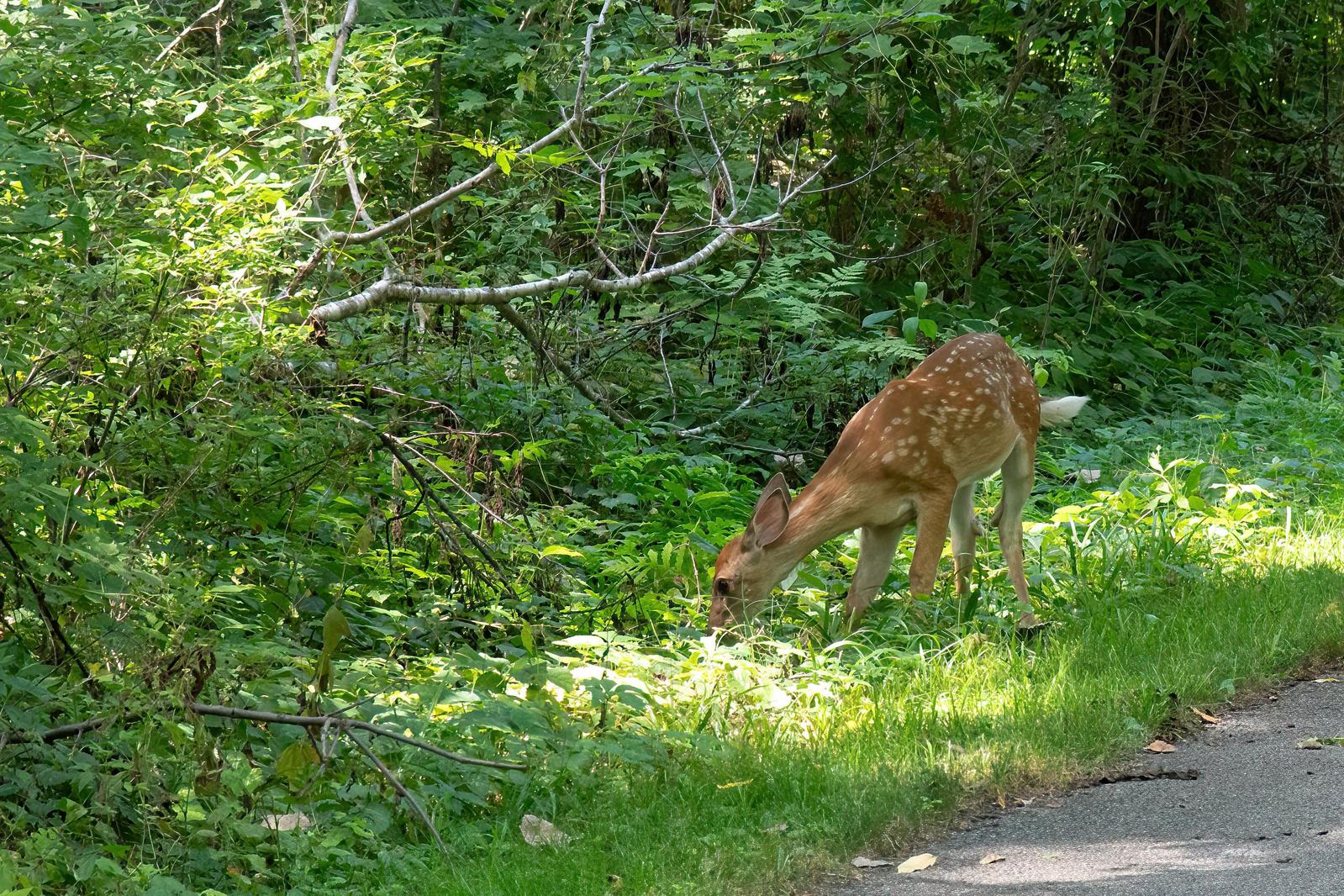
A gentle woodland pause, but the scene fights a bit with itself.
You’ve caught a calm, honest moment of a fawn grazing, and the dappled light does kiss her back nicely. This sits in wildlife/nature, with a whiff of human context from the bike path. The soft sunlight is working in parts — the coat and spots glow — but it also creates a bright patch of grass that pulls attention away from the head. The picture feels observant and respectful. Were you tempted to crouch lower or shift left to separate her head from the busy foliage and to decide whether the path is part of the story or a distraction?
TECHNICAL EXECUTION ★★★
Focus looks sound for a cautious, feeding subject; fur detail on the shoulder and flank holds up. Colour balance feels natural and restrained. The main technical weak point is the hotspot across the foreground grass — it’s a touch hot and competes with the animal. The head is in shade with no clear catchlight, so the most important detail reads a bit flat. Next time, consider a slight exposure bias of –0.3 to –0.7 EV to protect the highlights and recover the face later, plus AF-C with a single point on the eye at around 1/500–1/1000 sec to bank a sharper “head up” frame. To reach five stars I’d want tack-sharp eyes and better controlled highlights.
COMPOSITION ★★
The deer sits on the right third, which is fine, but the frame feels crowded: bright path on the far right, heavy foliage left, and twiggy branches near the head. Those elements drag the eye away from the subject. The head-down posture reduces connection and the path’s hard line becomes the strongest graphic shape. Either commit to the human–wildlife contrast by using the path as a clean leading line, or exclude it and simplify the background. A lower, slightly leftward position would put the head against the lighter grass, give space in the direction of gaze, and clean up the mergers. For a five‑star composition I’d want a more intentional relationship between animal, background, and path.
LIGHTING ★★★
The light is soft overall with pleasing glints on the spotted coat and a faint rim along the back. However, it’s dappled and uneven: the foreground grass is lit strongly while the face is in shade, so the viewer’s eye goes to the grass first. There’s no catchlight, which robs the head of life. Waiting for the fawn to step into a brighter patch or angling so the face catches a slice of light would help. Early or late light would warm the tones and give better separation. Five stars would need intentional light on the head and eye with highlights kept in check elsewhere.
STORY ★★★
The behaviour is clear — quiet foraging on the edge of a human space — and that’s a valid, gentle story. The bike path hints at coexistence, but it’s understated rather than purposeful. A small change in timing could add tension: the fawn looking up, ears pricked, or a single frame with a distant cyclist to justify the path’s presence. As is, it’s a pleasant record rather than a moment that makes you pause. To reach a higher rating, aim for a gesture that communicates alertness or curiosity.
IMPACT ★★★
It’s a calm, likeable image with tasteful colour and no gimmicks. The distractions and muted face keep it from being memorable. Stronger eye visibility, simpler framing, and decisive use (or exclusion) of the path would lift the presence considerably. A cleaner background and a small, bright catchlight would give it the snap it needs to stand out.
CONSTRUCTIVE NEXT STEPS
✓ Reframe with intent: either step left and crouch to remove most of the path and place the head against the lighter grass, or include more of the path as a true leading line to the deer — not just a bright edge.
✓ Prioritise the face: use AF‑C with a single point on the eye, 1/500–1/1000 sec and around f/4–f/5.6; wait for a head‑lift or ear‑twitch for a stronger gesture and catchlight.
✓ Tame the bright grass in post: reduce Highlights by about 0.5–1 stop, then add a subtle radial dodge on the face/back to guide the eye; clone or heal the small bright leaf and the twig that intersects near the head.
AI Version 2.0