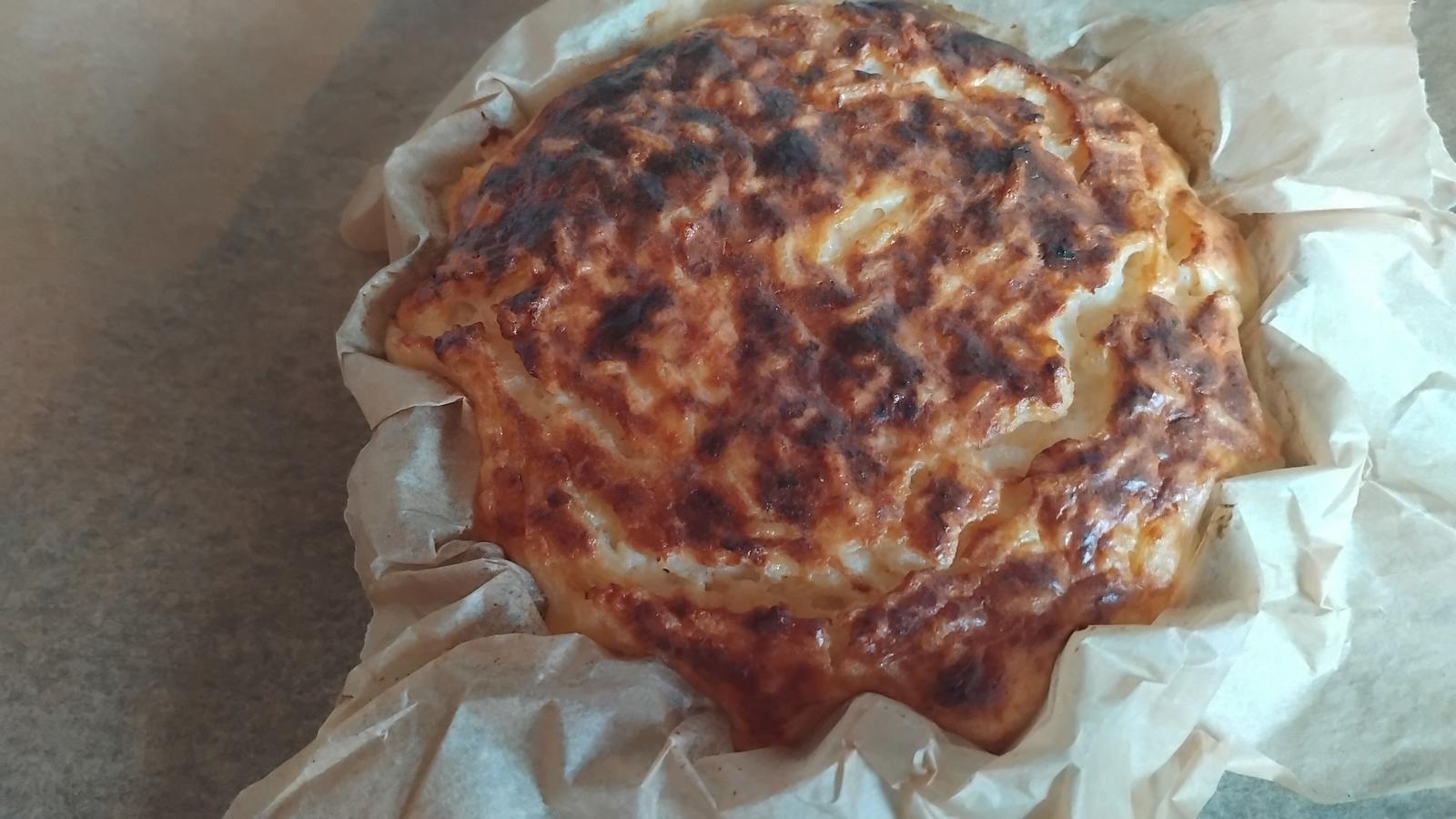
Rustic bake, but photographed like a quick snapshot rather than a considered food image.
You’re right to ask what needs attention in food photography. The essentials are light direction, colour accuracy, styling, and deliberate framing. Here we have a simple food/still‑life of a baked pie or quiche on parchment. The bubbling top and crinkled paper give a homemade feel, which is a good starting point, but the current lighting and framing make the food look heavy and slightly burnt rather than inviting. Aim to decide what you want the viewer to feel—cosy home baking or clean cookbook polish—and style everything to support that. What story did you want to tell: just‑out‑of‑the‑oven warmth, or a plated slice ready to eat?
TECHNICAL EXECUTION ★★
Focus appears acceptable but not crisp, with a slight softness across the surface. Exposure is uneven: the darker scorched patches sit next to bright, slightly blown highlights, which limits readable texture. The white balance leans warm/orange, likely from indoor bulbs, which muddies the pastry’s colour. I see no obvious artefacts, but the overall tonality is flat. To reach ★★★★★ you’d need accurate colour (daylight or custom WB), clean detail across the pastry, and controlled highlights that keep the texture intact.
COMPOSITION ★★
The pie is centred and crowded by the frame edges, while the parchment forms messy, high‑contrast folds that dominate the scene. The plain countertop contributes little and there are no supporting props to guide the eye or add context. Overhead-ish angle without symmetry makes the round subject feel a bit lopsided. A hero moment—a clean slice removed, a knife, a plate, a linen—would introduce shape and direction. For a higher score, compose intentionally: either a disciplined top‑down with space and order, or a 45° angle that shows depth and a chosen focal point.
LIGHTING ★★
This looks like mixed indoor lighting from above, producing flat highlights and patchy shadows. Top light glances off the glossy surface, exaggerating burnt spots and flattening texture. Food usually benefits from side or back light to reveal layers and make edges glow. There’s no reflected fill to soften the shadows on the opposite side. To reach ★★★★–★★★★★ use window side‑light at 45°, kill ceiling lights, and add a white card as bounce for gentle fill.
STORY ★
At present the image simply says “a pie on parchment.” There’s no cue about occasion, scale, or moment—no steam, slice, hands, or serving props. The rustic paper hints at home cooking, but without a supporting element it doesn’t land emotionally or practically. Consider what happens next in the scene: is someone about to cut it, is it cooling, is it part of a family meal? What single detail could show that?
IMPACT ★★
The realness of the bake and the parchment’s texture have potential, but the scorched top, warm cast and cramped frame reduce appetite appeal. Nothing strongly anchors the viewer’s eye, so it’s easy to move on. With cleaner styling, directional light, and a clear “hero” moment, this could become engaging. Five‑star impact would make me want to reach in, smell it, and take a bite.
CONSTRUCTIVE NEXT STEPS
✓ Move the dish beside a window and turn off ceiling lights. Place the light at 45° from the side or slightly behind; use a white card opposite for fill. Shoot RAW, ISO 100–200, around f/4–f/5.6, and set a daylight or custom white balance.
✓ Create a hero moment: rotate to the best-looking area, cut a clean slice and either remove it or lift it on a knife. Add one plate, a simple linen, and perhaps a small knife to direct the eye and imply serving.
✓ Compose deliberately: give breathing room around the circle, tame or trim the parchment so it frames rather than overwhelms, and choose either a clean top‑down or a 45° angle. Consider a darker matte surface to contrast the golden crust.
✓ Post‑processing: neutralise the orange cast (cool the temperature slightly), reduce highlights to recover texture, lift shadows a touch, and add selective clarity on the crust. Crop to a square or 4:5 with the pie off‑centre on a third for balance.
AI Version 2.0