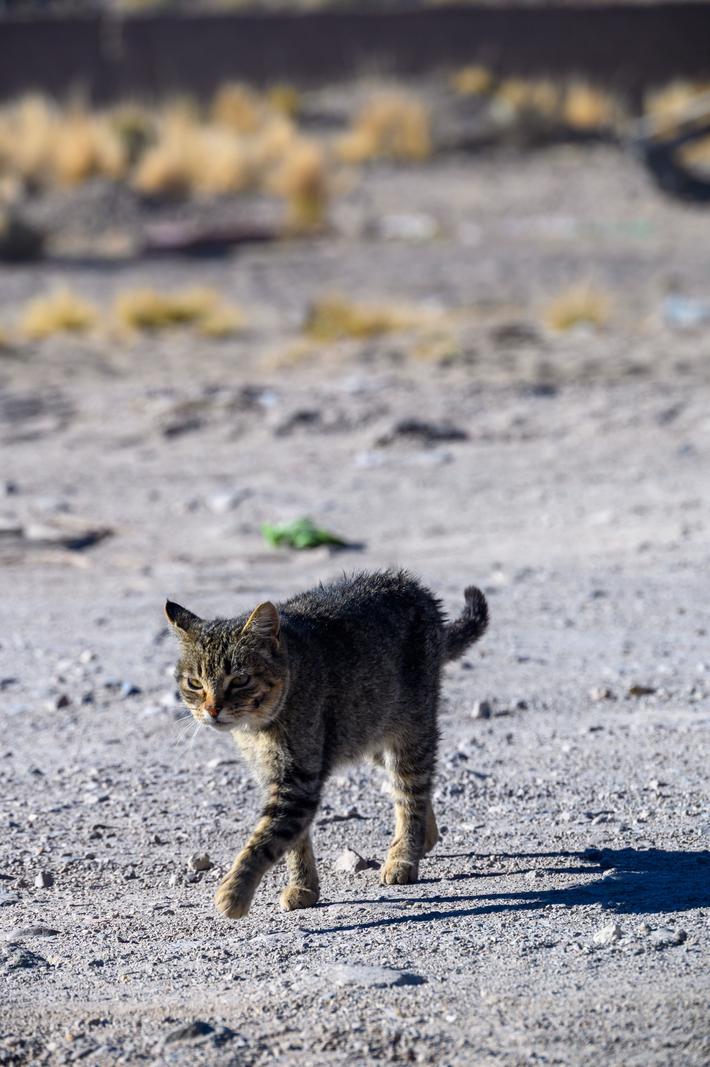
A confident little stride in tough light, with a strong subject that deserves a cleaner frame.
On your question: I wouldn’t centre this cat. Because it’s walking, giving it space to move into (to the right) creates energy; centring would make it feel static. The real issue is the clipped shadow at the bottom edge, which reads like an accident. You have two honest fixes: 1) frame looser or shoot a vertical next time to include the whole shadow, or 2) crop tighter now so the shadow is clearly, deliberately excluded. Fabricating extra shadow in post is possible (extend canvas + paint/dodge) but it’s a heavy manipulation and rarely looks convincing on gritty ground like this. Overall this is a wildlife-style animal portrait with good timing on the step.
TECHNICAL EXECUTION ★★★
Focus looks acceptable on the cat, though the eyes don’t feel razor‑sharp. Shutter speed seems fast enough to freeze the step, and the tones are natural without garish colour. The midday contrast leaves the fur a touch crunchy and the shadows deep, which flattens detail on the face. Background blur is handled well, though the bright green object behind the cat pulls the eye. With crisper focus on the eyes and a touch more tonal control, this would climb a notch.
COMPOSITION ★★★
The cat is roughly central with ample space to the right, which partly supports the sense of movement. The clipped shadow at the bottom is the main compositional problem—our eye expects to see it complete. A slightly lower viewpoint and placing the cat on the left third would add flow and separate it more from the ground. The tail comes close to the right edge, creating mild tension; a bit more breathing room would help. How would the frame feel if you’d shot a vertical to include both cat and full shadow as a graphic shape?
LIGHTING ★★
This is hard, high sun. It carves deep, unflattering shadows across the cat’s face and leaves the eyes dull, with no clear catchlight. The ground reflects a lot of light, exaggerating contrast and making textures look harsh. Early or late light, or open shade, would give softer fur detail and nicer colour. Even a small change—waiting for a cloud or moving so the sun skims the side—would add shape and reduce the squinting look.
STORY ★★
The moment is a simple stride—clear but not revealing much behaviour or character. There’s a hint of attitude in the forward paw and narrowed eyes, yet the scene feels generic and could be any cat, any dusty lot. Including more environment (or a human element) could build a stronger narrative about place. Alternatively, wait for a stronger gesture—yawn, look back, leap—to give the frame a hook. What were you hoping the viewer would feel about this cat—tough, curious, at ease?
IMPACT ★★
The subject has charm, but the harsh light and clipped shadow reduce the photograph’s presence. The palette is nicely muted and natural, which suits the scene. Without a stronger moment or more intentional framing, it’s easy to pass by. Clean up the distractions and time it for better light, and the same scene could hit much harder.
CONSTRUCTIVE NEXT STEPS
✓ Solve the shadow problem in-camera: frame looser or switch to a vertical orientation so the entire shadow sits inside the frame; alternatively, crop tighter now so the shadow is intentionally excluded rather than clipped.
✓ Shoot in softer light (early/late or open shade) and aim for a catchlight in the eyes; try around 1/1000s, f/4–f/5.6, ISO as needed, with −1/3 EV to protect highlights on the fur.
✓ Get lower and place the cat on the left third with more space to the right; this increases separation from the ground and emphasises the direction of travel.
✓ In post, remove the bright green object behind the cat, lift exposure slightly on the face with a small radial dodge, and ease contrast in the shadows for more fur detail.
AI Version 2.0