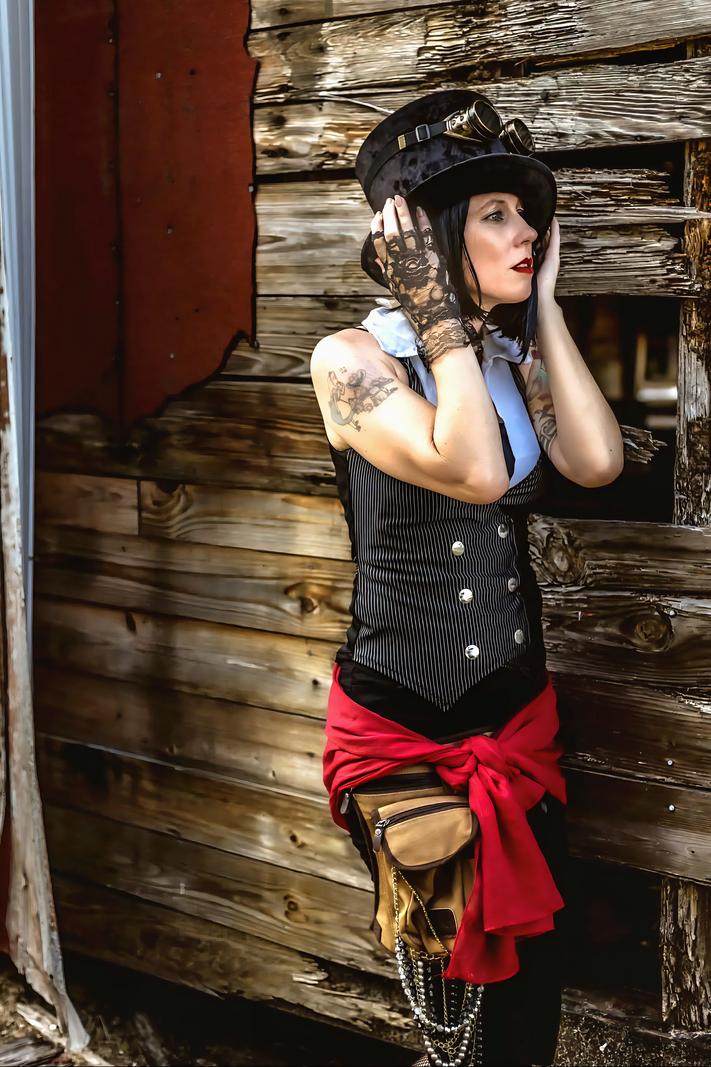
A strong character and a textured setting, but the background is starting to upstage your subject.
You’ve created a styled portrait with a fashion flavour: the steampunk outfit against the weathered timber has real promise. Your focus on the background shows—you’ve found a wall with great texture—but right now it competes with the model instead of supporting her. The heavy micro‑contrast on the wood and the bright red sash around the waist pull the eye away from the face, which should be the anchor. Ask yourself: were you trying to tell us about the character of the model or the character of the wall? If it’s the model, the background needs to quieten down and give her more space and separation.
TECHNICAL EXECUTION ★★★
Focus and exposure are sound; the eyes and facial plane are acceptably sharp and there’s no obvious noise or motion blur. Processing looks pushed—clarity/structure is high on the wood, giving it a crunchy look that fights skin texture and can make the image feel overworked. The red wrap is quite saturated compared with the rest of the palette, which drags attention downward. To reach five stars, keep the polish but dial back micro‑contrast on the background, tame the reds, and apply subtle local dodging on the face so the viewer lands there first.
COMPOSITION ★★★
The model’s hands to the hat create a readable gesture and the dark window behind her helps the profile stand out. However, the bright vertical strip on the far left edge and the busy pocket/beads cluster low right are eye‑catching distractions. She’s looking out of frame to the right, but there isn’t much space in that direction, which makes the pose feel a touch cramped; meanwhile the red sash forms a strong, competing shape near the centre. A cleaner edge (exclude the bright strip), a step to your right to give more “looking room,” and either simplifying or darkening the lower elements would strengthen the flow dramatically.
LIGHTING ★★★
Side light from camera left gives decent shape to the face and torso, and the hat shadow isn’t killing the eyes, which is good. That said, highlights on the near shoulder run a bit hot while the eyes could use a touch more lift. A small reflector or a white wall just out of frame on the right would open the eye sockets and balance the contrast under the brim. For five stars, aim for softer, more directional light (open shade or late‑day sun) that sculpts the face while keeping the background a notch darker.
STORY ★★
The costume hints at a world, but we don’t get much of the person wearing it. The hands-to-hat pose suggests she’s listening or adjusting, yet there’s no interaction with the environment to complete the thought—the moment feels arranged rather than lived. A simple action—peering through the broken window, adjusting the goggles, or a quick glance back to camera—would add character and connection. What single gesture would tell us who she is in this place?
IMPACT ★★★
The styling and textures give the image presence and it will appeal to fans of the look. Impact is reduced by competing hotspots and the overall busyness; your subject doesn’t quite dominate her frame. Calming the colour palette and simplifying the edges would let the strong costume and gesture speak louder. To reach a four or five, aim for one clear visual priority—her face—supported by everything else.
CONSTRUCTIVE NEXT STEPS
✓ Move the model 0.5–1 m off the wall and shoot around f/2.8–f/4; you’ll keep the timber’s character but soften it enough that the face becomes primary.
✓ Clean the frame: step right to remove the bright metal strip on the left, and either crop or darken the pocket/beads cluster; clone small bright flecks in the wood.
✓ In post, reduce background clarity/texture and pull red saturation/luminance down 10–20%; add a subtle radial dodge (+0.2–0.3 EV) on the face for immediate focus.
✓ Build a moment: ask her to interact with the window or goggles, or give more “looking room” and catch a decisive expression rather than a held pose.
AI Version 2.0