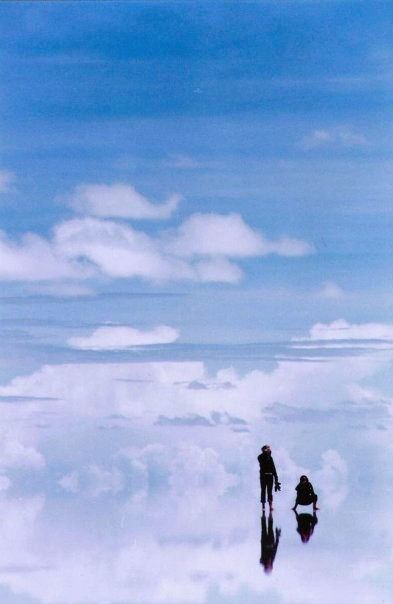
A quiet, sky-drenched moment where scale and reflection do the heavy lifting.
Short answer: no, it doesn’t feel overprocessed. The colour sits in a gentle, film‑like blue with soft contrast; nothing screams heavy editing or HDR. If anything, the scan leans a touch cyan, which is common with sky‑heavy negatives and can be dialled back slightly without losing the feel of the film. What you’ve made reads as a minimalist travel/fine‑art landscape: two small figures anchored on a mirror‑flat surface under an ocean of sky. The reflections are clean, the tonal roll‑off is smooth, and the restraint you’ve shown in processing supports the mood rather than fighting it. How intentional was the decision to keep the people this small—were you aiming for insignificance against the vastness, or would a step closer have built more connection?
TECHNICAL EXECUTION ★★★★
Exposure is nicely controlled: the whites in the clouds aren’t clipped and the midtones hold detail without muddy shadows. Grain looks natural for film and the scan appears clean, with no obvious haloes or sharpening artefacts. The overall blue cast feels slightly strong; a small warm shift would make the clouds less cyan and the skin tones (though tiny) less cold. The figures are understandably not razor‑sharp because they’re small in frame, but the silhouettes and reflections read clearly. Given the medium, this is solid and honest—refined but not sterile. To reach five stars I’d want a cleaner, slightly warmer white balance and meticulous spot removal if there are any tiny dust flecks hiding in the sky.
COMPOSITION ★★★★
The enormous negative space is the statement here, and it works—the two people and their reflections provide scale and a focal anchor. Their placement near the bottom centre keeps the frame calm, but it also makes the picture a touch safe. A step left or right to push them onto a third, or a slight crop, could introduce a little tension without losing the serenity. I like the echoing silhouettes on the mirror—those verticals are strong against all the horizontal cloud bands. Nothing is awkwardly clipped and the frame breathes well. Five stars would need either a more deliberate asymmetry or a slightly stronger gesture from the subjects to stop the eye and hold it longer.
LIGHTING ★★★★
Soft, even daylight suits this subject: no harsh shadows, clean reflections, and a gentle gradient through the sky. There’s enough contrast to separate clouds from their reflections, but it doesn’t feel punchy or forced. The cool palette adds calm, though the slight cyan bias keeps the scene a little chilly. A hint of low‑angle warmth—either by timing or a subtle grade—could deepen the sense of depth and make the clouds feel more dimensional. Still, the light supports the idea and never distracts. Five stars would come with more sculpting light (early or late in the day) to add depth to the cloud forms.
STORY ★★★
The tiny human figures introduce scale and a hint of narrative—one standing, one crouching—but the moment itself is quiet rather than decisive. I’m left curious about what they’re doing, yet the gestures don’t quite develop into a clear beat. Because they’re so small, we don’t get much emotion or character; the picture relies primarily on atmosphere. That’s fine for a minimalist piece, but it limits rewatch value. A step closer, a clearer interaction between the two, or a distinctive gesture (pointing, reaching, walking apart) would strengthen the story significantly. Do you have frames where their positions or actions change slightly?
IMPACT ★★★★
The mirror‑world effect delivers an immediate hit and the restrained palette keeps it elegant. Salar‑style reflections are common subjects, but the film softness and the huge vertical of sky give yours a calmer voice than most. It’s memorable for its scale and quietness rather than spectacle. Where it falls just short of iconic is in that missing micro‑moment—something human to hook into after the initial “wow.” With a stronger gesture or bolder placement of the figures, this could jump a tier. As it stands, it’s a refined, peaceful image that would print beautifully large.
CONSTRUCTIVE NEXT STEPS
✓ Nudge the scan slightly warmer: raise Kelvin or add a gentle yellow/red curve in the highlights to neutralise the cyan in the clouds while keeping the film feel.
✓ Explore a tighter variation: step 5–10 metres closer (or a modest crop) so the figures and reflections are 20–30% larger, placed on a third, to deepen the human connection without losing the vastness.
✓ Wait for or prompt a clearer gesture—have one subject walk, jump a shallow puddle, or reach towards the reflection—to create a distinct moment that anchors the scene.
✓ For future film scans, do a careful dust pass and consider a very light midtone S‑curve to add depth while keeping highlights soft; avoid strong clarity which breaks the serenity.
AI Version 2.0