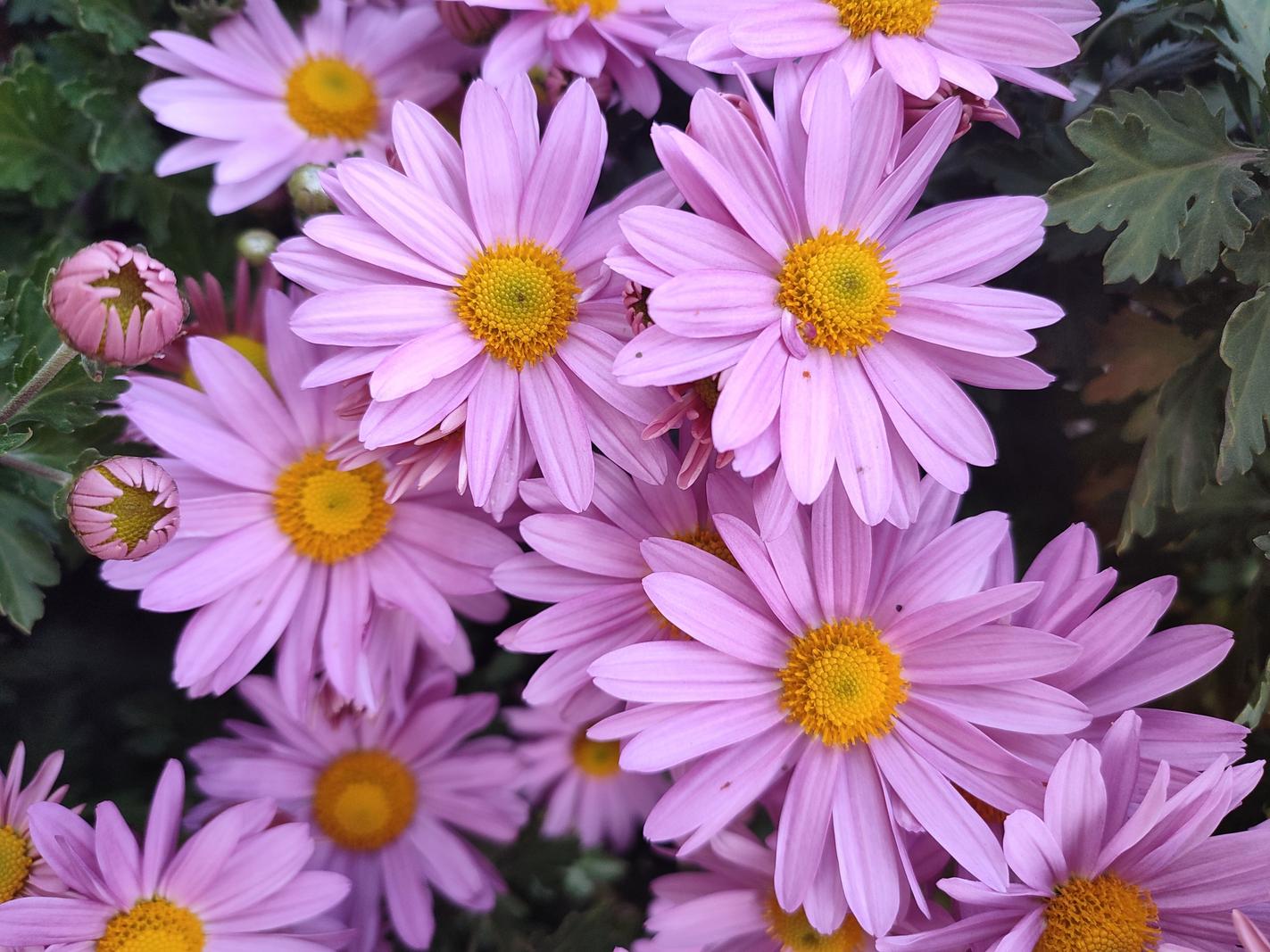
A gentle, well‑handled close‑up that shows lovely colour and detail, but it needs a clearer point of focus.
Short answer: neither is “better” in general — the angle must match your intention and the background. From above you emphasise pattern and symmetry and can create a tidy, graphic arrangement; from the side (or a low 45°) you reveal depth, petal layers and often separate a hero bloom from a busy background. In your photo — a macro/close‑up of chrysanthemums — the mostly top‑down viewpoint flattens the cluster and gives many equal focal points. A slightly lower, side‑leaning angle would let one flower lead and push the others into softer blur. Notice the two closed buds on the left and the strong yellow discs; either could be your “hero”. What do you want viewers to see first: the mass of blooms as a pattern, or the character of a single flower?
TECHNICAL EXECUTION ★★★★
Exposure and colour are well controlled; the pinks look natural and the yellow centres retain texture. Focus is crisp on several blooms, and there’s no obvious noise or artefacts. Depth of field is moderately deep, which keeps many flowers readable but also contributes to a slightly busy look. A touch of edge softness appears where petals meet the frame, likely from depth of field rather than motion. With a single, precise focus point on one chosen centre and a slightly wider aperture, you could add refinement without sacrificing detail. To reach five stars I’d want a cleaner separation between the hero bloom and the rest, or a deliberate focus stack if you intended full sharpness across the cluster.
COMPOSITION ★★★
The frame is filled with colour and texture, which is pleasing, and the two unopened buds on the left add variety. However, there isn’t a clear primary subject; several yellow centres compete for attention. The tight crop trims petals along the edges, creating a crowded feeling rather than intentional boldness. The diagonal sweep of blooms top‑right to bottom‑left is promising; anchoring it with one dominant flower — perhaps the bright one near the centre‑right — would give the eye a starting point. Consider stepping back slightly to give breathing space, or go tighter and abstract to commit to the pattern. A deliberate choice either way would strengthen the design.
LIGHTING ★★★★
Soft natural light suits the subject, preserving delicate petal texture without harsh highlights. There’s a gentle fall‑off into the foliage which keeps attention on the blooms. The light direction is mostly top/front, so forms read clearly but not dramatically. Backlight at a low angle could make the petals glow and add dimension, while a diffuser on a brighter day would maintain this softness. To reach five stars, I’d like a touch more modelling — a sense of shape created by light, not just even illumination.
STORY ★★★
This is largely a “beauty of nature” study rather than a moment, but there is a hint of narrative in the contrast between the closed buds and open flowers. Showing one bloom as the hero with buds supporting could suggest stages of growth more strongly. As it stands, the image records abundance rather than a specific idea. Ask yourself: what is the single thought you want to convey — pattern, tenderness, or life cycle? A clear choice will guide viewpoint and focus.
IMPACT ★★★
The colours are pleasant and the scene is attractive, but the lack of a clear focal point limits memorability. Many similar images exist; what will make yours stand out is either a graphic overhead pattern done with precision or a side‑lit, three‑dimensional hero bloom. Tight control of edges and selective depth would raise the punch. With a stronger lead subject or bolder angle, this could move up a level.
CONSTRUCTIVE NEXT STEPS
✓ Choose a “hero” bloom, then shoot from a low 30–45° angle and use f/2.8–f/4 (or your widest sharp aperture) to blur the surrounding flowers; place a single AF point on the hero’s yellow centre.
✓ If you want everything sharp instead, mount a tripod on a still day and make a small focus stack (3–6 frames from front petals to rear), then blend carefully; this suits a top‑down pattern approach.
✓ Clean the frame edges: either step back slightly to avoid clipping petals or crop tighter to create an intentional abstract; remove tiny dark specks on petals with healing/clone for a polished finish.
✓ Experiment with backlight in early or late sun and hold a white card opposite the light to bounce a little fill into the flower’s centre — this adds sparkle without harshness.
AI Version 2.0