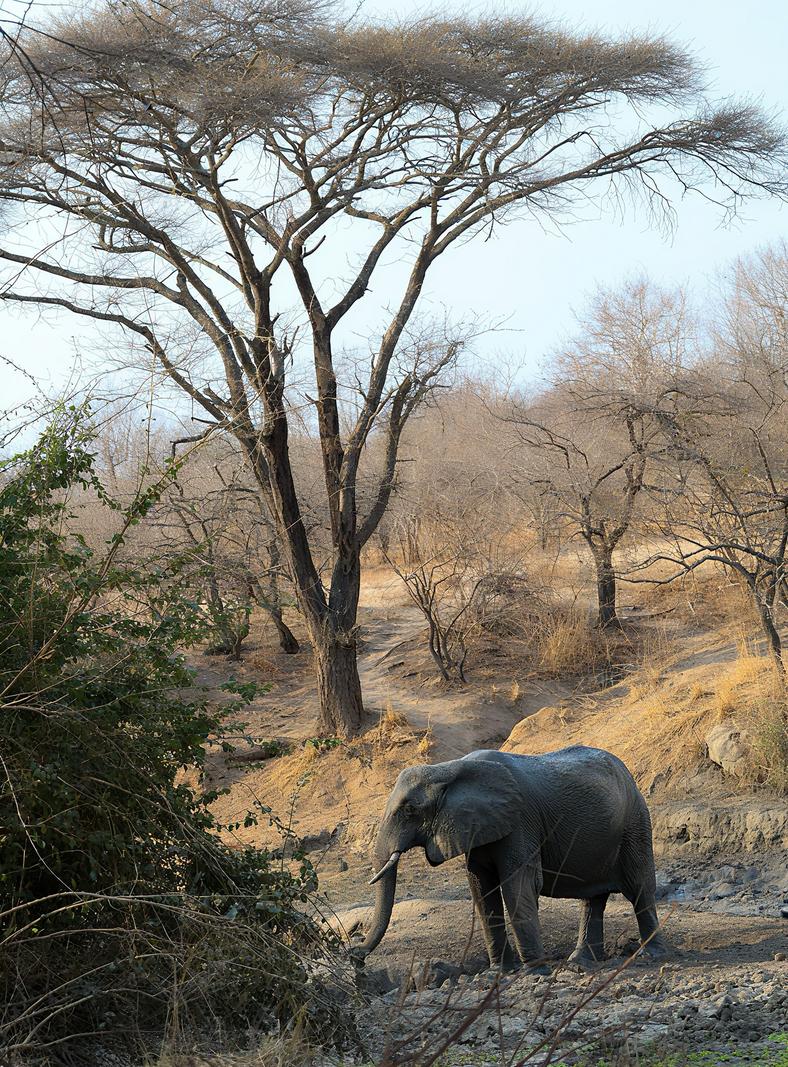
A strong environmental moment with a proud subject, but the frame is competing with too many twigs and edges.
You’re right to question the clutter; the bramble at lower left and the busy branchwork across the mid‑ground steal attention from the elephant. With wildlife like this, you have two honest options: commit to an environmental portrait or isolate the animal. To reduce the mess in-camera, shift your position a couple of metres to the right and slightly higher so the elephant sits against the clean sandy bank, using the ridge to hide the foreground bramble. A longer focal length and a wider aperture (for example 300–400mm at f/4–5.6) will narrow the field of view and soften that stick-heavy background. In post, a crop from the left by roughly 15–20% and a little from the bottom will immediately tidy the frame. As a wildlife image, it’s close—how important is the acacia to your story here compared with a cleaner portrait of the elephant?
TECHNICAL EXECUTION ★★★★
Exposure is well judged; the elephant holds good detail in the shadows and there are no heavy, processed tones. Focus looks solid on the head and tusk, which is the critical area. Colour is natural and restrained, suiting the dry-season palette. I can’t see artefacts or heavy sharpening haloes. To reach five stars, aim for a crisper catchlight and even cleaner separation via a slightly wider aperture to reduce background sharpness without sacrificing subject detail.
COMPOSITION ★★★
The vertical format introduces a pleasing relationship between the big acacia and the elephant, giving scale and place. However, the green tangle at the lower left corner drags the eye, and the mid‑ground branches create a net of lines around the subject. The elephant is placed low and right with room to walk into the frame, which is good, but its body merges with several dark trunks behind it. A modest crop from the left and bottom would simplify things immediately. On location, a small step right and higher would have separated the elephant from the tree trunks and hidden the bramble behind the bank. What mattered more to you—the towering tree as character, or a cleaner portrait with less environment?
LIGHTING ★★★
The light is gentle and even, which keeps texture on the skin readable and avoids harsh glare. That said, the subject sits mostly in flat, open shade while the background feels a touch brighter, reducing punch. A low sun angle or a patch of side light would add shape and a catchlight to bring the face alive. Waiting for the elephant to step into a brighter patch or adjusting position to place the background in deeper shade would increase separation. A subtle post dodge on the head and tusk could help direct the eye.
STORY ★★★
This reads as a calm pause in a dry riverbed—an honest slice of habitat. The grand acacia suggests scale and season, which is a good narrative choice. However, there isn’t much behaviour or tension; it’s more a record than a moment. A lifted foot, a trunk reach, or dust kick could add that extra beat of life. Consider whether including more of the path or waiting for interaction with the environment (drinking, dusting) would deepen the story.
IMPACT ★★★
The subject is impressive and the place feels real, but the frame lacks the clarity that gives a “wow” moment. Visual noise on the left and mid‑ground dilutes presence. With cleaner separation and stronger light on the face, this could rise quickly. The concept—majestic animal under a sprawling tree—is sound; it just needs tighter execution to make it memorable.
CONSTRUCTIVE NEXT STEPS
✓ Reposition: move 2–3 metres to the right and slightly higher to place the elephant against the clean sandy bank, using the ridge to block the bramble and to separate it from dark trunks.
✓ Optics and settings: use a longer focal length (300–400mm) at f/4–5.6 to tighten the field of view and blur the busy twig background while keeping the head razor sharp.
✓ Timing for light: wait for the elephant to step into a patch of side light or for the sun to skim across the face, creating a catchlight and more shape.
✓ Post‑processing: crop ~15–20% from the left and a little from the bottom; then gently dodge the head/tusk and burn the bright mid‑background branches. Clone out one or two strongest stray twigs near the bottom edge.
AI Version 2.0