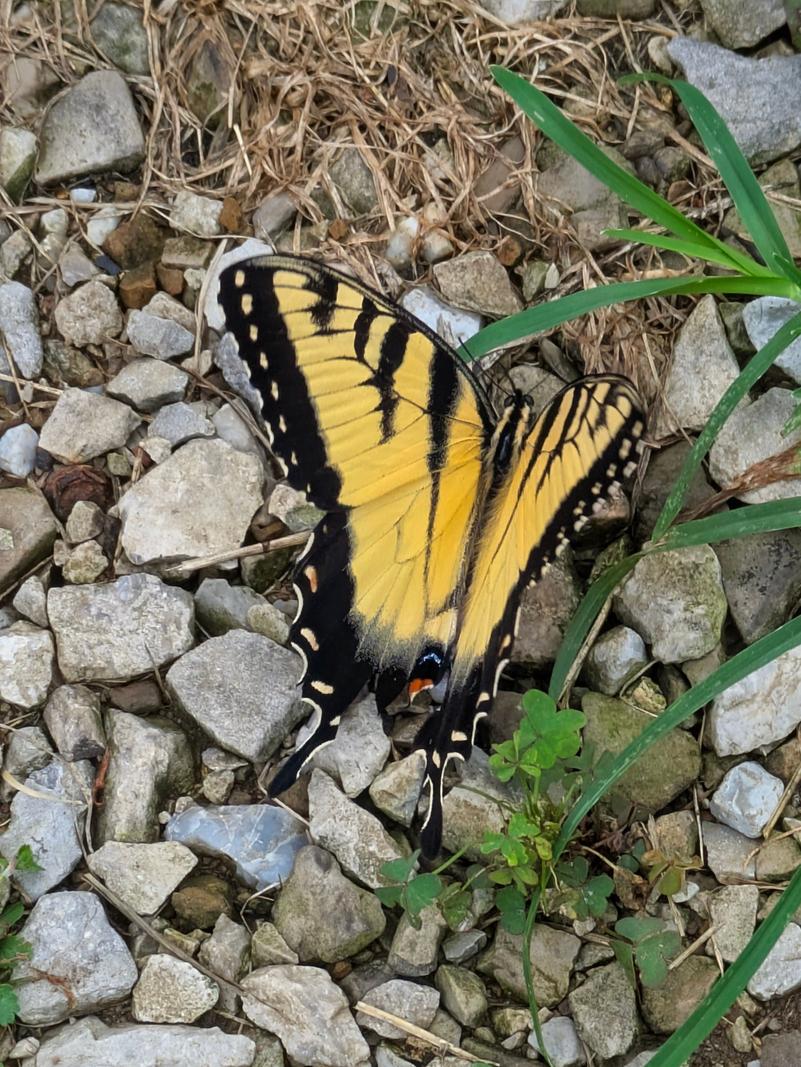
Bold colour on a messy stage — the butterfly pops, but the background steals attention.
You can absolutely make strong nature photos with a phone; improvement will come more from decisions than from gear. Here you’ve caught a striking yellow-and-black swallowtail resting on pale stones — a classic “wildlife portrait” moment. The diagonal wings and the small orange spot near the tail are lovely details, but they’re fighting against a busy gravel background and a couple of bright stones that pull the eye. With small adjustments in viewpoint, background choice and phone handling, this could move from a good snapshot to a clean, intentional image. What stopped you from shifting a step to place the butterfly against the green patch on the right, or from getting lower so the background fell away?
TECHNICAL EXECUTION ★★★
Focus looks solid for a phone — the thorax and wing textures hold up well, and there’s no obvious motion blur. Exposure is mostly controlled; the yellow is near the edge but not clipped, while the pale stones retain detail. Colour feels natural and not over‑pushed, which is good. Where the file struggles is micro‑contrast and separation: the phone’s generous depth of field keeps the stones crisp, so the subject doesn’t pop as much as it could. For five stars you’d want cleaner isolation (via macro/tele options or distance to background), a touch more precision in where you tap‑to‑focus, and selective sharpening confined to the butterfly in post.
COMPOSITION ★★
The butterfly sits slightly left of centre with wings forming a strong V shape — a good anchor. However, the scene is cluttered: bright stones around the left wing and the tuft of dead grass top‑left pull attention, and the green blade at right tugs the eye out of frame. The left wing is close to the edge, creating a cramped feeling, while there’s extra empty gravel above. A lower viewpoint or a small sidestep to place the insect over a cleaner patch (the green clover area works) would simplify the frame dramatically. How might the picture change if you left a little breathing room around all wingtips and used a tighter, vertical crop to eliminate the messiest corners?
LIGHTING ★★★
The light appears open and soft, likely overcast — kind to colour and helpful for detail. It’s also a bit flat, so the butterfly lacks modelling and the stones feel samey. Early or late light from the side would add shape and a subtle sheen to the wings, and a tiny catchlight in the body. On a bright day, shading the immediate area with your body or stepping into open shade would reduce the bright rock hotspots. Five‑star light would sculpt the subject and separate it gently from the ground without harsh contrast.
STORY ★★
There’s a hint of behaviour here — swallowtails often “puddle” minerals on gravel — but the frame doesn’t emphasise that narrative. No proboscis or interaction is visible, and the busy setting reads more like a found snapshot than a chosen moment. A beat of patience to catch the tongue extended, or wings half‑raised, would give the scene purpose. Including more of the green patch, or a second butterfly if present, could build context. To reach four or five stars, aim for a clear behavioural cue or a cleaner environment that says “this is why the butterfly is here.”
IMPACT ★★★
The yellow against grey rock is a strong, immediate contrast and gives the image some punch. Still, competing bright stones dilute that impact, and the flat perspective keeps it feeling ordinary. A cleaner frame and lower angle would add presence and make the colour sing. This is a pleasing record; with tighter control it could become a small, memorable wildlife portrait.
CONSTRUCTIVE NEXT STEPS
✓ Move your feet before moving your fingers: take one small sidestep and crouch so the butterfly sits over the cleanest patch (e.g., the green clover), leaving 5–10% space around all wingtips; shoot a tighter vertical to exclude the messy top‑left corner.
✓ On your phone, tap‑to‑focus on the head/thorax and slide exposure down slightly to protect the yellow; use 2× optical/tele if your phone has it, otherwise avoid digital zoom and crop later for quality.
✓ Shoot in open shade or early morning when butterflies are sluggish; if needed, use your body to shade the bright stones to reduce hotspots and let the colours sit richer.
✓ In post, crop to remove the dead grass top‑left and the bright stone left of the wing; use a selective brush to lower highlights on the surrounding rocks (about −0.3 to −0.5 EV), then add a touch of structure/sharpening only to the wings for separation.
AI Version 2.0