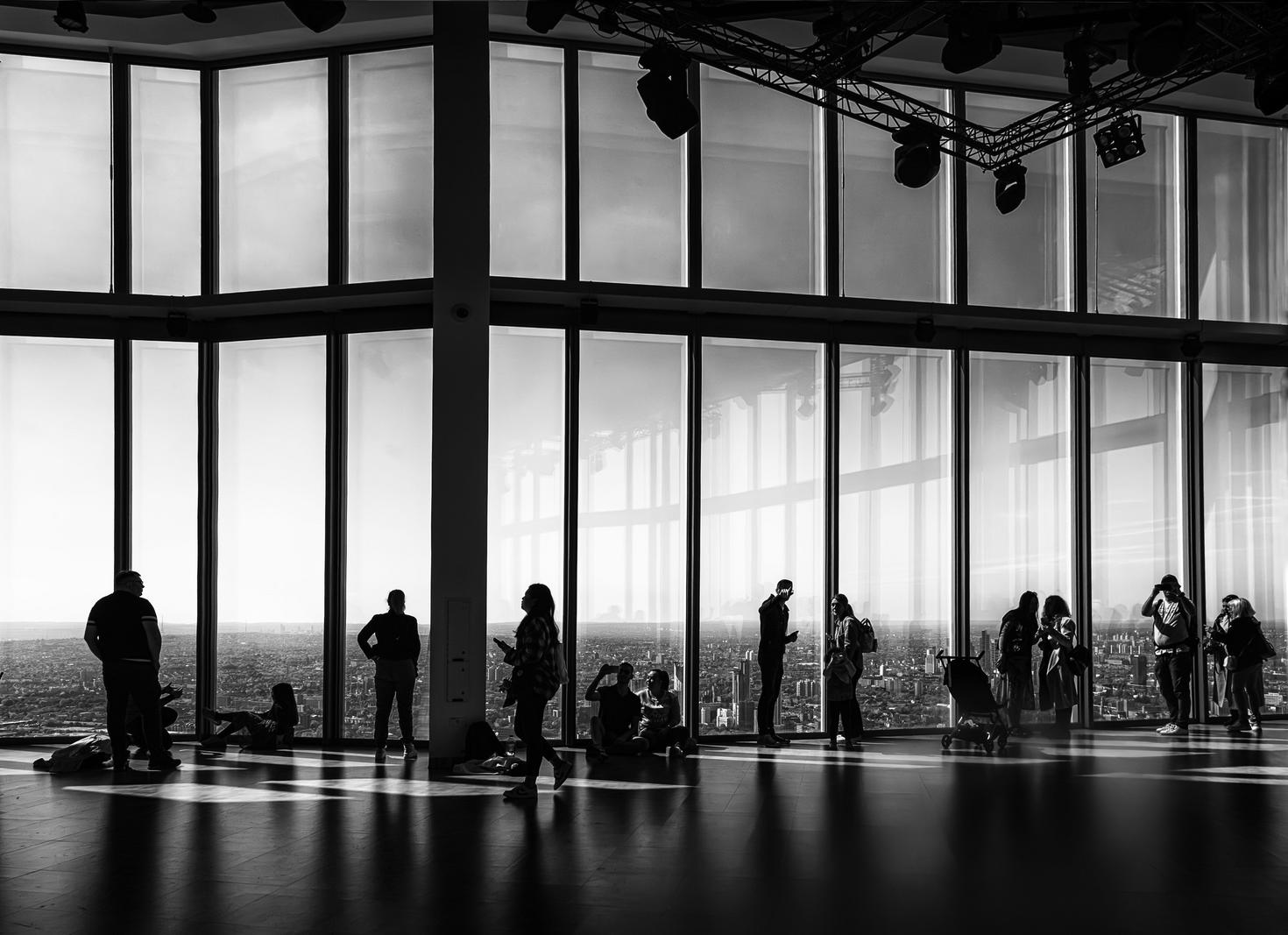
A strong grid of glass and a gentle rhythm of human silhouettes pull us into the city.
You’ve achieved the semi‑silhouette well: the figures read as dark shapes with just enough detail to feel present, while the city beyond remains legible. This sits comfortably in street/travel territory with a dose of architectural geometry. The ceiling rig, tall window mullions, and scattered groups create a layered public‑space scene. One question to push this further: did you want a single “hero” figure, or was the goal an even rhythm across the frame? Knowing that would help you decide how long to wait and where to stand.
TECHNICAL EXECUTION ★★★★
Exposure is nicely judged for a backlit room: the skyline holds detail and the interior falls into clean, rich blacks without turning to mush. The conversion to black and white feels natural with no heavy halos or crunchy sharpening. Reflections in the glass add texture but don’t overwhelm. There’s a touch of tonal greyness in the upper window panels and some bright floor patches that pull the eye, both of which could be refined in post. To hit five stars I’d like to see slightly deeper, more uniform blacks in the interior and a tidier top edge.
COMPOSITION ★★★
The window grid provides a strong framework and the horizon sits at a comfortable level, letting the city read clearly. People are well spaced in places (the seated group near centre‑right works), but the central pillar bisects the frame and the truss and lamps along the top add visual weight that doesn’t help the story. The right edge feels crowded while the far left is relatively empty, so the balance drifts. Several figures merge with mullions, softening their silhouettes. A lower, slightly leftward position or a crop that trims the ceiling rig and recentres the visual weight would strengthen the order.
LIGHTING ★★★★
Backlight is used intentionally and suits the semi‑silhouette aim. The brightest panels create clean separation, and the slashes of light on the floor add depth. The light is soft enough that we keep a hint of detail in clothing without losing the graphic quality. However, the top panes are a bit milky; tightening contrast there would stop the eye drifting upward. A touch more underexposure in‑camera (‑0.3 to ‑0.7 EV) could have carved the figures even more crisply.
STORY ★★★
The scene communicates a clear sense of place: people pausing to look over a city from a high vantage point. There are small gestures—a phone raised, a stroller paused, someone seated on the floor—that suggest calm observation. What’s missing is a decisive anchor: a standout gesture or interaction to hold the frame. Right now the image is about atmosphere more than a specific moment. Waiting for a single strong action—someone pointing, embracing, or reacting to the view—would lift the narrative.
IMPACT ★★★
The scale of the windows against the city and the band of silhouettes make for an engaging first read. It’s visually pleasing but not yet unforgettable because the frame doesn’t resolve around a clear focal moment and the top rig steals attention. Remove that distraction and land one compelling gesture and this could move up a level.
CONSTRUCTIVE NEXT STEPS
✓ Reframe or crop to eliminate the ceiling truss and lights; a tighter top edge or a slightly lower camera position will keep focus on the window grid and figures.
✓ Watch spacing: wait until key figures are cleanly separated from mullions and from each other, then build the frame around one “hero” gesture placed on a third.
✓ In post, deepen interior blacks and subtly burn the brightest floor patches and upper window haze; add a gentle midtone contrast to the skyline to hold detail without losing the silhouette feel.
✓ If repeating the shot, try ‑0.3/‑0.7 EV and 1/250s or faster to keep people crisp while maintaining that semi‑silhouette cutout.
AI Version 2.0