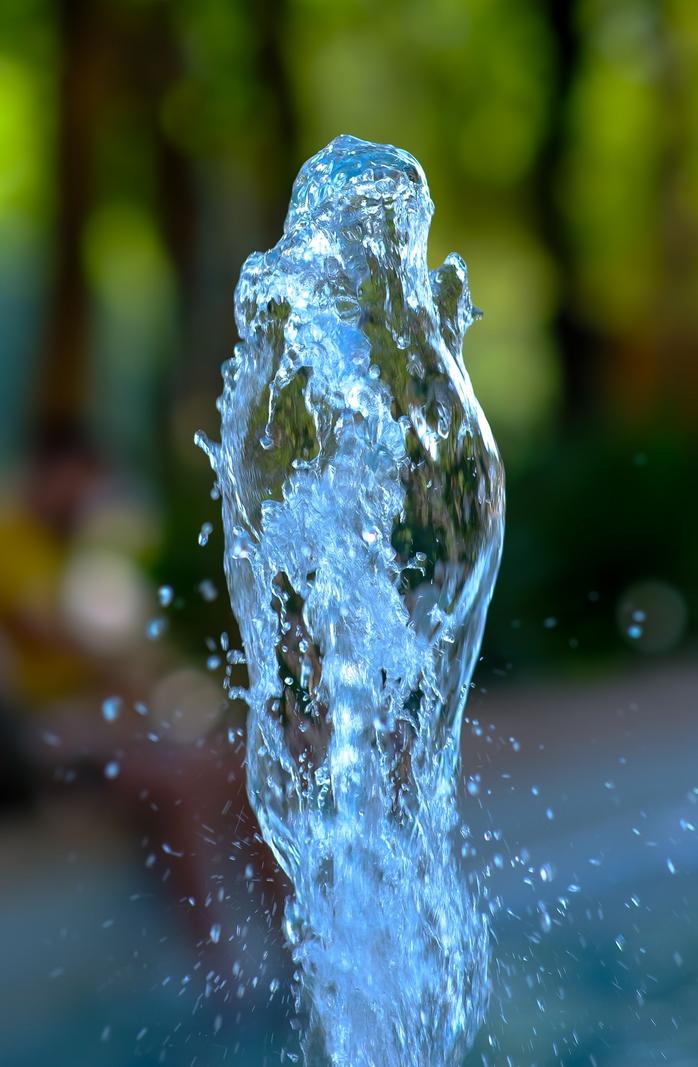
A clean, frozen moment of water with pleasing bokeh, but it needs stronger intention to rise above a simple study.
Its good? Need to improve something?
Short answer: yes, it’s good in craft; it can be better in purpose. You’ve nailed a fast shutter and clean focus that reveal beautiful texture in the fountain plume, and the soft greens behind give a nice summer feel. This reads as an abstract/fine‑art close‑up rather than a travel or landscape shot. Where it falls short is in the story and the composition choices: the spout is centred, the top is close to the frame edge, and a bright yellow patch on the left background competes for attention. Ask yourself: what exact shape, gesture, or relationship did you want the water to make, and how could you control background and timing to serve that idea?
TECHNICAL EXECUTION ★★★★
The shutter speed is high enough to freeze detail crisply; individual rivulets are resolved without smear, suggesting around 1/1000–1/2000s. Focus is spot on the main column and the background blur is smooth, implying a wide aperture that works well here. Colour is clean if a little cool—the water skews blue, which may be a stylistic choice but looks slightly unnatural. There are a few bright specular highlights and tiny droplets that clip, but they’re not deal‑breakers for this subject. To reach five stars, tame the blue cast and polish micro‑contrast so the texture feels natural rather than crunchy.
COMPOSITION ★★★
The subject is centred and vertically dominant, which is safe but static. The top of the plume sits close to the upper edge, creating mild crowding; the base is cropped out, so the stream feels suspended rather than grounded. A bright yellow blur on the left and a bright bokeh circle on the right pull the eye away from the water. A cleaner background or a more deliberate crop—either giving breathing room above or committing to a tighter abstract—would strengthen the frame. Consider whether an off‑centre placement or a symmetrical, perfectly vertical treatment serves your idea best.
LIGHTING ★★★
Ambient daylight renders the water clearly with sparkling highlights, but it’s fairly neutral and doesn’t add emotion. Side or backlight at golden hour would carve the edges with a rim and introduce warmer tones that feel more “alive” than the current cool cast. The speculars are a touch harsh, likely from midday sun; diffusion or timing later in the day would soften them. As is, the light is functional rather than expressive. For a five‑star treatment, make light a character—choose an angle and time that sculpts the column and separates it from the background.
STORY ★★
As a concept—“water is life”—the image hints at an idea but doesn’t show a specific moment beyond a frozen spout. There’s no contextual clue (source, people, hands, environment) to deepen the message, so the frame reads as a technical study rather than a narrative. Shape language could help: a crown, arc, or recognisable gesture formed by the water would create a decisive moment. Right now, the picture asks the viewer to supply meaning. What single gesture or context could you include to turn this from an object study into a moment?
IMPACT ★★
It’s visually pleasant and competent, but it doesn’t linger. Close‑ups of fountains are common; without a distinctive shape, light, or context, the image blends into that category. The cool saturation and stray bright blobs dilute focus, reducing punch at first glance. With more intentional timing and background control, this could become a striking minimalist piece. To reach higher impact, aim for a unique silhouette or light quality that makes viewers stop.
CONSTRUCTIVE NEXT STEPS
✓ Control the background: shift a metre or two to place a uniform dark patch behind the plume; use 85–200mm at f/2.8–f/4 to compress and simplify, then remove the bright yellow patch and right‑side hotspot with a heal/clone in post.
✓ Chase a stronger gesture: shoot short bursts at 1/2000s and time the cycle to catch a crown, arc, or split that reads as a recognisable shape; leave a little headroom so the form isn’t cramped.
✓ Make the light work for you: return at late afternoon with side/backlight for a warm rim and clearer separation; a small flag or your own body can shade the lens to keep contrast.
✓ Refine colour and texture in post: reduce overall saturation a touch, cool/warm selectively so water feels neutral, and ease off clarity on the water edges to avoid a crunchy look while keeping the core detail sharp.
AI Version 2.0