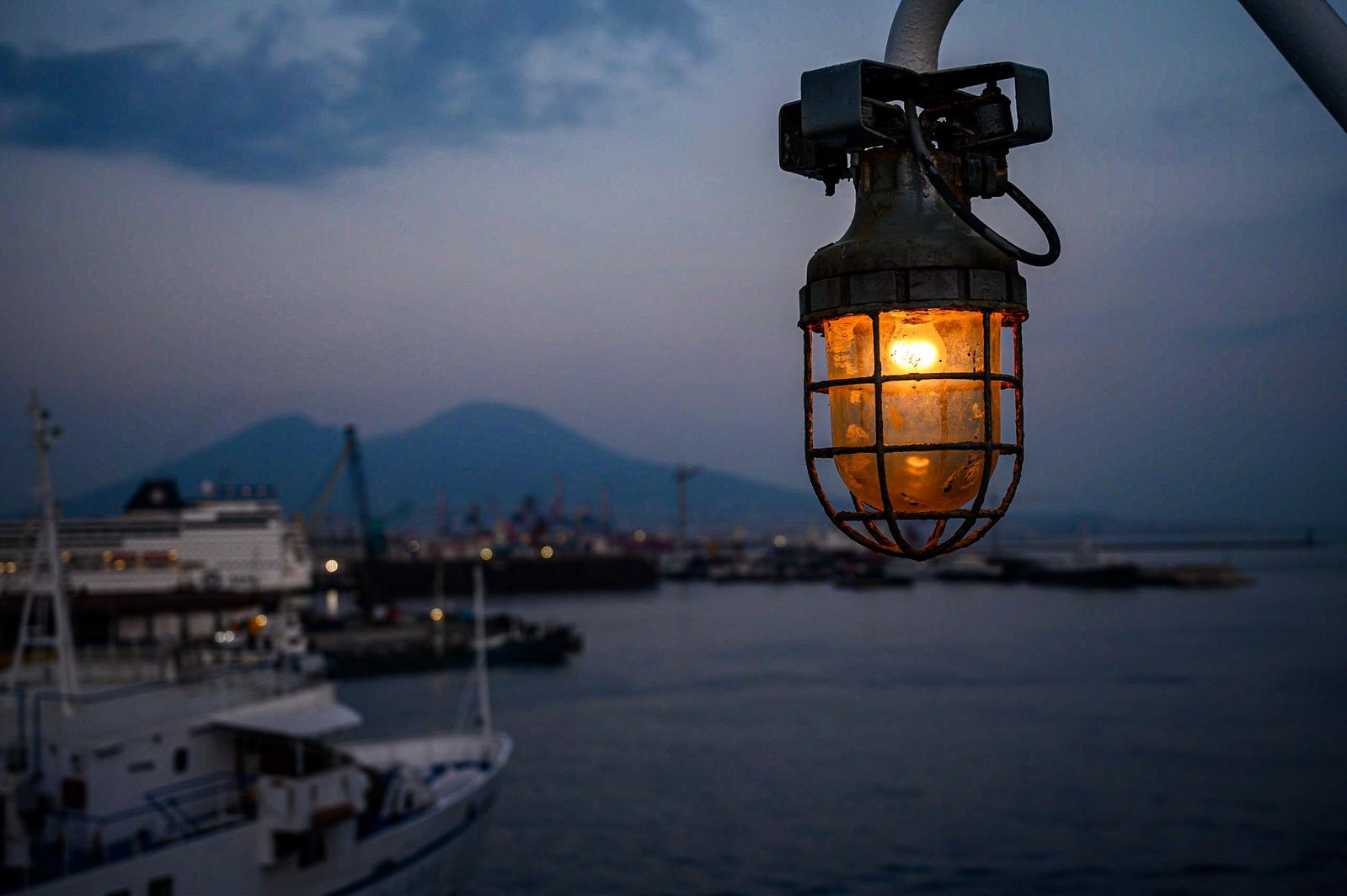
A warm ship’s lamp against the cooling harbour sets a calm, departure mood.
This reads as travel photography anchored by a working detail from the ferry. You’ve leaned into the blue hour well, using the orange lamp as a counterpoint to the cool harbour and distant hills. The choice to focus tightly on the lamp while letting the port dissolve into bokeh suggests you wanted mood over description. Did you consider giving the lamp a little more breathing room on the right and top, or experimenting with depth of field so the harbour felt a touch more legible? Those decisions would shape how much this becomes a mood piece versus a sense‑of‑place photograph.
TECHNICAL EXECUTION ★★★★
The lamp is crisply focused and exposure is controlled—there’s glow without blowing the highlights to white. Background blur is smooth and free of artefacts, and colour feels natural with a clean warm–cool contrast. I don’t see distracting noise or sharpening halos, so the processing is restrained. The only minor technical quibble is that the lamp’s brightest core is close to clipping, which slightly flattens the texture of the bulb area. On a moving ferry you likely needed a safe shutter; keeping it at or above 1/125s with ISO raised is sensible. For ★★★★★, I’d want fractionally more highlight detail in the lamp (−0.3 to −0.7 EV or a small local pull in post) and a little more micro‑contrast on the glass to emphasise the worn texture.
COMPOSITION ★★★★
Placing the lamp on the right third works, and the blurred port and mountain sit comfortably as a counterweight. The curved arm and cage lines give structure, and the harbour lights echo the bulb nicely. However, the lamp is quite close to the right and top edges, creating a small sense of crowding; the cut pipe/arm reads a bit abrupt. The bright white boat in the lower left corner is out of focus yet quite luminous, which competes for attention with the lamp. A step back or a slightly wider focal length to include more negative space around the lamp, plus managing that bright corner, would strengthen balance. Did you try aligning the lamp a touch left of the mountain’s peak to set up a clearer “dialogue” between foreground and background?
LIGHTING ★★★★
The timing is good: blue hour softens the scene and lets the lamp glow without harsh contrast. The warm tungsten through dirty glass feels authentic and creates mood. Background light levels are low but readable, which supports the calm atmosphere. The lamp does dominate, and the rest of the frame is relatively flat by comparison; a tiny reduction in the lamp’s intensity would help the harbour breathe. To reach ★★★★★, I’d want either a little rim light catching the ferry structure or subtle shaping on the foreground metal to add depth beyond the bulb itself.
STORY ★★★
There’s a quiet narrative of departure—working light, calm water, distant harbour—so the sense of time is clear. What’s missing is a human or kinetic element to elevate it from mood to moment: a crew silhouette, a gull cutting across the frame, or a passing vessel would add life. As it stands, it’s a good atmospheric scene but more descriptive than eventful. Consider what you want the image to say about the journey—anticipation, routine, or farewell—and then look for a gesture that embodies that idea. A small interaction would add the extra layer this needs.
IMPACT ★★★
The warm–cool contrast and industrial lamp are appealing and pull you in quickly. It holds attention for a beat, but the frame settles into a familiar “lamp at blue hour” motif without a distinctive twist. The near-edge placement and bright lower-left corner slightly dilute the punch. A stronger secondary element or cleaner framing would make it more memorable. To hit ★★★★ or ★★★★★, aim for a unique compositional relationship or a decisive moment within the harbour layer.
CONSTRUCTIVE NEXT STEPS
✓ Give the lamp more air on the right/top by stepping back or going ~10% wider; keep it on the right third but include the full curve of the arm for a cleaner frame.
✓ Locally reduce lamp highlights by 10–20% and add a touch of texture/clarity to the glass; darken the bright white boat in the lower left by about 0.5–1 stop with a brush to stop it competing.
✓ Experiment with depth of field: try f/4–f/5.6 at ISO 800–1600 and 1/125–1/250s to retain lamp dominance while making the harbour and mountain a shade more legible.
✓ Wait for a small moment—crew member passing, gull in flight, or another vessel aligning with the mountain—to give the scene a lived, journeying beat that deepens the story.
AI Version 2.0