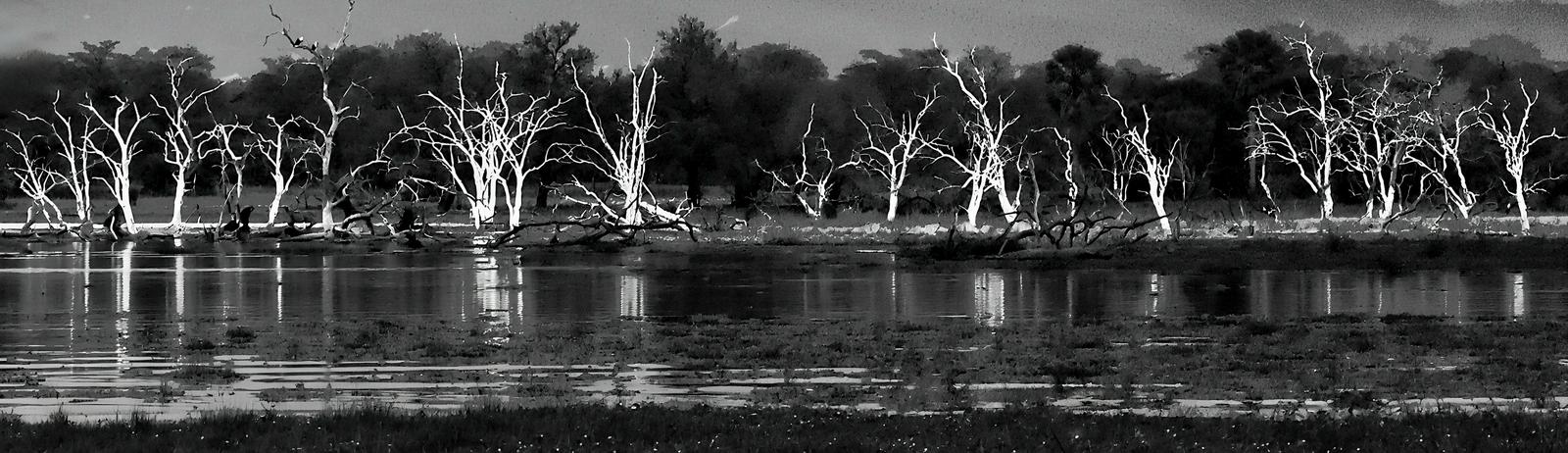
A moody riverscape with a strong graphic rhythm from those ghostly, leafless trees.
Thanks Stephen. This is a step forward in coherence, but if your intent is to show the fish eagles, they’re still too small to function as a readable subject—most viewers will miss them. As presented, the picture works best as a fine‑art leaning landscape: the line of bleached trunks, the dark woodland behind, and the slick reflections create a stark, graphic scene. If you want the birds to carry the frame, the composition needs to change; if not, lean fully into the landscape idea and make one distinctive tree or reflection the anchor. Which of those two goals were you prioritising when you pressed the shutter?
TECHNICAL EXECUTION ★★★
The monochrome conversion has punch and the overall exposure holds, but the brightest sections of the white trunks appear clipped, losing texture that would add bite. Blacks in the water and background woodland feel a little crushed, which flattens some mid‑tone detail. I’m also seeing a mild “crunchy” look along high‑contrast edges—likely from clarity/dehaze or aggressive contrast—producing slight halos around branches. The water is smooth enough, but the reflections look a touch muddy; a subtler tonal curve would help. Pulling back the highlights and opening mid‑tones would restore detail without sacrificing the graphic feel.
COMPOSITION ★★★
The panoramic crop suits the subject and emphasises the repeating forms nicely. However, there isn’t a clear anchor—my eye roams along the tree line without landing anywhere decisive, and the “tallest tree” with the eagles doesn’t read strongly at this distance. The fallen trunks across the midline add some texture but also create a near‑continuous horizontal barrier that splits the frame and lessens depth. Consider giving one tree dominance (more space around it, or placing it off‑centre) and using foreground water patterns to lead into the line of trees. Watch the far‑right edge; bright branches close to the border pull the eye out of the frame.
LIGHTING ★★★
The soft light keeps the scene believable and avoids harsh glare on the water. That said, the light feels broadly flat, so separation between the white trees and the darker woodland relies almost entirely on processing rather than direction. Side light at dawn/dusk, or thin mist, would carve the trunks and add dimensionality without needing heavy contrast. The reflections show some nice highlights, but they’re repetitive rather than guiding. Timing this for slightly lower, warmer light would add shape and texture to the bark while preserving the moody atmosphere.
STORY ★★
As a landscape, the mood is clear: a flooded, skeletal treeline under calm water. As a wildlife image, the story doesn’t land—the eagles are simply too small to matter. There’s no decisive moment or singular tension beyond the graphic contrast, so the frame reads more as a study in pattern than as a scene with an event. Introducing a stronger moment (birds taking off, ripples breaking the reflection, mist rolling through) would lift this from description to narrative. Ask yourself: what emotional beat did you want the viewer to experience here—stillness, unease, grandeur?
IMPACT ★★★
The high‑contrast white trees against the dusky backdrop make an immediate impression, and the panoramic width gives scale. However, the lack of a focal anchor and the heavy reliance on processing cap the staying power. I remember the shapes, not a specific moment or subject. Achieving more in‑camera separation and a clearer point of focus would push this towards a four‑star impact. A cleaner tonal treatment with one dominant element would also help it linger.
CONSTRUCTIVE NEXT STEPS
✓ Decide the primary intent at capture: if it’s wildlife, use a longer focal length or a dedicated tighter frame of the tallest tree so the eagles are unmistakable; if it’s landscape, pick one standout tree and give it space as the visual anchor.
✓ Revisit the scene in low, directional light or light mist; place yourself slightly off‑axis to get side light on the trunks for natural separation and depth, and include a foreground water pattern leading in.
✓ In post, reduce highlights on the white bark and lift mid‑tones in the woodland to recover texture; then use subtle local dodge/burn to guide the eye to your chosen anchor and clone out bright specks near the right edge that pull attention.
AI Version 2.0