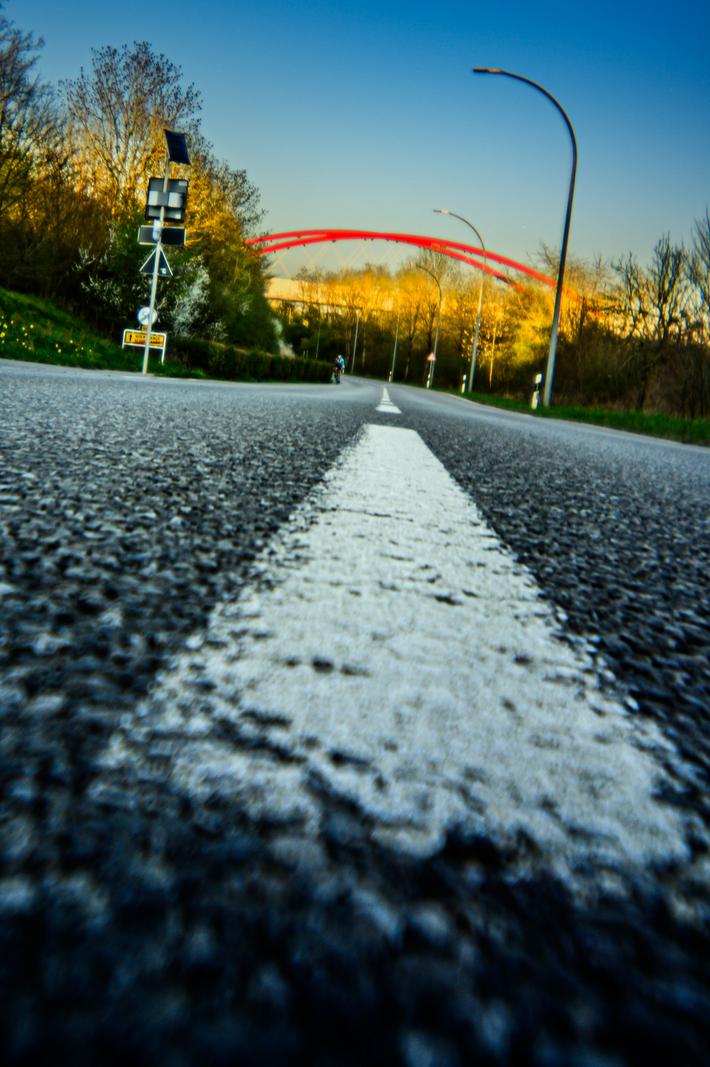
A daring ground‑level view with a strong leading line that nearly delivers on its promise.
Your experiment with angle is clear: the camera is almost on the tarmac, using the centre white line to drive the eye towards the red bridge in the distance. That’s a solid idea for an architectural/urban scene and the bridge is a good payoff. The question I’d put to you is: what do you want the viewer to land on—the red bridge, the road texture, or the small cyclist? Right now the foreground dominates so strongly that the bridge and human presence feel like afterthoughts. Tightening that intent will guide both your framing and your depth‑of‑field choices next time.
TECHNICAL EXECUTION ★★★
The file looks clean with natural colour and no obvious artefacts. Focus seems to sit mid‑frame, leaving the first third of the white line soft and the bridge not especially crisp; that shallow depth of field undercuts the graphic idea. A smaller aperture (around f/11–f/16) and hyperfocal focusing would give you front‑to‑back sharpness that suits this kind of geometric scene. White balance is pleasant—cool sky against warm trees—though the road in shade feels slightly dull compared to the background. There’s a slight tilt that reads more accidental than intentional; it’s small, but noticeable in the lamp posts.
COMPOSITION ★★
The central white line is a strong spine, but the sheer amount of foreground tarmac overwhelms the true subject. The bridge—the most interesting shape and colour—is small and high in the frame, so the eye arrives but doesn’t stay. Street furniture left and right (sign cluster and lamp posts) adds clutter and competes with the arch. The tilt adds tension but, combined with the leaning poles, it mostly looks off rather than dynamic. A step or two forward and a lower horizon would let the line meet the bridge more decisively while simplifying the edges.
LIGHTING ★★★
The warm evening light on the trees and the red bridge is attractive and helps the arch pop against the sky. The road surface sits in open shade, giving flat, grey tones—fine for texture, but it lacks bite compared to the glowing background. The transition from cool foreground to warm background works, though a more unified light on the main subject would be stronger. Timing is good; a minute or two later when the bridge is fully lit might have tightened the harmony.
STORY ★★
As it stands, this is mostly about form rather than a moment. The tiny cyclist offers scale and a hint of narrative, but they’re too small and too central to matter. If the rider had been closer, crossing the white line or passing under the arch, you’d have a real beat to anchor the geometry. Ask yourself: what small human gesture would complete this scene while keeping the architecture dominant?
IMPACT ★★★
The low viewpoint and red bridge create an immediate hook, and the texture of the tarmac draws you in. However, the dominance of the empty foreground and the lack of a clear focal finish reduce the punch. With straighter geometry, cleaner edges and stronger depth‑of‑field, this concept could hit much harder. Right now it’s an engaging study that feels like a near‑miss rather than a finished statement.
CONSTRUCTIVE NEXT STEPS
✓ Stop down to around f/11–f/16 and focus a few metres into the scene (use hyperfocal distance) to hold detail from the white line through to the bridge; raise ISO as needed to keep a safe shutter.
✓ Reframe a step or two forward so the central dash visually connects with the base of the red arch; keep the camera level to prevent leaning lamp posts, then apply a small perspective correction in post.
✓ Simplify the edges: crop or clone the left sign cluster and any bright roadside distractions so the bridge and line remain the only graphic shapes.
✓ If you want a human element, pre‑focus and wait for a cyclist to enter the frame nearer the bridge or on the centre line; use about 1/500s to freeze them cleanly.
AI Version 2.0