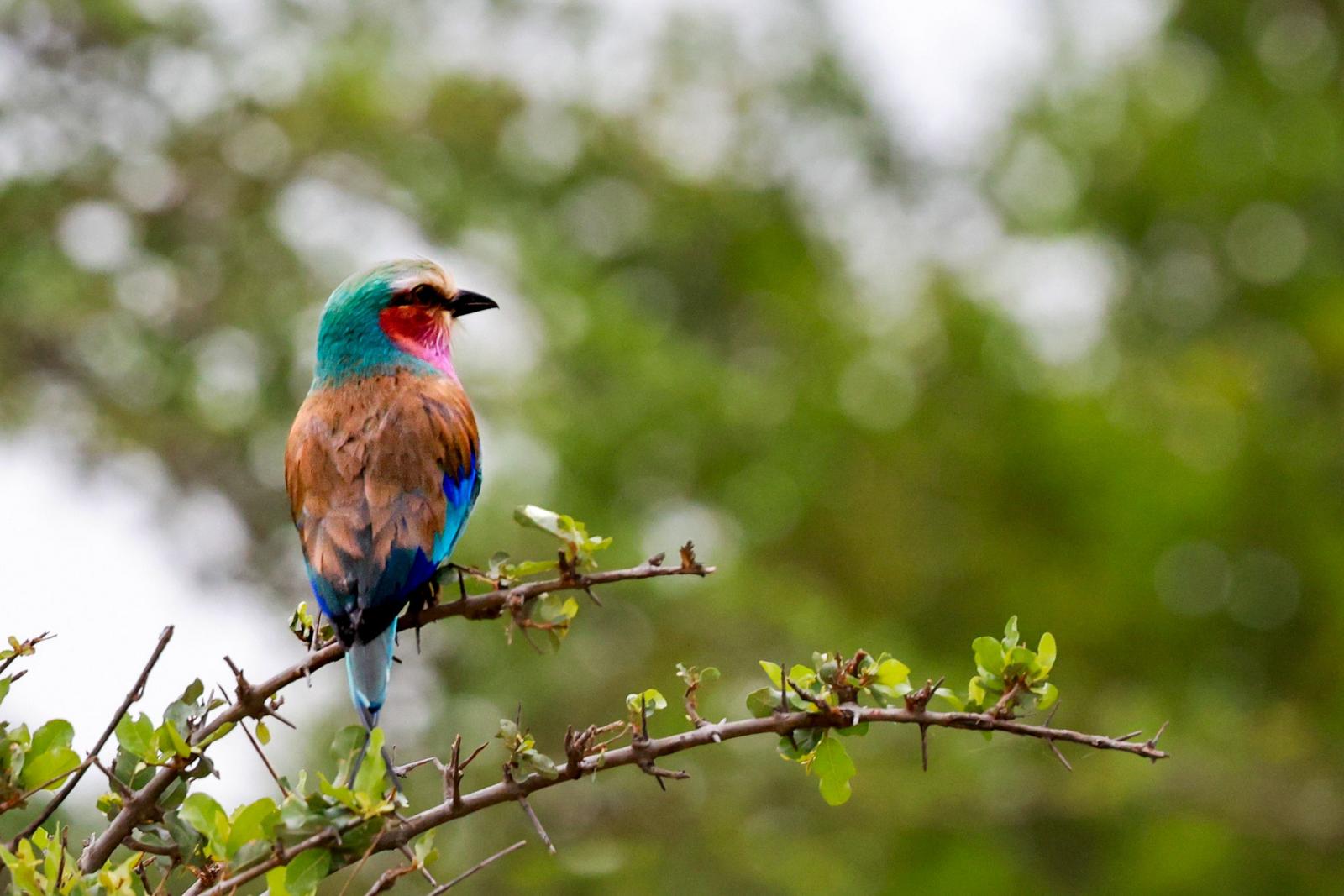
A clean, colourful portrait of a gorgeous roller with pleasing bokeh and a strong diagonal perch.
You’ve made a solid wildlife portrait, Stephen: the bird is sharp, the background is smooth, and the branch gives a nice diagonal anchor. If your question is “what more can I do?”, the short answer is: tighten the framing to reduce the empty right side, tone down a few bright distractions, and, on the next encounter, work for a stronger head angle or behaviour. This sits squarely in wildlife photography, where light, eye contact and moment separate a good record from a memorable frame. Notice how the roller is facing left while most of the negative space is to the right; that creates a mild “looking out of the frame” feeling. How intentional was that choice, and what would the image feel like if the space was in front of the bird’s gaze?
TECHNICAL EXECUTION ★★★★
Focus looks good on the bird’s head and mantle, with enough feather detail to hold up well. Exposure is balanced; the greens aren’t clipped and the bird’s bright plumage retains detail. Noise appears well-controlled and the background blur is clean without artefacts. Colours are rich but still believable for this species; just keep an eye on the blues and cyans, which can tip into “electric” if pushed. A small lift on the eye would help the connection, as the catchlight is subtle. To reach five stars I’d want critically sharp eye detail and absolutely no pull from bright bokeh hotspots.
COMPOSITION ★★★
The diagonal thorny branch is a strong line and the clean background helps the subject stand out. However, the bird is looking left while the frame gives most space to the right, so the picture feels like it’s backing the subject into the edge. The tail sits close to the lower border and some small leaf clusters along the branch compete for attention. A tighter, more vertical crop would concentrate the viewer on the bird and perch and remove excess right-side space. Alternatively, if you have wider margins in the original, giving more room on the left would let the gaze breathe. Consider whether a lower or slightly different viewpoint could have placed a darker patch of background behind the head for extra separation.
LIGHTING ★★★
The soft, overcast light is gentle and flattering, preserving colour and avoiding harsh contrast on those mixed plumage tones. It is safe, but also a little flat; the bird’s head lacks sculpting and the eye doesn’t sparkle. You’ve avoided blown highlights on the throat and wings, which is good. A touch of directionality—early or late sun—would add shape and a cleaner catchlight. Watch the bright bokeh circles in the top-left; they pull the eye slightly. For a five-star result, I’d look for warmer, lower-angled light or a momentary shaft of sun that gives dimensionality without blowing the blues.
STORY ★★★
This functions as a calm portrait: a beautiful bird paused on a thorn branch. There’s no behaviour beyond perching, so the narrative is limited. A pre-launch crouch, a wing stretch, or prey handling would add character and elevate the frame from “pretty” to “engaging”. The thorny branch hints at habitat but doesn’t add much beyond texture. Ask yourself: what micro‑moment would say something about the roller’s life—hunting, courting, preening—that you could wait for next time?
IMPACT ★★★
The species’ colour alone gives the image a natural punch, and your clean background helps it read quickly. However, rollers are often photographed this way; without a stronger moment or more intentional framing, it blends into the genre’s middle ground. The backward-looking composition reduces presence slightly. With a more dynamic gesture or a bolder crop to emphasise the diagonal, this could move up a notch. For five-star impact I’d want a decisive moment or light that makes this frame unmistakably yours.
CONSTRUCTIVE NEXT STEPS
✓ Try a 4:5 vertical crop centred on the bird and the diagonal perch; remove much of the empty right side and a little from the bottom to reduce the twig clutter, keeping the tail clear.
✓ In post, add a subtle radial dodge on the eye/face (+0.2–0.3 EV, a touch of texture) and burn the brightest bokeh discs in the top-left (–0.3 to –0.5 EV) to keep attention on the head.
✓ Tame the blue/cyan saturation by 5–10% to avoid a “neon” look and apply selective sharpening only to the head and chest feathers.
✓ Fieldcraft for next time: position so the empty space is in front of the bird’s gaze and wait for behaviour (prey toss, wing stretch, or take-off). Aim for around 1/1000s at f/5.6–f/7.1 to freeze micro-movements while keeping the background soft.
AI Version 2.0