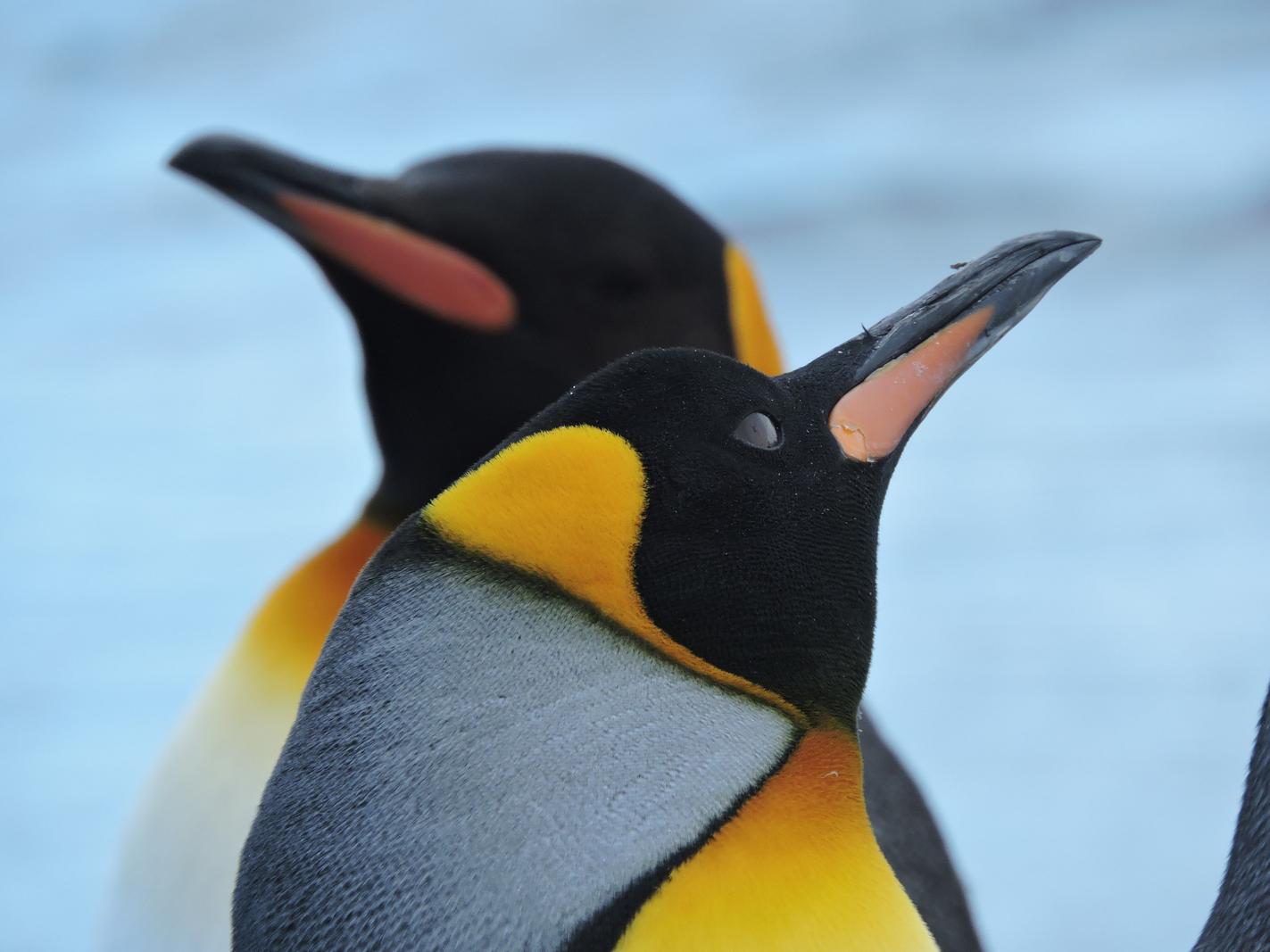
Close, colourful and tactile — but the second bird steals a little more attention than it should.
The softly rendered penguin behind mostly helps: it adds depth, context and a hint of pair‑bonding that turns a simple animal portrait into something more layered. Where it becomes mildly distracting is the bright orange bill/cheek patch near the top left; that saturated splash competes with the foreground bird’s eye and throat and it overlaps the main subject’s yellow neck, creating a small merger. In short, the second bird is a good idea, but its placement and brightness need managing. This reads as wildlife portraiture shot in gentle, overcast light; the leading subject is sharp with lovely feather detail and a confident upward pose. Did you try a small sidestep or a fraction wider framing to separate the background bill from the foreground neck and give the lead beak more breathing room?
TECHNICAL EXECUTION ★★★
Focus and detail on the foreground plumage and bill are strong, and exposure looks well controlled with clean whites and rich blacks. Colour treatment is natural rather than over‑amped, which suits the subject. The main weakness is the eye: it appears covered by the nictitating membrane and lacks a catchlight, so the “connection point” isn’t crisp. That single detail pulls the image down a notch in wildlife terms where the eye is the priority. To reach five stars you’d need a sharp, lively eye and perhaps a touch more micro‑contrast on the head to lead attention there.
COMPOSITION ★★★
I like the diagonal of the lead bird sweeping to the top‑right and the layered second bird providing context. However, the rear bill and orange cheek patch sit close to the edge and intersect the front bird’s neck, creating a visual tug of war. The lead beak also presses the top‑right border, adding edge tension that feels a bit cramped. A half‑step to your right (or asking for a moment until the back bird shifts) would separate shapes and keep the attention on the front head. A slightly wider or looser crop on the right would also calm the frame.
LIGHTING ★★★
Soft, overcast light flatters the penguins’ texture and keeps colours honest. It avoids harsh specular hits on the beaks and preserves feather detail. The trade‑off is a flatness around the eye and head; without directional light there’s little modelling or sparkle. A tiny catchlight or a side‑lit moment would add dimension. Under these conditions, timing the head tilt to catch a sliver of sky reflection in the eye would elevate the look.
STORY ★★★
There’s a hint of relationship — the second bird implies a pair or colony — and the uplifted posture suggests a brief behavioural moment. Because the background bird is soft and not clearly interacting, the narrative remains a suggestion rather than a scene. The closed/veiled eye softens any emotional pull. Waiting for a mutual gesture (both bills raised, or the back bird glancing forward) would strengthen the story markedly. What behaviour were you hoping to show here — courtship, calling, or simply intimacy of proximity?
IMPACT ★★★
The colours and proximity have immediate appeal and the file feels clean and honest. Competing bright colour on the rear bird and the quiet eye reduce punch and memorability. It’s a pleasing frame that hints at more than it ultimately delivers. With tidier separation, a livelier eye, and a touch more breathing space, this could move into a standout penguin portrait. Originality would further improve with a clearer behavioural cue.
CONSTRUCTIVE NEXT STEPS
✓ Reframe slightly: a small step to your right (or waiting for the rear bird to shift) will separate the background bill from the foreground neck; also give the lead beak more space at the top‑right to reduce edge tension.
✓ Prioritise the eye: fire short bursts and wait for the eyelid to open and catch a reflection; even a faint catchlight transforms engagement.
✓ Local toning in post: gently darken and desaturate the background penguin’s orange patch by about −0.3 EV and −10 saturation so it supports rather than competes; add a subtle clarity/texture boost on the foreground head only.
✓ Consider aperture around f/5.6–f/8 (if distance allows) to keep the lead bird fully crisp while maintaining a soft background, giving you wiggle room if the head tilts forward/back without losing sharpness on the eye.
AI Version 2.0