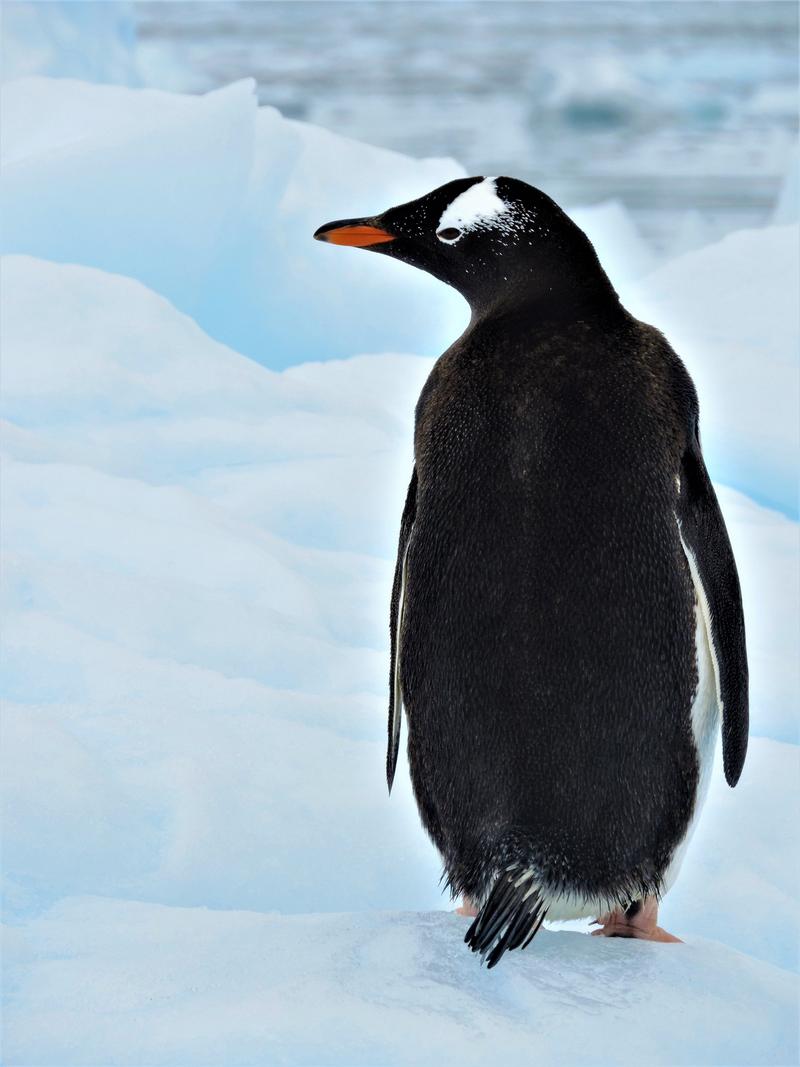
A clean, quietly charming penguin portrait with strong detail and calm tonality.
Thanks for flagging the ethics up front, Kit. The photo reads as a longer‑lens wildlife portrait — compression and shallow depth of field make you feel close while keeping a respectful distance. The bird shows no sign of stress and the scene looks natural, so your fieldcraft comes across well. This sits firmly in wildlife portrait territory: one subject, simple environment, and a restrained palette of ice blues and the penguin’s orange bill. The strongest elements are the crisp feather detail and the soft, clean background that isolates the profile nicely.
TECHNICAL EXECUTION ★★★★
Exposure is well handled for the tricky dark‑on‑white scenario: the snow retains texture and the bird’s blacks aren’t crushed. Feather detail along the flank and tail looks sharp, suggesting a stable shutter and good focus. Colours are natural and muted, with the orange bill providing a gentle accent without tipping into saturation. I do notice a faint edge glow around the body against the bright ice, likely from global sharpening or local contrast; it’s minor but worth refining. To reach ★★★★★, clean up any haloing and coax a touch more micro‑contrast in the head and eye area to make the critical focus pop.
COMPOSITION ★★★
The centred, three‑quarter profile is safe and readable, but it leaves narrative energy on the table. The penguin is looking left while the heavier negative space sits mostly behind it; giving more room in the direction of gaze would strengthen the frame. The bottom crop is comfortable, and the tail and feet are intact, which helps. The background ice shapes are soft and non‑distracting, though they don’t actively support the subject. For five stars, place the bird slightly right of centre with more left‑side air, or go lower and closer to eye level to separate the head cleanly against a single tone of ice or sea.
LIGHTING ★★★
Overcast polar light gives you gentle contrast and honest colour, which suits the species. There is a subtle rim on the head and back that outlines the bird pleasantly, but overall the light is flat and doesn’t sculpt much form. A small, clean catchlight in the eye is hard to see, so the face doesn’t jump forward as strongly as it could. Early or late light would add dimensionality and texture to the plumage. To reach ★★★★★, aim for soft side light with a visible catchlight, or use the rim intentionally by positioning the head against slightly darker ice to exaggerate the outline.
STORY ★★★
This is a solid wildlife portrait: a Gentoo (looks like it) at rest on ice, comfortable in its environment. The turned body and averted gaze feel calm but also a little passive — it’s a “between moments” frame rather than behaviour. A step in motion, a call, or interaction with wind‑blown snow would elevate narrative interest without sacrificing respect. The clean habitat context helps, but there’s limited tension or decision in the moment. What drew you to this particular pause — was it the graphic profile, or were you waiting for an action that didn’t quite happen?
IMPACT ★★★
It’s pleasant, publishable, and consistent with good field ethics, but it doesn’t rise above the many similar penguin portraits out there. The quiet palette and tidy background give it polish; the lack of a distinctive gesture keeps it from being memorable. A stronger moment or bolder viewpoint would add the needed bite. Getting to ★★★★★ would require either exceptional light, a decisive behaviour, or a composition that feels unmistakably yours.
CONSTRUCTIVE NEXT STEPS
✓ Reframe with intent in the direction of gaze — place the penguin one step to the right in‑camera, leaving clear negative space to the left so the profile “breathes.”
✓ Go a little lower to near eye level and watch for a clean backdrop behind the head; even 20–30 cm can separate the beak and crown from busy ice shapes.
✓ Wait for a small behaviour cue — a lifted foot, a call with open beak, or a shake sending snow from the tail — to add story without disturbing the bird.
✓ In post, reduce any edge halos by lowering global sharpening/clarity and using a masked, low‑radius sharpening pass on the eye and bill; add a subtle dodge to the eye to create a catchlight if one is present but muted.
AI Version 2.0