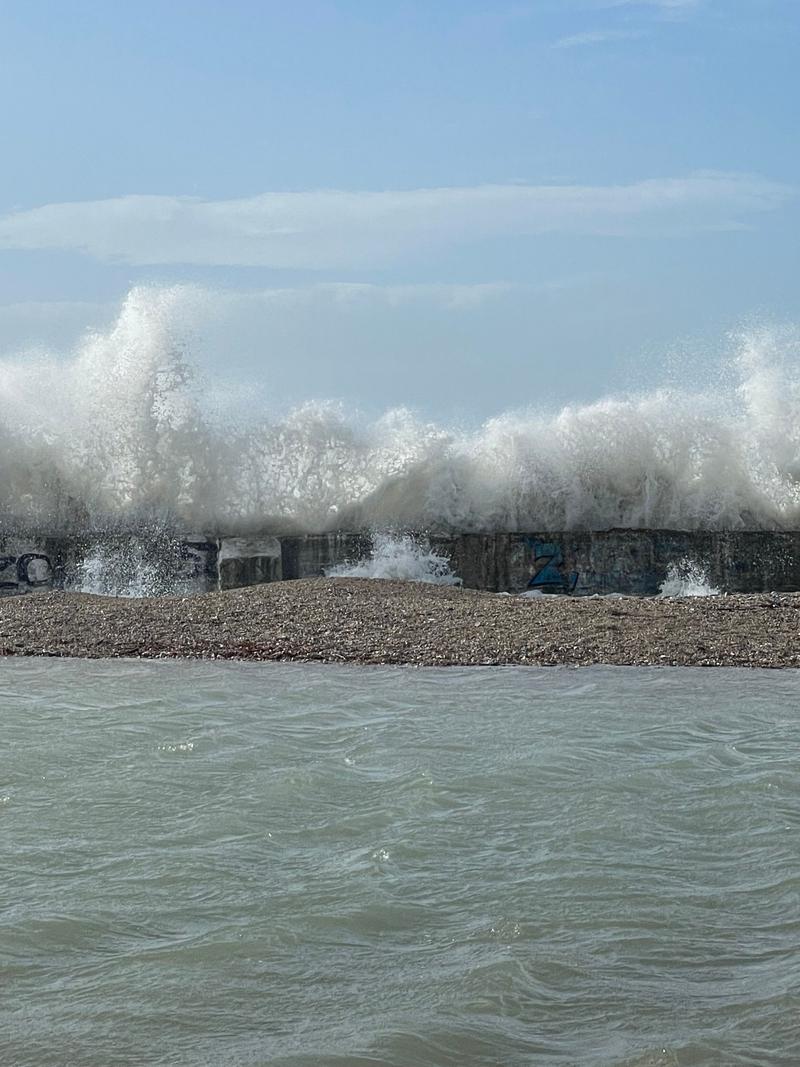
Great timing on the crash — you’ve caught the sea at full punch.
Is the right angle the right light etc
You’ve made a clean seascape, and the strongest element is the sheet of white spray rising over the concrete breakwater. To your question: the angle and light are workable but not ideal for drama. Shooting square-on flattens the scene into horizontal bands and the mid‑day light keeps the water a bit grey and gentle. A lower or side-on viewpoint would give the wall a diagonal that adds depth, and early or backlit light would make the spray glow. What drew you to this exact spot — the power of the wave, the graphic line of the wall, or the textures in the gravel? Clarifying that will guide your next choice of angle and timing. This sits between landscape and travel.
TECHNICAL EXECUTION ★★★★
The fast shutter has frozen the spray crisply; you can read the droplets and the water surface is nicely detailed. White balance feels natural and the colours are pleasingly muted rather than over‑pushed. Some highlights in the foam are close to clipping, but they’re acceptable for the subject and add to the sense of force. I don’t see obvious artefacts or noise, so your file handling is solid. To protect the brightest spray next time, consider −0.3 to −0.7 EV and shoot in burst to catch the best shape. A polariser at roughly 90° to the sun could also tame glare on the foreground water.
COMPOSITION ★★
The frame reads as three flat stripes: pale green water, a band of pebbles, and the concrete wall topped by foam. That straight-on approach removes depth and gives the eye nowhere to travel after admiring the splash. The large area of foreground water doesn’t add information and dilutes the focal moment. A tighter crop from the bottom or a lower position closer to the pebbles would emphasise the impact zone. Even better, stepping several metres left or right to run the wall diagonally would create perspective and a clear entry line into the wave — have you tried that?
LIGHTING ★★★
The light is even and serviceable, which helps with exposure, but it doesn’t add much character. Midday/early‑afternoon illumination flattens the wall and keeps the water a uniform tone. Side or backlight at low sun would rim the spray and carve texture into the concrete, giving a sense of volume. Stormy light or late golden light would both elevate this subject significantly; protect the whites with slight negative exposure compensation.
STORY ★★
The picture says “waves battering a sea wall,” which is a start, but it stops there. There’s no secondary element — a figure, a gull, a weather marker, or a distinctive coastline — to give scale or place. Because the angle is square-on, we don’t see how long or high the wall is, so the power of the wave lacks context. Think about what you want the viewer to feel: the relentlessness of the sea, or the smallness of human defences? That choice will determine whether you include more wall for scale or tighten to celebrate form and texture.
IMPACT ★★★
The captured moment has punch, and the clean treatment avoids gimmicks — good choices. However, the flat geometry and neutral light keep it from being memorable. With a stronger viewpoint and more directional light, this scene could jump a grade. Right now it’s a solid record rather than a standout frame.
CONSTRUCTIVE NEXT STEPS
✓ Rework the viewpoint: move 5–10 metres left or right so the breakwater runs diagonally through the frame, or get lower to the pebbles to reduce the empty foreground and increase the wave’s height.
✓ Time for light: shoot at sunrise/sunset or under bright backlight so the spray glows; start around 1/1000s, ISO 200–400, with −0.3 to −0.7 EV to protect the whites.
✓ Post: crop 15–25% from the bottom to minimise the flat water; add a gentle midtone contrast boost to the spray and clone the blue graffiti on the wall which pulls the eye.
✓ Alternative look: on a tripod and when it’s safe, try a 0.5–2 s exposure with an ND filter to turn the crash into a misty veil against the hard wall for a more artistic take.
AI Version 2.0