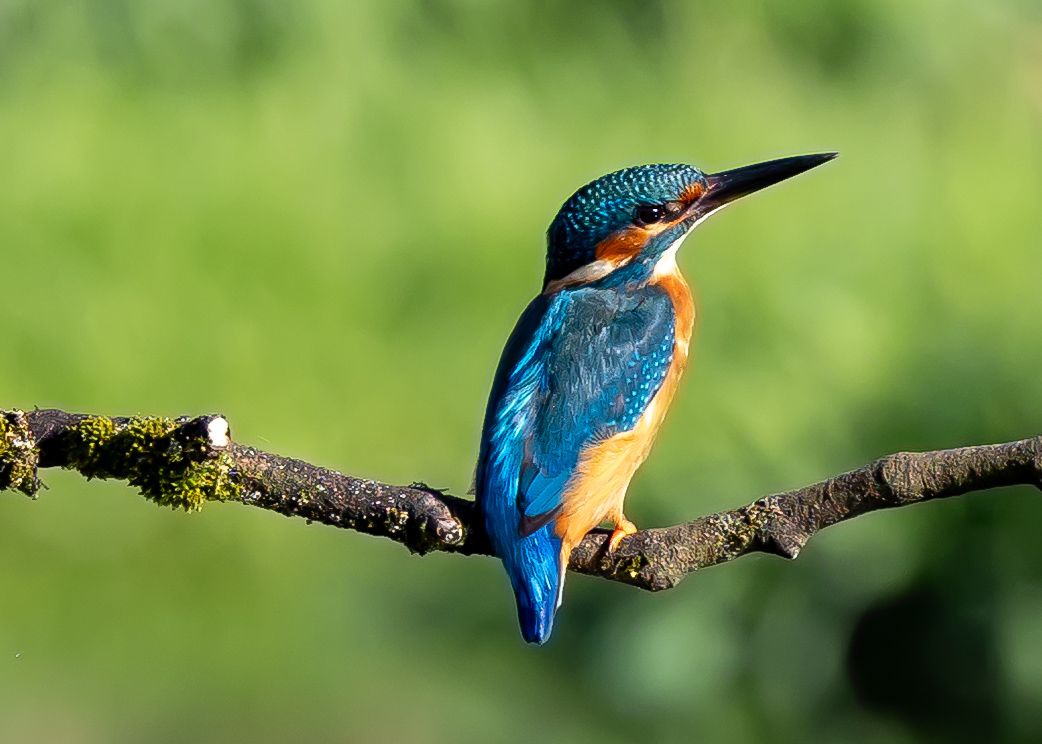
A clean, punchy kingfisher portrait with pleasing colour and separation.
I struggle with noise and getting sharpness. This is a shot with a canon r6. Mkii – RF 70-200. F2.8 L
Shitter 1/3500, F4.5 ISO 800
On this frame your sharpness and noise control are already strong—the eye and head show crisp feather detail and the background is smooth. With a perched bird, 1/3500s is overkill; it forces ISO up without giving you anything in return. On the R6 Mark II ISO 800 is fine, but you could comfortably shoot 1/1000–1/1600s at f/5.6 and land around ISO 200–400 for even cleaner files and a touch more depth of field across the beak and shoulder. If you’re still seeing softness, check technique: use Servo AF with Animal Eye Detection, back‑button focus, and stabilisation on; brace your elbows or use a monopod. Looking at the image itself (a wildlife portrait of a kingfisher on a mossy branch), the exposure is well judged and colour is lively, though the cyan/blue could be dialled back a notch for a more natural look. How close were you and was this heavily cropped? Big crops often masquerade as “sharpness” issues and exaggerate noise.
TECHNICAL EXECUTION ★★★★
Focus is locked nicely on the eye and mask line, with clean feather texture and a small catchlight. ISO 800 on this body produces minimal noise; the background looks smooth and free of artefacts, suggesting sensible noise reduction. The 1/3500s shutter kept everything immobile, but it wasn’t necessary for a static perch and likely cost you ISO headroom and depth of field. Colour is punchy but borders on electric in the blues—easy to tame with a small HSL adjustment. To push this to five stars, drop shutter speed, stop down slightly, and keep sharpening/NR selective so the feathers stay crisp while the bokeh remains creamy.
COMPOSITION ★★★★
The bird is well‑placed with breathing room to the right—the direction it’s looking—which feels natural. The diagonal branch gives a stable perch and guides the eye through the frame. Two small distractions weaken the flow: the bright white lichen blob on the left section of the branch and a couple of tiny highlights on the bark; they pull attention from the bird. A slightly tighter crop from the left would minimise that pull while keeping the full tail and beak. Five‑star territory would need either a cleaner perch or a moment that adds extra tension to the look‑room.
LIGHTING ★★★★
Soft, directional light models the head, neck and flank nicely without harsh shadow blocks. The background is evenly lit and distant, so the subject pops cleanly. Highlight control on the crown and beak is good, with just enough sheen to show texture. The light is pleasant rather than dramatic; golden‑hour side light or a thin overcast with a brighter catchlight would add dimension. Still, it flatters the bird and suits a natural portrait.
STORY ★★★
This is a strong identification portrait—clear species, healthy plumage, calm moment. What it lacks is behaviour: no call, no fish, no wing flick, no interaction with the environment. The pose is side‑on and safe, which works but doesn’t surprise. Consider waiting for a head turn towards you, a shake that sends droplets, or the instant of take‑off to elevate it beyond a record shot. What behaviour do you most often see at this perch that you could anticipate next time?
IMPACT ★★★★
Kingfishers are inherently striking and the clean background makes this instantly appealing. The file feels publishable and would hold up well in print at moderate sizes. It falls short of unforgettable because it’s a familiar “perched kingfisher on a branch” without a unique gesture or setting. Reduce the small distractions and aim for a micro‑moment and it will stand out more. As it is, it’s a very solid, attractive wildlife portrait.
CONSTRUCTIVE NEXT STEPS
✓ For perched birds, use Manual with Auto ISO or Av with a minimum shutter: target 1/1000–1/1600s at f/5.6; this lowers ISO and increases depth of field across beak, eye and shoulder without sacrificing sharpness.
✓ In Lightroom, mask the background and apply stronger noise reduction there; on the bird, use modest Detail/Sharpening with the Masking slider around 70–90 so sharpening only hits feathers.
✓ Clean the frame: clone/heal the bright lichen patch on the left branch and any tiny white flecks; pull Blue/Cyan saturation down −5 to −10 for more natural plumage.
✓ Field craft for extra bite: stay longer for behaviour (fish catch, shake, call) and pre‑focus on the perch using Servo AF with Animal Eye Detection and back‑button focus so you’re ready the instant something happens.
AI Version 2.1