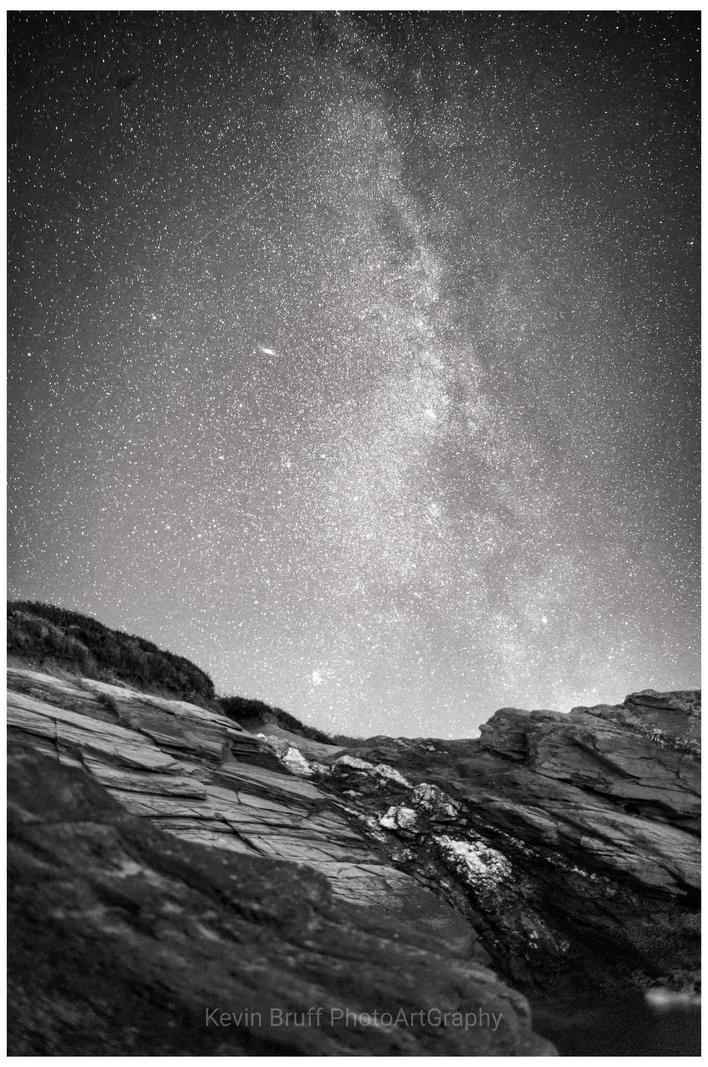
A striking monochrome take on the Milky Way with jagged rock adding grit and scale.
Black and white for astro is a bold choice, Kevin—it pushes the image toward fine‑art rather than postcard colour and puts all the weight on texture and structure. Here the silver band of the Milky Way reads well, and the layered rock in the foreground gives a raw, geological counterpoint. This sits between landscape and fine‑art night photography. The big questions become: are the stars clean and the land purposeful, and does the tilt feel intentional? That’s where the strengths and weaknesses of this frame show up.
TECHNICAL EXECUTION ★★★
Stars look mostly point‑like, suggesting a sensible shutter time, though I can see light noise in the sky and some edge softness that feels like wide‑open coma or slight defocus. The foreground is soft and a little muddy, likely from shallow depth and very low light rather than motion blur. Tonal control in the sky is decent for a monochrome conversion—no obvious clipping—and the Milky Way core is distinguishable without heavy halos. However, grain in the shadows and the faint smear of brighter patches reduce polish. To reach five stars you’d want cleaner noise management (stacking), crisper edge stars (stop down a touch or use a sharper wide), and a better-rendered foreground exposure captured separately.
COMPOSITION ★★
The diagonal slope of rock from lower left to mid‑right has potential to lead into the Milky Way, but the overall tilt feels arbitrary rather than deliberate. With most of the weight at the bottom left and the galaxy running almost centre-right, the eye wobbles between them without a clear landing point. The scrubby horizon line near the left edge is a weak shape and competes with the sky. The strong layered slabs could be a great anchor if they were aligned to point directly at the Milky Way core, or if the horizon were levelled to reduce distraction. A more decisive framing—either embrace a bold, graphic diagonal or keep it level and place the core on a third—would lift this a full star or two.
LIGHTING ★★★
Natural starlight is handled competently: the Milky Way has separation and the global exposure is in the right ballpark. The land, though, sits in a dull mid‑grey with small blown white patches on the rock, offering little texture or dimension. Without a gentle foreground exposure (blue hour blend or subtle low‑level light), the scene lacks depth. In monochrome, controlled local contrast and a luminous core are crucial; here the galaxy could be dodged slightly and the periphery burned to focus attention. A tracked sky plus untracked foreground, carefully blended, would elevate the light quality dramatically.
STORY ★★
The photograph communicates “night at the rocks under the Milky Way,” but it stops there. There’s no specific moment—no weather, human scale, or distinctive landform—to deepen the narrative. The tilt hints at drama but doesn’t resolve into a clear idea. Consider what you want the viewer to feel: the weight of ancient stone beneath a river of stars, or a sense of vertigo on a cliff? What single element could you add or emphasise to make this more than a pretty sky—perhaps a lone outcrop, a tide pool reflection, or a stronger geological gesture?
IMPACT ★★★
The monochrome decision gives the image personality and sets it apart from the usual neon‑blue astro edits. Still, the slight technical roughness and uncertain framing blunt the initial hit. The watermark and border at the bottom also pull attention away from the sky, which reduces presence. With a cleaner finish, purposeful geometry, and a more textured foreground, this could move from “nice” to “commanding.” What would the frame feel like if the rock slabs arrowed unmistakably into the bright core on the right third?
CONSTRUCTIVE NEXT STEPS
✓ Reframe with intent: either level the horizon and place the Milky Way core on the right third, using the rock layers as leading lines, or go all‑in on a strong diagonal by rotating so the slabs clearly point at the core; avoid the current in‑between tilt.
✓ Clean capture for the sky: at 14–20mm on full‑frame, aim for 10–12 s, f/2–2.8, ISO 6400, then stack 10–20 frames (Sequator/Starry Landscape Stacker) to cut noise and tighten stars; stop down one third if edge coma is visible.
✓ Give the land shape: shoot a separate blue‑hour or low‑level‑lit frame at ISO 1600–3200 for 30–60 s to reveal rock texture, then blend with the sky exposure; keep it subtle to maintain a natural look.
✓ Post: remove the border/watermark from the image area; apply local dodge on the Milky Way core and a gentle burn vignette on the outer sky; add a mid‑tone contrast curve to the rocks to pull out layers without clipping the bright patches.
AI Version 2.1