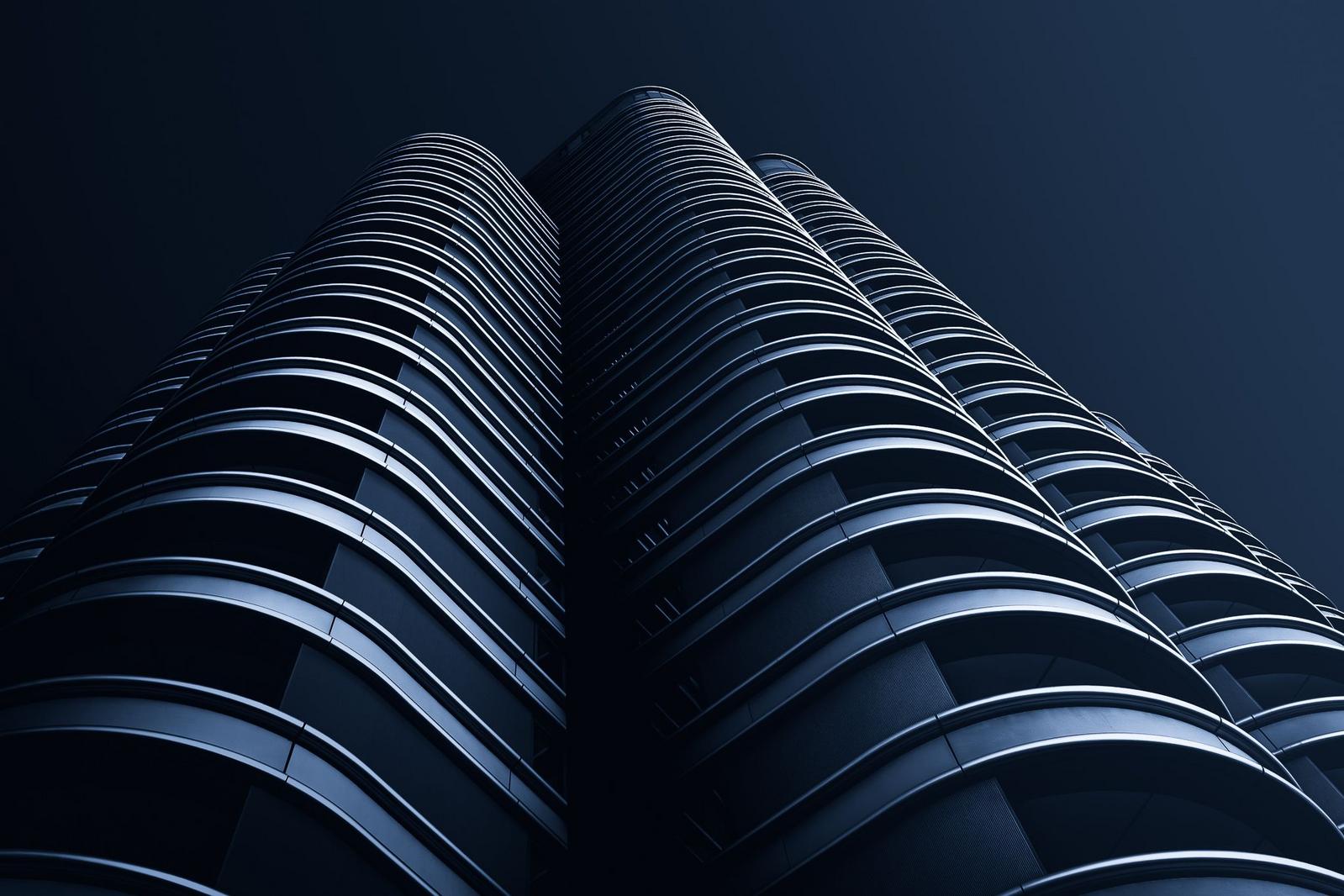
A bold, graphic study of height and rhythm that leans confidently into abstraction.
Short answer: yes, this could be exhibited—especially within a fine‑art architectural series—because it has strong geometry, clean tonality, and a clear point of view. What works best is the commanding low angle and the repeating curved balconies that drive the eye upward; the cool blue grading keeps it restrained and modern. What holds it back from top-tier exhibition calibre as a standalone is that the concept feels thin (form for form’s sake) and the alignment isn’t absolutely exact, which matters in graphic architecture work. This image sits between architectural and fine‑art genres: it documents a building, but your choices make it about pattern and ascent rather than place. One question for you: was your central subject the rhythmic rails themselves, or the dark vertical void between the towers? Your answer should guide whether you correct perspective for symmetry, or push the convergence even further for drama.
TECHNICAL EXECUTION ★★★★
Edge‑to‑edge sharpness looks strong, with clean highlight control on the metal rails and no obvious noise or halos—well handled processing. The cool mono‑blue grade is tasteful and consistent, avoiding the garish look that ruins many architectural edits. The deepest blacks in the central cleft are fully crushed, which gives punch but risks losing subtle depth and printing as a featureless block. On very smooth gradients like this sky, watch for banding when exporting for print; use 16‑bit files and gentle noise dithering if needed. To reach ★★★★★, I’d want impeccable tonality in the darkest areas and proof of flawless rendering on a large print (no micro‑halos, no banding, perfect edge acuity).
COMPOSITION ★★★★
The viewpoint is strong and deliberate, turning the façade into a set of ascending waves. The near‑symmetry works, but it’s not exact: the right “tower” feels a touch heavier and the central seam is slightly off‑centre, creating a minor lean. The bottom corners clip the balcony curves in different ways; that asymmetry introduces small friction in an otherwise ordered frame. These are small issues, yet in a graphic study they matter. A hair more breathing room at the lower edges or a micro‑reframe to lock the central axis would make this feel surgically precise—pushing it toward ★★★★★.
LIGHTING ★★★★
The light rakes across the metal in a pleasing way, giving subtle specular lines that define each balcony without hotspots. The overall dusk‑blue mood supports the brutal, futuristic feel. That said, the light is consistent rather than dramatic—there’s no single plane catching a brighter kiss that sets a cadence. A touch more directional contrast (either by time of day or selective dodging/burning) could carve extra depth into the curves. Masterful lighting here would add a deliberate crescendo of brightness as the eye rises.
STORY ★★★
This is primarily a study of form, repetition and scale. It suggests ascent and a slight chill, but it doesn’t say much about the building’s purpose, location, or life around it. That’s fine for fine‑art, but as a single frame it lacks a conceptual hook beyond “look at these beautiful lines.” A small narrative pivot—weather, a single lit balcony, or a human trace for scale—could offer a stronger reason to linger. Ask yourself: what quality of this structure do you want viewers to feel—power, isolation, serenity—and how might you embed that in the frame?
IMPACT ★★★★
It’s striking and print‑worthy, the sort of image that holds a wall well and reads cleanly from a distance. The upward thrust and disciplined colour give it presence. Where it falls short of iconic is originality: there are many low‑angle high‑rise abstracts; this is a strong entry in that language, but not yet a signature statement. A more exacting symmetry or a distinctive moment in the light would lift it to ★★★★★.
CONSTRUCTIVE NEXT STEPS
✓ Refine symmetry: in post, use Guided Upright/Transform to nudge the central axis dead‑centre and equalise left/right weight; check edges so the bottom balcony curves are clipped in the same way or not at all.
✓ Print‑oriented tonality: lift the central blacks a touch (5–10 points) and apply subtle local dodging to a few rail highlights to create a gentle brightness ladder upward; add a hint of grain or dithering to prevent sky banding when printing.
✓ Consider a series: return at different times (low sidelight, mist, or rain on the metal) or include a single lit balcony/human silhouette for scale—curate three images that share palette and geometry for exhibition strength.
✓ In‑camera option: if you want power without keystoning, shoot further back with a tilt‑shift (or stitch a vertical pano) to keep verticals parallel while retaining the heroic low viewpoint.
AI Version 2.1