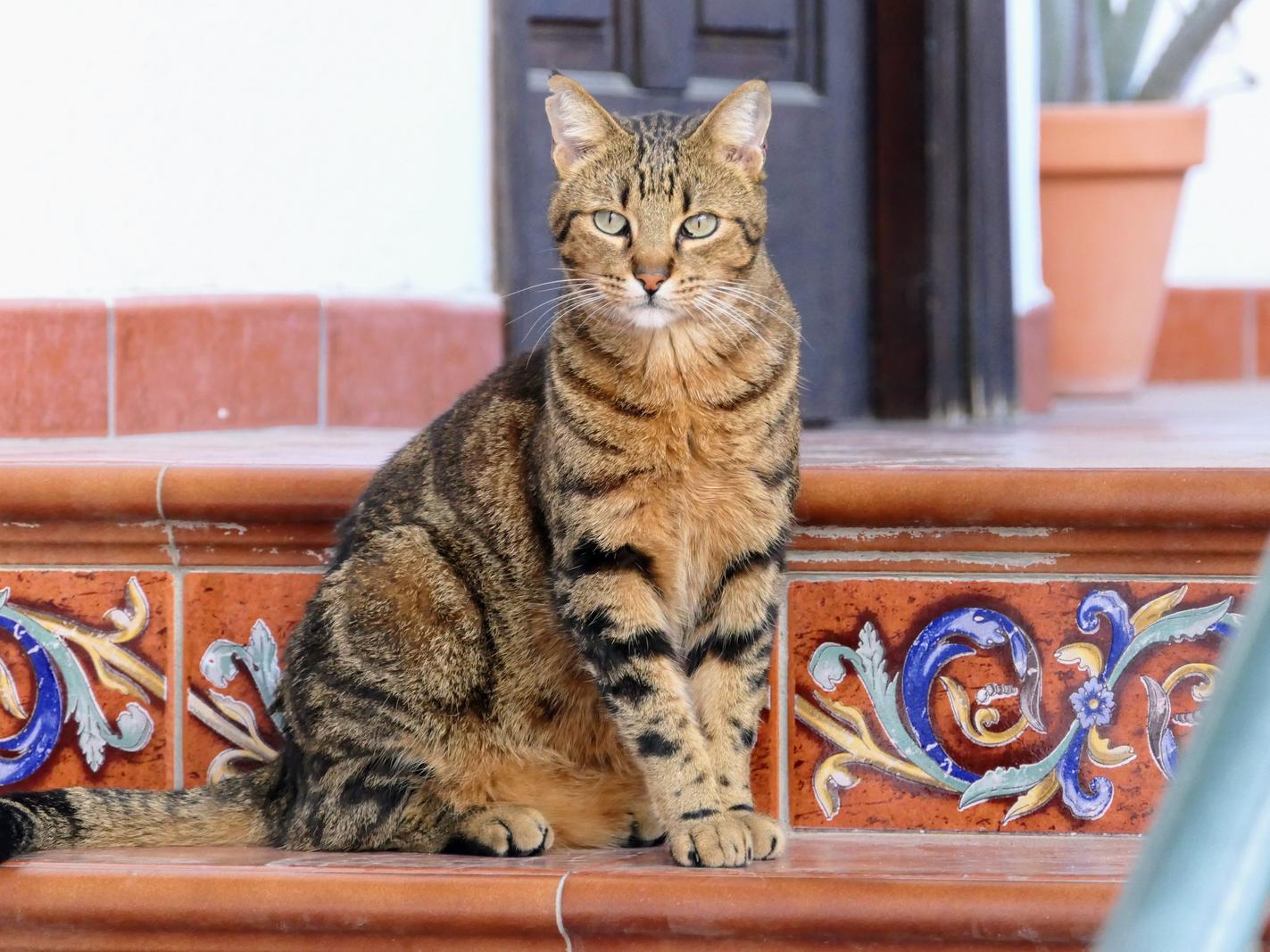
A calm, confident cat meets the lens on a tapestry of patterned tiles.
You’ve nailed the “stare” — the cat’s steady gaze and upright posture are the strongest parts of this frame. This sits between wildlife and an environmental animal portrait: a characterful tabby, shown in its place. The ornate terracotta tiles create a strong sense of location while the dark doorway gives helpful separation behind the head. One question for you: did you want the tiles to be a co‑star, or simply a backdrop to the stare? Your answer will guide decisions on depth of field, crop, and shooting position.
TECHNICAL EXECUTION ★★★★
Focus looks very good on the eyes and whiskers, and the fur holds detail without crunchy sharpening. Exposure is balanced; the tabby’s darker coat retains texture and the warm tiles are not blown out. Colours feel natural and restrained, which suits the subject. There is, however, a soft turquoise wedge intruding at the bottom‑right that looks like an out‑of‑focus object — it reads as a technical distraction and is easy to remove in post. For five stars I’d want critical tack-sharp eyes plus a completely clean perimeter with no stray elements or processing clues.
COMPOSITION ★★★
The cat is centred and solid, and the head sits partly against the dark doorway which helps it pop. The frame gets busy around the edges: the plant pot at top‑right, the bright white wall at top‑left, and the turquoise intruder at bottom‑right all tug at the eye. The sweeping tail leads leftwards straight out of frame; it’s nice to include, but its exit point competes with the face for attention. A small step to your right would have placed the entire head against the dark door and lost the pot, and a slightly tighter, taller crop would minimise the left and right clutter. How would a lower, more eye‑level viewpoint change the power of that stare and reduce the amount of patterned tile competing for attention?
LIGHTING ★★★★
Soft, open shade gives gentle contrast and flattering fur detail, with no harsh midday shadows — a good choice. There’s a faint catchlight that adds some life, though it’s subtle; a tiny shift to let the cat face a brighter patch would strengthen it. The dark doorway acts like a backdrop, giving separation without needing heavy post. To reach five stars, I’d look for slightly more directional light to sculpt the face — early or late light across the muzzle would add depth while keeping the natural look you’ve used well here.
STORY ★★★
The fixed gaze and confident posture communicate a simple, readable moment: this cat owns these steps. It’s a clean portrait but the scene doesn’t progress beyond that; there’s no gesture or behaviour to deepen the narrative. Waiting for a micro‑moment — a paw lift, blink, yawn, or tail curl — would add that extra beat of life. Keeping the environmental context is good, but a clearer decision about how much of it you want will also strengthen the story.
IMPACT ★★★
The combination of a striking stare and decorative tiles makes a pleasant, publishable frame. However, the distractions on the edges and the static pose cap the drama. A cleaner frame and a more decisive behaviour would elevate it from a nice portrait to a memorable one. Trim the clutter and heighten the gesture, and the image would linger longer.
CONSTRUCTIVE NEXT STEPS
✓ Recompose in-camera: move 20–30 cm to your right and slightly lower so the cat’s entire head sits against the dark doorway, eliminating the plant pot and reducing the bright white wall; keep ears clear of edges.
✓ Use a wider aperture (around f/2.8–f/4) or a longer focal length from a bit farther back to soften the busy tile patterns and isolate the face.
✓ Wait for a micro‑gesture (stretch, yawn, paw lick) and shoot a short burst; these tiny behaviours add story without needing to move the cat.
✓ In post: clone/heal the turquoise object at bottom‑right; gently burn the bright wall areas; add a subtle, local dodge on the eyes and a touch of negative clarity/saturation on the nearest tiles to keep the cat dominant.
AI Version 2.1