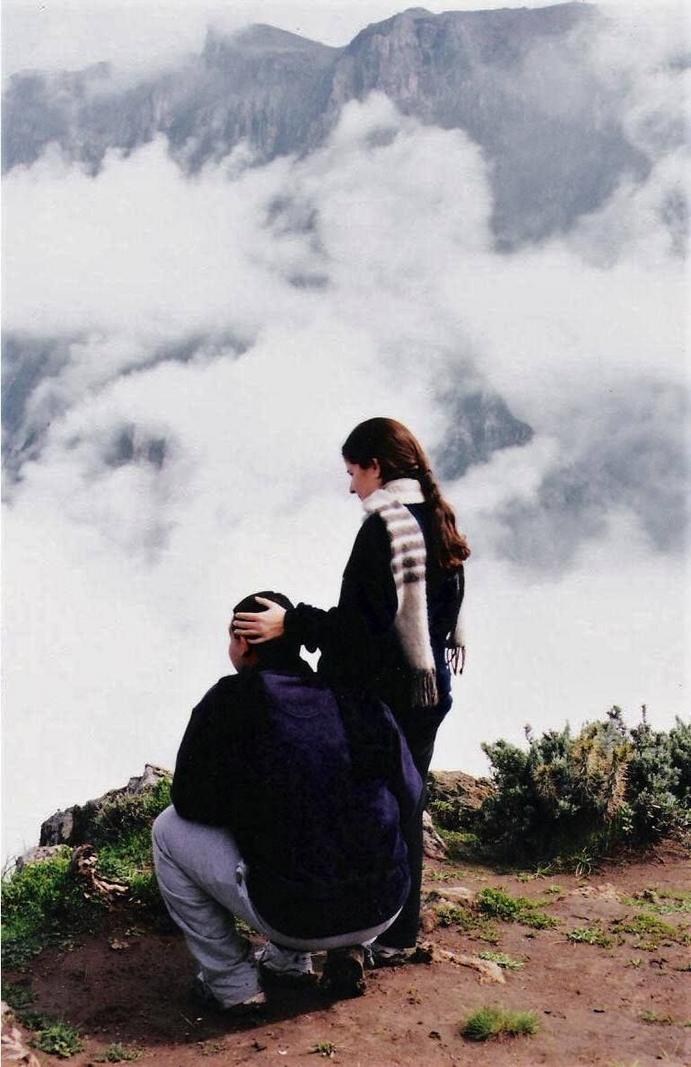
A quiet, tender moment perched above the clouds, almost made by a bird that never enters the frame.
Missing the bird does change the picture’s centre of gravity, but it doesn’t sink it—the touch of the woman’s hand on the man’s head holds a gentle human moment. This reads first as travel photography with a candid portrait element: two people sharing a breath on the edge of a vast landscape. The strongest pieces are the sea of cloud and that small gesture, which together suggest scale and companionship. If the condor had been in frame, it would have anchored their gaze and given the scene a clear climax; without it, the picture relies entirely on the relationship between the figures and the void. Did you consider framing to leave more “air” in the direction they’re looking, so the viewer can imagine what they see?
TECHNICAL EXECUTION ★★★
The exposure is broadly well handled: the clouds hold texture and the mountain isn’t blown, which is no small task in such high-contrast conditions. The figures are a touch underexposed, leaving faces and the scarf short of detail—recoverable with selective dodging on the midtones. Sharpness looks acceptable for a hand‑held travel frame, though not critically crisp; it feels like a slight film‑scan softness or modest motion. Colour is restrained and natural, which suits the mood. To reach five stars you’d want cleaner micro-contrast on the subjects and a touch more detail in the shadows without flattening the sky.
COMPOSITION ★★★
Placing the pair low-right gives the clouds room to breathe and suggests scale; the hand on the head is an effective focal gesture. However, the crouching figure is cramped against the lower edge and the bush on the right competes for attention. The small strip of mountain at the top draws the eye away from the human moment without adding much. Because we never see the condor, the current framing leaves us staring into empty space rather than a point of interest. What would a metre step to your right and slightly lower have done—clean silhouettes against pure cloud, more space into their gaze, and no bush merger?
LIGHTING ★★★
Soft, cool light from the cloud cover creates a calm atmosphere and prevents harsh highlights; it suits the location. The downside is flatness on the figures—faces fall into shadow, especially the man’s, so their expressions disappear. There is some nice rim detail in the woman’s hair and scarf, but it isn’t quite enough to separate them clearly. A small exposure lift (+0.3 to +0.7 EV) or a slight shift to catch a brighter patch would have helped the people read without washing out the clouds. Five-star light here would model the subjects a little while keeping that airy sky—think gentle side light or a brighter background for clean silhouettes.
STORY ★★★
The human connection is the story: a steadying hand and two people sharing a view above a canyon of cloud. It’s quiet and believable, but we’re told there’s a condor and the frame can’t show it, so the narrative feels like the beat just before the decisive one. Without the bird, the image needs either more expressive body language or a cleaner composition that turns the void into deliberate suspense. Consider whether the photograph is about wildlife or companionship; if it’s the latter, moving closer and excluding the mountain could strengthen that choice. To reach five stars, give us either the condor clearly placed in their line of sight or a tighter human moment that doesn’t rely on it.
IMPACT ★★★
The altitude and cloud sea have presence, and the tenderness of the gesture is memorable. Competing edges (the top mountain strip, the right-hand bush, the tight crop on the croucher) dilute the punch. The absence of the bird leaves the frame resting in “almost”—pleasant but not gripping. With a cleaner frame and a defined subject—either the condor or a more pronounced human moment—this could step up a level. Imagine this same scene with the bird sweeping into the empty space they’re watching; that would transform the image’s staying power.
CONSTRUCTIVE NEXT STEPS
✓ Anticipate the wildlife moment: pre-compose with space where the bird will enter, switch to AF‑C (continuous), back‑button focus, 1/1000s at f/5.6–f/8 with Auto‑ISO, and fire a short burst as the condor appears.
✓ On location, try a step right and slightly lower to place both figures fully against the clouds, give extra room into their gaze, and eliminate the bush; ensure feet and edges aren’t cramped.
✓ In post, crop a little from the top to remove the mountain strip and 3–5% from the right to tame the bush, then subtly dodge the faces and scarf by ~0.3–0.5 stop and add local contrast to the clouds to deepen texture without pushing saturation.
AI Version 2.1