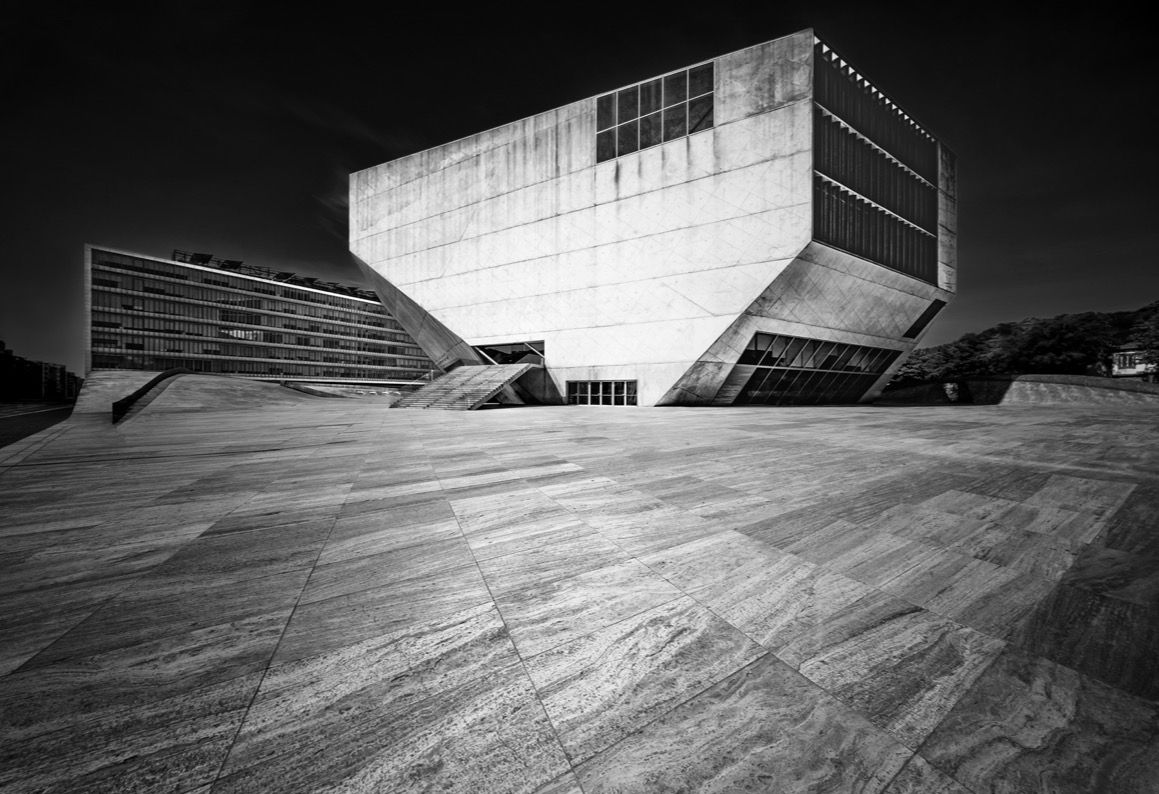
A bold, low‑angle study that turns Casa da Música into a hulking geometric monolith.
Your intention to strip the scene to form and tone is clear, and this frame does read as sculpture rather than mere record. The achromatic treatment and very dark sky push it firmly into fine‑art architectural territory, and the discipline shows. What stands out is the assertive perspective from the sweeping stone plaza up to the faceted cube, with the lower building on the left acting as a counterweight. The choices are confident; the question is whether the presentation of space and light is giving you all the depth this structure can offer. As you refine this series, ask yourself: how much floor does the image need to communicate scale before it starts diluting the drama?
TECHNICAL EXECUTION ★★★★
Edge‑to‑edge sharpness is strong, and the façade textures and plaza grain hold up well, indicating careful focus and a small aperture on a tripod. Tonal control is clean; the whites are restrained and the blacks are rich without obvious clipping in important areas. The sky treatment is heavy but mostly controlled—if I’m picky, there’s the faint risk of a “cut‑out” feel around the top edges where the bright façade meets the very dark sky, which often comes from aggressive masking. Perspective is handled well; verticals feel deliberate rather than accidentally keystoned. To reach five stars, I’d look for subtler edge transitions against the sky and a touch more micro‑contrast separation between the cube’s different planes to avoid a slightly flat mid‑tone block.
COMPOSITION ★★★★
The low viewpoint lets the plaza tiles act as strong leading lines, pulling the eye directly to the cube—good use of negative space and geometry. Placing the main mass high and to the right adds tension, while the long, slanted block on the left balances the frame and emphasises the site’s angular language. However, the foreground occupies over half the frame; it establishes scale, but it also slows the eye and risks turning the image into an exercise in flooring texture. A tighter bottom crop or shooting from a few metres closer would let the structure claim more dominance without losing that expansive feel. How intentionally did you choose this precise proportion of floor to building, and does it match the “sculpture first” aim of the series?
LIGHTING ★★★
The light is even and functional, which suits documentation but leaves the form a little under‑modelled for a fine‑art read. The upper face of the cube sits in a broad mid‑tone, while the under‑planes are darker, yet there’s limited gradation to shape the volume. The brooding, almost black sky provides drama but doesn’t add nuanced depth to the architecture itself. Late‑day raking light would carve stronger shadows along those bevels and reveal the building’s geometry more vividly. Consider whether you want the light to be neutral and timeless, or a more directional light that actively sculpts the form.
STORY ★★★
The concept is clear: isolation, scale, and the transformation of a public building into an abstract object. That reads, but the frame remains largely a formal exercise with little tension beyond the geometry. A single human element—perhaps a distant figure or a blurred passer‑by from a long exposure—could introduce scale and a subtle narrative without breaking minimalism. Alternatively, weather or changing light could provide the “moment” the scene currently lacks. What relationship between the building and its plaza do you want the viewer to feel: emptiness and austerity, or a living space held at a distance?
IMPACT ★★★★
It’s a striking image with strong presence; the severe tonality and monumental perspective are hard to ignore. That said, the ultra‑dark sky/bright façade aesthetic is now a familiar fine‑art architecture trope, so originality relies on your specific framing and light. Here, the viewpoint and the building’s distinctive shape carry the weight and make it memorable. To push it to five stars, aim for either a more singular light event or a framing that reveals an unexpected facet of the structure’s design. A touch more tension or scale cue would help it linger longer.
CONSTRUCTIVE NEXT STEPS
✓ Reduce the foreground dominance: crop 15–20% from the bottom or shoot 3–4 metres closer so the cube occupies more of the frame while keeping the strongest tile seams as lead‑ins.
✓ Return in late afternoon with the sun at roughly 30–45° to the façade; use ISO 100, f/11 on a tripod, and a 6–10 stop ND for a 30–120 s exposure to keep the minimalist sky but add sculpting shadows across the bevels.
✓ In post, soften any edge halos where the façade meets the sky by refining masks with a 2–3 px feather and raise sky blacks slightly (to ~5–8%) to avoid a cut‑out look; local dodge/burn the separate planes to increase dimensionality.
✓ Consider a single, small human figure or a blurred cyclist in the plaza for scale—kept distant and low contrast—to add a subtle moment without breaking the minimalist intent.
AI Version 2.1