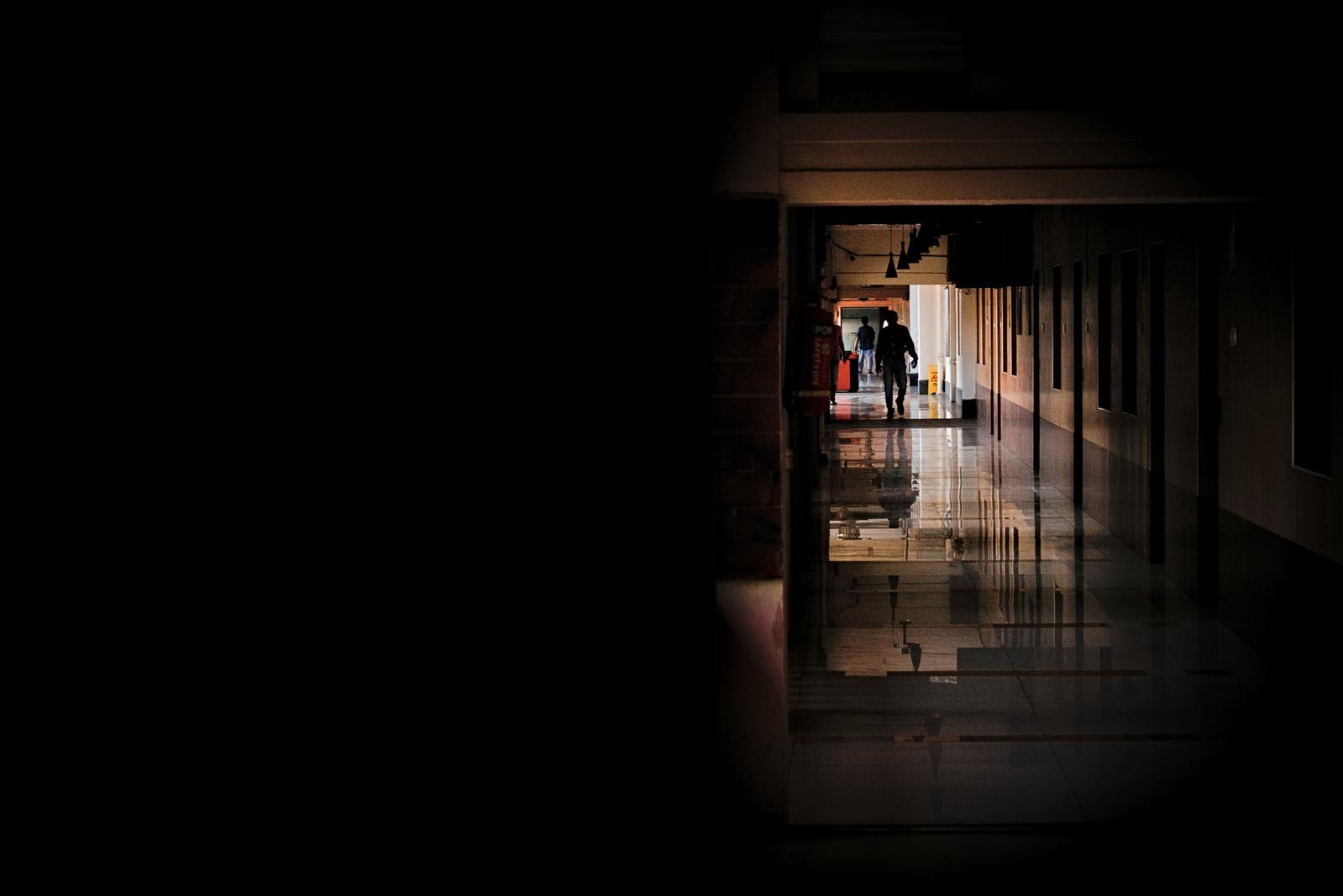
Moody corridor, strong idea — held back by an overbearing “keyhole” frame and a thin moment.
Your instinct is clear: use darkness to funnel the eye to a small, mysterious slice of life. The glossy floor, the distant silhouettes, and the cool/warm light shift down the corridor are good raw materials for a street‑leaning architectural scene. What it lacks is a decisive human moment and a cleaner, more intentional frame. The black surround reads as a heavy, oval vignette rather than a real foreground frame, which makes the device feel like a trick rather than part of the place. If you love negative space (I do too), let it feel structural (a wall, a doorway edge) and then wait for a stronger gesture at the far end. What were you shooting through here, and how much of that black was added or chosen in camera?
TECHNICAL EXECUTION ★★★
Focus and exposure look sound for the conditions; highlights in the bright doorway hold, and reflections keep detail. The file doesn’t show obvious noise or artefacts at this size. The issue is the heavy, uniform fall‑off around the frame — it reads like an applied oval vignette, which pulls attention to processing rather than the scene. Blacks on the left are clipped to pure zero, losing any suggestion of texture that could sell this as real space. For five stars, keep the darks rich but retain a breath of detail, and avoid processing that announces itself.
COMPOSITION ★★★
The central corridor and receding lines naturally draw the eye to the walking figure; that part works. However, the black area occupies roughly two‑thirds of the frame and is uniformly rounded at the edges, which feels arbitrary and imbalanced. A harder, linear foreground edge (doorframe/wall) or simply less black would feel more intentional. The human subjects are small and mid‑stride without a clean silhouette separation, so they don’t carry the weight you’ve given them. A vertical frame or a tighter crop on the right third would amplify depth and reduce dead space.
LIGHTING ★★★★
Available light is handled well: the distant warm patch contrasts with the cooler corridor and creates atmosphere. The reflective floor adds texture and a secondary path for the eye. Deep shadows along the right wall help the figure stand out without swallowing the scene. The only drawback is that the imposed darkness around the perimeter competes with the natural contrast already present. To reach five stars, rely on the real light/shadow of the hallway and let the architecture do the framing.
STORY ★★★
There is the seed of a story: a person heading down a quiet institutional corridor with a second figure beyond. But there’s no clear gesture or interaction to reward a long look — no turn of the head, no meeting, no pause at the light. The cone, extinguisher and fixtures give place but not purpose. Waiting a beat for a cleaner stride (leg separation) or for two figures to cross in that bright doorway would add tension. What outcome did you hope for at the end of the corridor — arrival, departure, or a meeting?
IMPACT ★★★
The mood is strong on first glance, but the “peep‑hole” look blunts its seriousness and makes it feel contrived. Because the figures are small and moment is thin, the image doesn’t fully land after the initial read. Reduce the gimmick, strengthen the moment, and this scene could be striking. With a truer frame and a decisive human gesture, this would step up a level.
CONSTRUCTIVE NEXT STEPS
✓ Reframe with a real architectural edge: shoot from behind a doorframe or wall so the negative space is straight and textural, or crop to a vertical to give the corridor two‑thirds of the frame and the black one‑third.
✓ Work the moment: pre‑focus on the bright doorway and wait for a subject to hit that lit zone with clear leg separation or an interaction; short burst at 1/250–1/500 sec will nail the stride.
✓ Post‑processing: if you burn the edges, use linear gradients not an oval; lift the deepest blacks slightly (e.g., black point +3 to +5) to keep a hint of detail so the darkness feels like space, not a mask.
✓ Lower the camera to knee height to double the figure with a stronger reflection, or step closer to increase subject size while keeping the vanishing lines intact.
AI Version 2.1