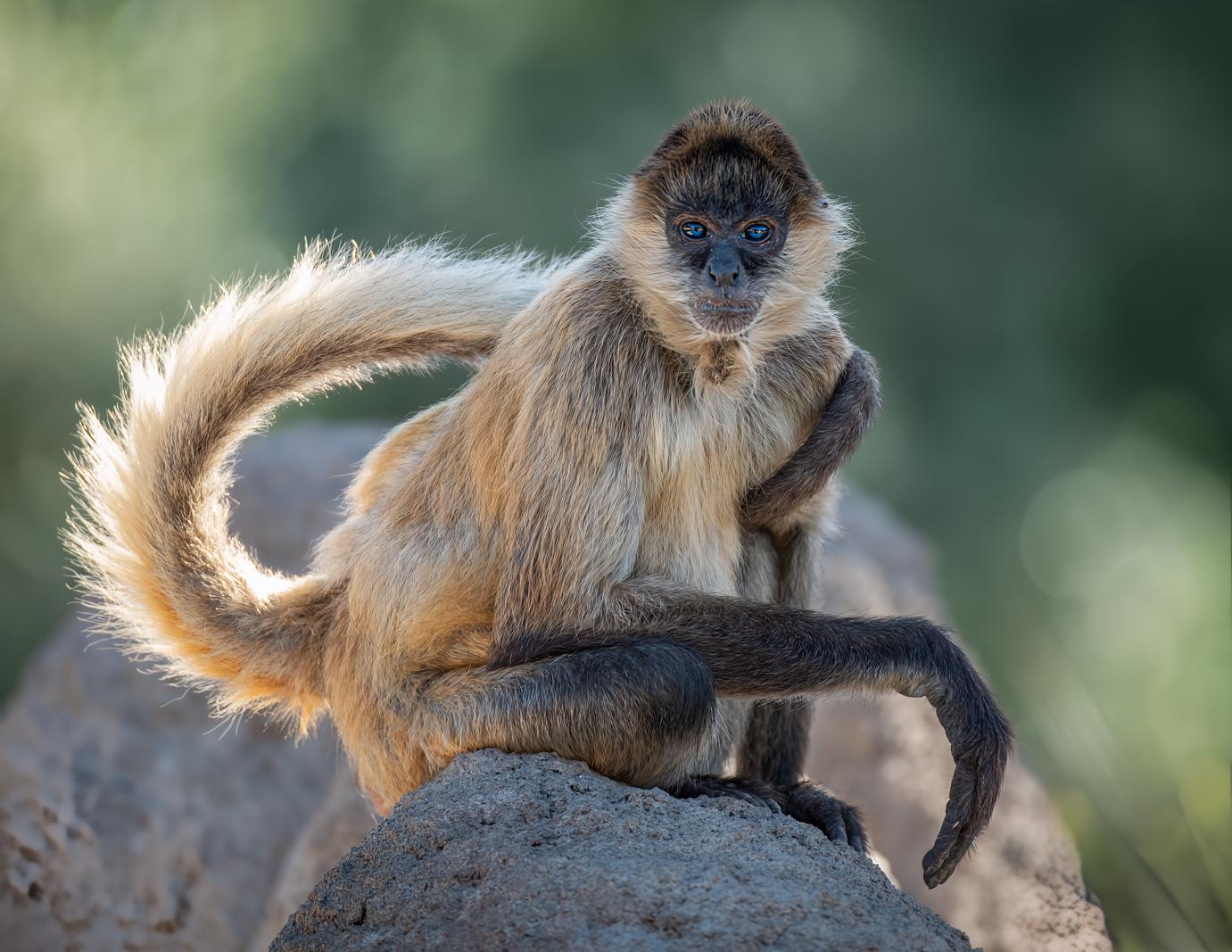
A strong wildlife portrait anchored by that coiled tail and a confident stare.
You were right to focus on the stare—that’s the photograph’s hook, and it lands. To your question: the face exposure is close, but a touch low. Detail is present in the mask and muzzle, yet the eyes and nose sit a fraction too deep in the mid‑tones compared with the nicely rim‑lit fur. A small local lift (+0.3 to +0.5 stop on the face with a soft brush or radial mask, plus a little micro‑contrast in the eyes) would bring the expression forward without breaking the natural light. This sits squarely in wildlife portrait territory: clean background, sharp eyes, and a moment of connection. Did you consider waiting for a slight head turn toward the light or shifting position a step to your left to catch a stronger catchlight?
TECHNICAL EXECUTION ★★★★
Focus is crisp on the eyes and face, with lovely detail in the fur—exactly where it matters. The background is clean and renders as a smooth green blur with no distracting artefacts. White balance feels natural, and colours are restrained, which suits the subject. The only minor weakness is the slightly underexposed face relative to the brighter rim‑lit coat, which makes the expression a bit recessive; this is easily improved in post. Noise looks well controlled and sharpening is tastefully handled. For five stars I’d want the face tonality lifted just enough to match the brilliance of the fur while retaining texture.
COMPOSITION ★★★★
The S‑curve of the tail is a gift—it creates elegant energy on the left and balances the diagonal of the long arm on the right. The rock provides a solid base and the clean background keeps all attention on the monkey. Framing is slightly tight at the bottom right around the hanging hand/foot, which feels a touch crowded compared to the breathing room given to the tail. Centring works here because the pose is asymmetric and dynamic, but a whisper more space to the right would let that extended limb read more gracefully. Consider whether a marginal crop from the left could also tighten the dialogue between the face and the tail. With those tweaks, the composition would feel fully resolved.
LIGHTING ★★★★
The back/side light creates beautiful rim detail along the tail and shoulder, adding depth and texture to the fur. The background falls into a gentle, neutral blur that helps separation. However, the face is in open shade and reads a touch flat compared to the sparkling highlights on the coat. A tiny head turn toward the light—or your moving a small angle round—would have given a brighter catchlight and more dimensionality across the muzzle. Ethically, I’d avoid on‑camera flash for a subject like this; waiting for the light or a different pose is the better solution. Lift the face locally in post and you’ll balance the scene.
STORY ★★★
This is a solid character portrait: the direct gaze and relaxed, almost folded posture suggest curiosity and calm. The coiled tail adds personality and hints at agility. That said, the frame stops short of behaviour—there’s no feeding, interaction, or movement that pushes it beyond a portrait into a moment of wild action. The “staring contest” is felt, but we don’t see a second element (another animal, a gesture change, or a micro‑interaction) to deepen the narrative. Could a few more seconds of patience have caught a blink, a yawn, or a reach that layered the story?
IMPACT ★★★★
The clean execution, strong eye contact, and sculptural tail make this memorable. It has presence on first view and would hold well in print. The slightly shaded face keeps it a notch shy of commanding; brightening the expression would add bite. It’s distinct enough to rise above generic wildlife portraits, but not yet at the “can’t forget it” level reserved for rare behaviour or perfect light on expression. With the tonal tweak and a touch more breathing room around the limb, this would step up another gear.
CONSTRUCTIVE NEXT STEPS
✓ In post, add a soft radial mask over the face: +0.3 to +0.5 exposure, small shadow lift, a hint of Texture/Clarity on the eyes, and a subtle catchlight dodge to pull the viewer straight in.
✓ Next time, shift a step left or wait for a slight head turn toward the light to catch a stronger catchlight and model the muzzle—no flash needed and fully ethical.
✓ Give a little more space to the right and bottom to avoid crowding the hanging limb; alternatively, trim a sliver from the left to balance the tail’s dominance.
✓ Burn down any bright bokeh hotspots in the top right and the brightest edge of the rock so nothing competes with the face at first glance.
AI Version 2.1