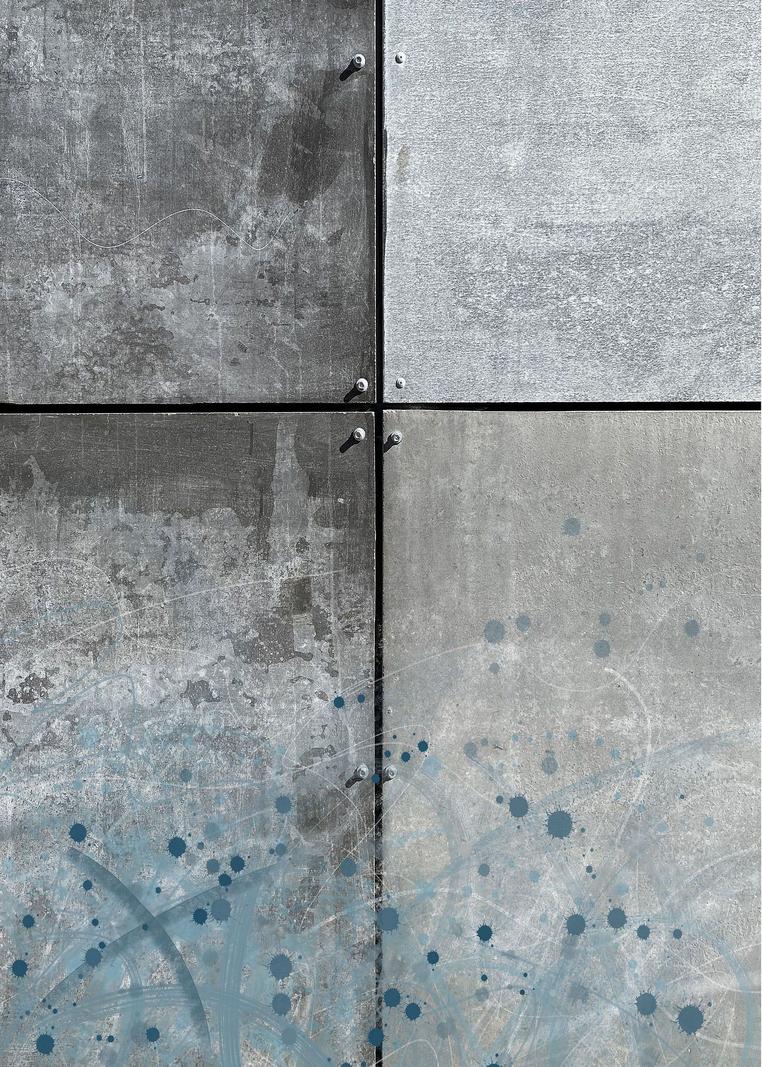
A clean architectural study with added paint, but the concept feels half‑formed.
You’re venturing into mixed‑media territory, which is a solid direction. Here you’ve photographed a grid of concrete panels with bolts and then added blue paint marks and splatters. As a fine‑art experiment, the foundation is strong: the rigid cross of seams and the restrained grey palette give you a disciplined base to react against. Right now, though, the paint sits on top of the photo rather than in conversation with it; it feels decorative rather than purposeful. Ask yourself: what idea should the paint carry — chaos breaking the grid, weathering, a human trace, or something else?
TECHNICAL EXECUTION ★★★
Exposure and sharpness are sound; the concrete texture is crisp, the seams are clean, and colours are sensibly muted. There are no obvious artefacts or noise problems. Where it weakens is in the integration of mediums: the paint marks have a uniform look and don’t pick up the wall’s texture or the light direction, so they read as pasted rather than bonded to the surface. Edges of splashes are consistently sharp, which breaks realism on a gritty wall. To reach five stars, make the marks interact physically with the scene (cast slight shadows, wrap around bolts, follow micro‑texture) or create them in-camera by painting on a print and re‑photographing.
COMPOSITION ★★★
The central vertical and horizontal joints create a strong scaffold and the four bolts act as visual punctuation. The tonal contrast between the darker left panels and lighter right panels adds interest. However, the painted energy is concentrated almost entirely along the bottom edge, making the frame bottom‑heavy and leaving the top half feeling like an empty ceiling. Several splatters clip the lower border, which feels accidental rather than intentional. Consider whether the cross should be exactly centred or deliberately offset, and whether the paint could be placed to lead the eye through the grid and towards a clear focal point.
LIGHTING ★★★
The light is even and serviceable, allowing the concrete’s texture to show. It doesn’t add mood or shape, but it also doesn’t create problems. Side‑light would carve the seams and bolt heads with small shadows, giving the structure more bite and helping any real paint marks feel tangible. If the paint is added digitally, mimic that side‑light with subtle shading so it sits in the same lighting world as the wall. A deliberate choice of time of day could lift this from functional to atmospheric.
STORY ★★
I can see a potential idea — human gesture versus industrial order — but it isn’t clearly expressed. The grid is disciplined; the blue marks are random, yet their placement doesn’t challenge the grid or respond to the bolts and seams. Because of that, the picture reads more like a textured background with a paint overlay than a statement. What emotion or message should the marks deliver: rebellion, mapping, weather, sound? Anchoring the piece to one of those would strengthen it.
IMPACT ★★
The textures are pleasing and the palette is tasteful, but the image doesn’t linger. The mixed‑media idea is promising, yet the execution feels cautious and generic. Stronger intent, bolder placement of marks, and better integration would make it memorable. Aim for either tension (marks breaking rules of the grid) or harmony (marks echoing the geometry) and commit to that choice.
CONSTRUCTIVE NEXT STEPS
✓ If you stay digital, mask the paint so it wraps around bolt heads and catches the wall’s micro‑shadows; lower saturation of the blue slightly and vary opacity/edge softness to make it belong to the surface.
✓ Try a physical approach: paint on a printed photograph (or on a similar wall with permission), then re‑photograph under raking side‑light so real texture, gloss and shadows bind the mediums together.
✓ Rebalance the frame: either centre the cross precisely with a square crop, or place it on a third; distribute marks so they interact with the bolts and seams rather than sitting only along the bottom.
✓ Decide on a clear concept (e.g., “order versus impulse”) and place each stroke in service of that idea — for instance, a single deliberate arc crossing the vertical seam and stopping at a bolt could become the focal moment.
AI Version 2.1