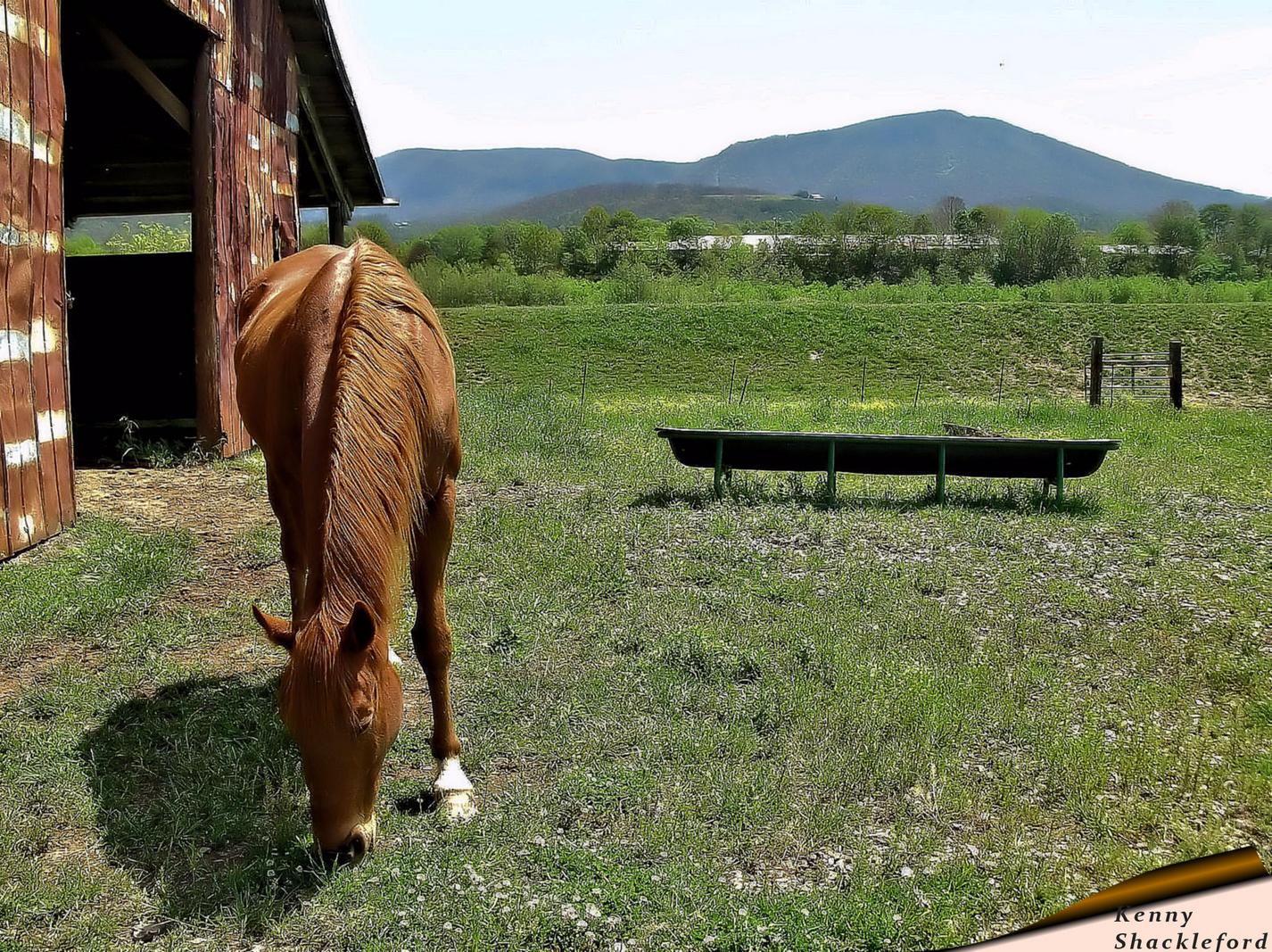
A calm rural moment, but the hard light, processing and framing stop it from landing.
Credentials noted. I’ll respond to the picture on its own terms, as I would with any photographer at any level. This reads as a pastoral landscape with the horse as the foreground anchor. The mountains are lovely and the scene has potential, but what’s on the screen feels more like a quick record than a deliberate photograph. What was your primary intent here — a portrait of the horse in its place, or the landscape with a hint of life? Your answer matters, because the current framing sits uncomfortably between the two.
TECHNICAL EXECUTION ★★
The file shows heavy clarity/structure and saturation that create a crunchy, HDR‑ish look, especially in the barn boards and grass. Midday contrast is high and the shadows are dense (note the dark semicircular shadow around the horse), while colours in the field read unnaturally intense. There’s evidence of haloing along the mountain ridge and some JPEG softness in the distance. The bevelled name ribbon in the bottom right is a graphic overlay that dates the image and harms printability. To reach five stars you’d need cleaner, lighter‑handed processing, a natural palette, and a presentation free of gimmicks or borders.
COMPOSITION ★★
The horse is crowded by the barn on the left and its head is down toward the frame edge, leaving it little breathing space. The dark barn opening forms a heavy visual block that competes with the subject, while the feeder and gate on the right pull the eye with no clear purpose. The horizon is fine, but the frame lacks a strong organising line or relationship between horse, trough and mountain. A step to your right and lower would have separated the horse from the barn, given it space to “look into,” and aligned the animal with the open field and hills. A tighter crop eliminating the trough could also clarify the subject.
LIGHTING ★★
This is very harsh midday sun. It flattens the horse’s coat on the lit side and drives the shadows to black under the neck and along the ground. There’s no catchlight in the horse’s eye (head-down also contributes), so the animal feels lifeless. Early or late light would shape the form, add warmth to the pasture, and bring out the ridge lines in the background. Waiting for a thin cloud to soften contrast would also help if timing is fixed.
STORY ★★
The frame tells us “a horse grazes beside a barn,” which is factual but thin. There’s no gesture — ears forward, a lifted head, or interaction — to create a moment. The trough and gate hint at farm life yet aren’t used to build a narrative; they just sit as clutter. If the horse had stepped into the sun with its head up toward the hills, we’d have a clear relationship between animal and place. What moment were you hoping to catch, and how long did you wait for it?
IMPACT ★★
The elements are pleasant, but the image doesn’t linger. Processing calls attention to itself, the light is unforgiving, and the frame lacks a decisive choice about subject. The added signature ribbon further reduces polish. With cleaner editing, better timing, and purposeful placement, this could carry more presence.
CONSTRUCTIVE NEXT STEPS
✓ Return in golden hour and wait for a gesture — ears pricked or the head lifted — then shoot from a metre or two to the right and lower, giving the horse space to “look into” the frame and separating it from the barn.
✓ If you want an environmental portrait, choose f/5.6–f/8, ISO 100–200, 1/500s, and remove the feeder from the frame (or hide it behind the horse) to simplify; if the horse is the subject, use a longer focal length and f/2.8–f/4 to soften the background.
✓ In post, reduce global clarity/structure and saturation, open the shadows slightly on the horse, and remove the circular shadow/vignette look; present without the bevelled name banner and consider a subtle, clean crop that trims the barn while keeping the mountains.
AI Version 2.1