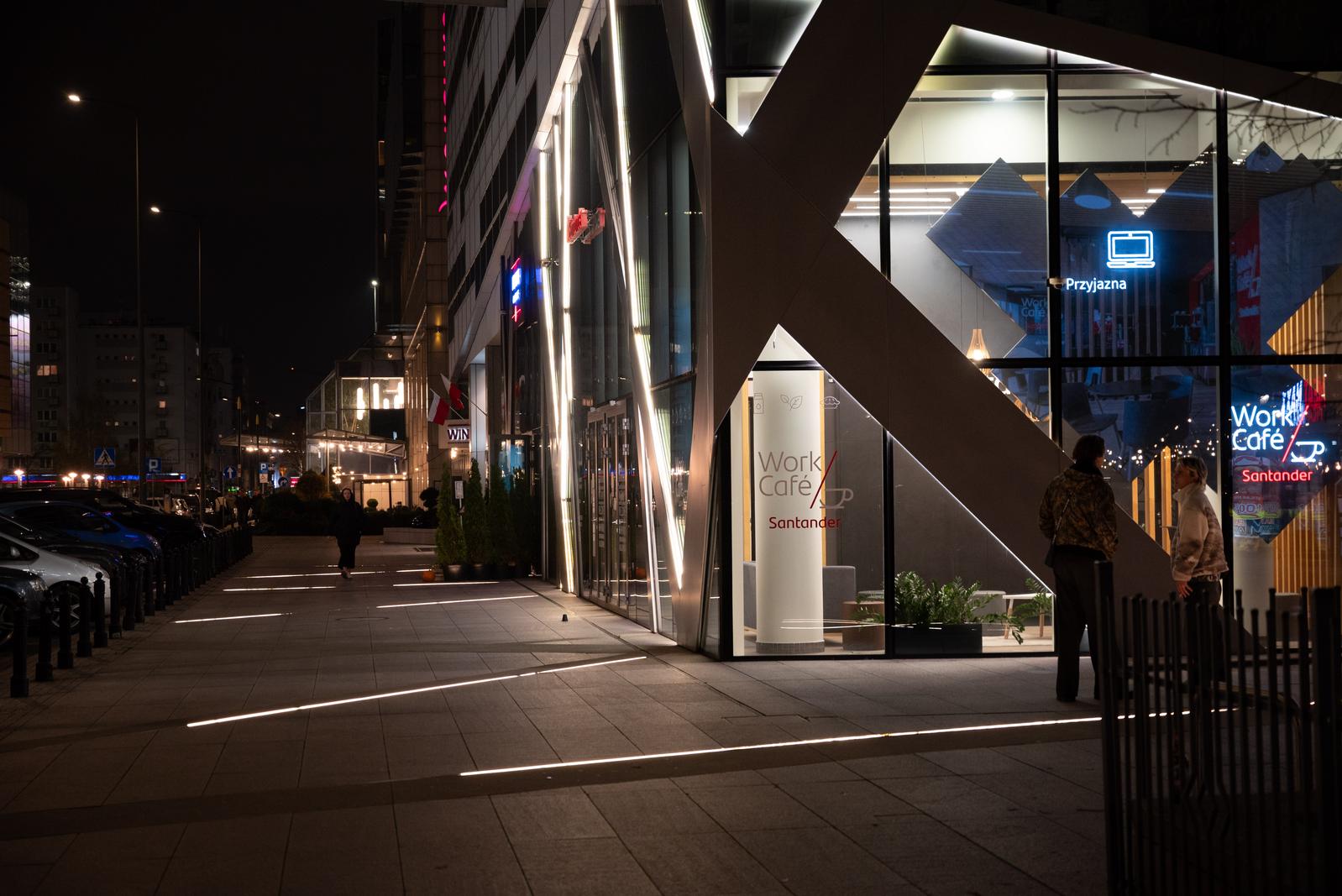
Sleek urban geometry and glowing lines create a cool night-time mood, but the human moment is thin.
Yes, this answers “Light” clearly: the illuminated pavement strips, vertical edge lighting on the facade, and the café’s signage are the visual engine of the frame. You’ve treated light as design more than illumination on people, which suits an architectural–street hybrid. The strongest elements are the X‑shaped structural beam and the diagonal bands of light on the ground guiding us to the glass corner with the “Work Café” branding. Where the image hesitates is in deciding whether the people outside are a true subject or incidental. If your intent was to show people interacting with light, the light never quite lands on them. What did you want the viewer to notice first—the café geometry or the conversation by the window?
TECHNICAL EXECUTION ★★★★
For a night scene, exposure is handled well: highlights on the facade are intact and shadow detail along the pavement remains readable. Noise is controlled and edges look crisp, suggesting a stable stance or good image stabilisation. Mixed colour temperatures (cool exterior strips, warmer café interior) are natural and not overprocessed. The two people on the right are a touch soft, likely from low shutter speed rather than focus error, and there’s a slight muddiness in the deepest blacks. There are no obvious artefacts or HDR halos. To reach five stars, lock a faster shutter (around 1/125s or higher) and fine‑tune white balance to keep the warm–cool contrast while avoiding slight green in the street lighting.
COMPOSITION ★★★
The frame has pleasing structure: the X‑beam and the lit pavement lines create strong vectors pulling the eye toward the café corner. However, the two people—your only active element—are pushed tight to the right edge and partly crowded by the dark railing, which weakens their presence. The brightest sign inside (“Work Café Santander”) competes for attention with their darker figures, so the eye oscillates without settling on a clear subject. The left side contains a long stretch of relatively empty pavement that doesn’t add new information, diluting concentration. A step left and closer would align the people within the bright wedge of glass and give them breathing space. A subtle crop from the left could also tighten the story around the café corner.
LIGHTING ★★★
The urban lighting provides rhythm and mood—the ground strips are a nice motif and the facade edge lighting draws a clean line through the frame. Inside the café, warm light adds depth and contrast to the cool exterior. But the people stand in comparative shadow, so the light doesn’t shape them or signal their importance. Faces lack lift or catchlight, so the human element feels secondary to the architecture. Moving so that window glow or a pavement strip lit their faces would have elevated the moment. The balance is good overall, but the story-bearing subjects are underlit.
STORY ★★
There is a hint of narrative—two people talking outside a late‑night café—but no decisive gesture or tension that holds us. Without an expressive moment (a laugh, a hand to face, someone stepping through a light band), the scene reads more as a well‑lit place than a lived moment. The bright interior branding becomes the most communicative element, which is advertising rather than story. Waiting a few beats for an action—someone exiting, a passerby crossing a strip of light, or a clearer interaction—would transform this into a true street scene. What small human beat were you hoping to catch here, and how might the light have helped reveal it?
IMPACT ★★★
It’s visually pleasing with confident night colour and modern geometry, and it communicates the city’s polished vibe. The image holds for a moment but doesn’t linger in memory because the human element never peaks. The signage becomes the de facto focal point, which reduces emotional pull. Trim the frame to focus on the corner and land a cleaner human moment, and the image would gain bite. As it stands, it’s a solid study of urban light rather than a memorable street photograph.
CONSTRUCTIVE NEXT STEPS
✓ Reposition: step a metre left and slightly forward to place the two people inside the bright glass triangle, clearing the railing and giving them space from the edge; aim to include their full silhouettes.
✓ Prioritise the moment: wait for a gesture or a passerby to cross a pavement light strip; shoot at 1/125–1/250s, f/2.8–f/4, and raise ISO as needed so the human action is crisp.
✓ Post: crop a little from the left to reduce dead space, then gently dodge the faces and lower the interior signage by about 0.3–0.5 stops so the eye favours the people over the logo.
AI Version 2.1