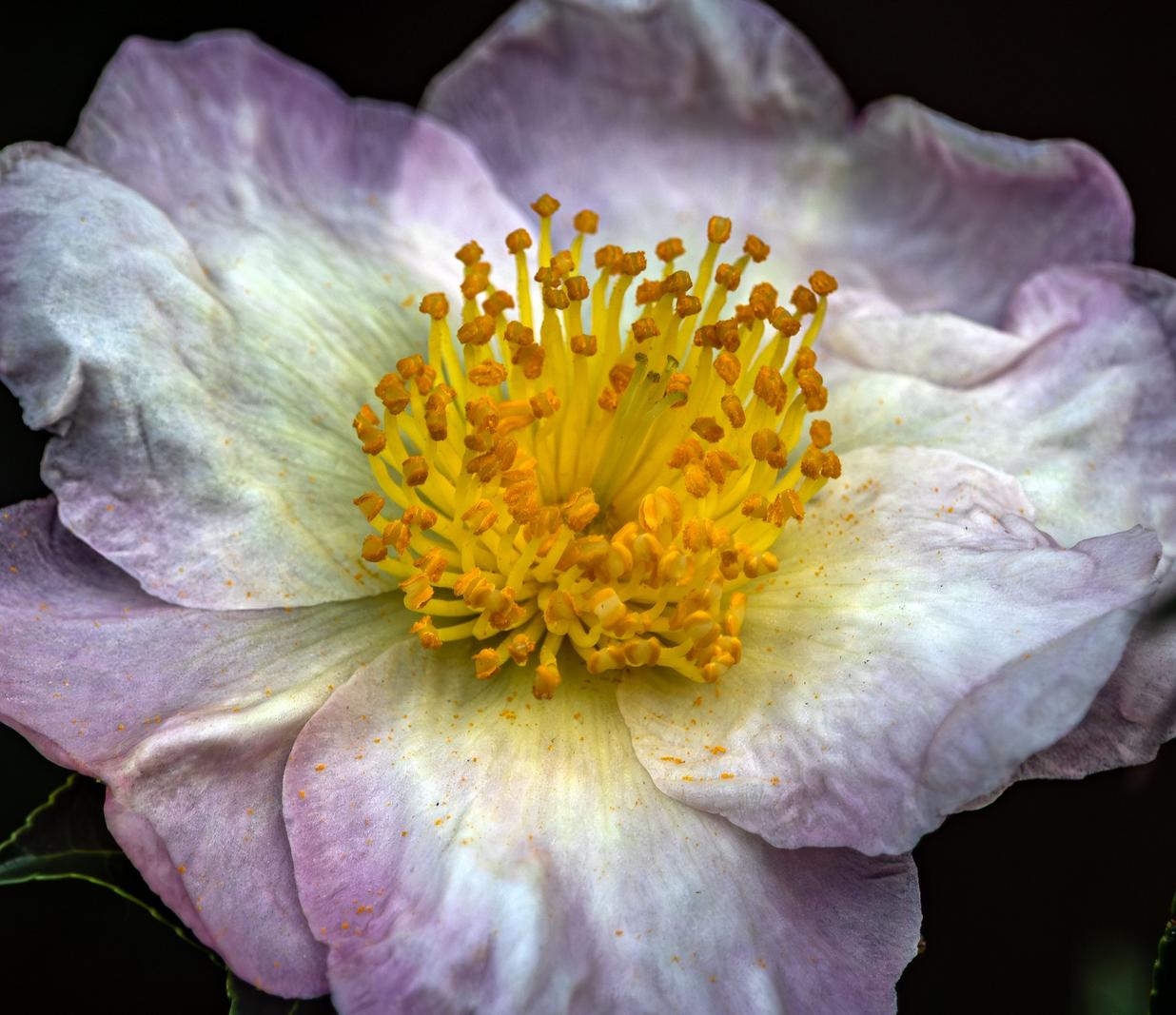
A clean, detailed flower close‑up with strong colour—now it needs a bolder, more deliberate point of view.
Thanks, Gordon. You’ve made a solid macro study: the yellow stamens are crisp and the dark background keeps the attention where it belongs. To improve it, decide what the hero is—are you celebrating the crown of stamens or the form of the whole bloom? That single choice will drive framing, depth of field, and processing. Below I’m critiquing it as a macro flower portrait and outlining precise steps to push it from good to standout.
TECHNICAL EXECUTION ★★★★
The core focus on the central stamens is sharp, with attractive detail in the anthers and visible pollen grains. Depth of field feels a touch shallow for the whole crown—several outer stamens drift soft—suggesting either a slightly wider aperture than ideal or a single-frame approach where a short stack would help. Colour is mostly natural, though the petals carry a faint magenta/grey cast and the micro‑contrast on the petal texture looks a bit “crunchy,” likely from elevated clarity/sharpening. Noise and artefacts are minimal, and exposure is controlled with no blown highlights. For five stars, aim for uniform sharpness across the stamen ring (smaller aperture or focus stacking), tame the clarity, and fine‑tune white balance to keep the petals clean and gentle.
COMPOSITION ★★★
The subject fills the frame well and the eye lands immediately on the golden centre, which is a safe, effective choice. However, the frame feels cramped on the top and right edges, and a small green sliver in the lower‑left corner pulls attention. The partial petal cut‑offs don’t feel intentional; they read as necessity rather than design. Consider either committing to a tighter crop around the stamen crown (square or vertical) or stepping back to include the full petal circumference with breathing room. What would the image say if you isolated three or four stamens on a diagonal rather than the entire disk?
LIGHTING ★★★★
The light is soft and flattering—likely overcast or diffused—so the colour holds and the pollen textures read well. That said, it’s a little flat across the petals, which mutes their shape. A small white reflector from one side would lift detail and create mild direction, and gentle backlight could introduce translucency and sparkle. Highlights are well controlled, and the dark background helps separation. To reach five stars, shape the light with intent to create micro‑shadows that model the stamens and add dimensionality without harshness.
STORY ★★★
This is a clean botanical portrait that shows structure and texture nicely. The scattered pollen dust hints at life, but there’s no real “moment” beyond the static bloom. A visiting pollinator, a falling grain of pollen, or morning dew would introduce a sense of time and make the frame feel less generic. Alternatively, pushing towards abstraction (selecting a single expressive stamen and strong negative space) would give it a clearer concept. For a five‑star story, include a fleeting element or commit to an abstract visual idea that feels intentional.
IMPACT ★★★
It’s pleasing and well made, but flower macros are common; without a distinctive angle or moment, the image blends into the crowd. The slightly crunchy processing on the petals and the edge crowding soften the elegance that could make this sing. The bright yellow centre provides pop, yet the frame doesn’t deliver a fresh viewpoint. Strengthen impact by simplifying the frame, clarifying the hero, and refining the tonality so the textures feel natural and refined. A clearer composition or a small behavioural moment would lift it to four stars or more.
CONSTRUCTIVE NEXT STEPS
✓ Choose a direction: either crop tight to a square/vertical around the stamen crown, or step back to include the full bloom with clean margins; in both cases clone out the small green sliver bottom‑left.
✓ For fuller sharpness, shoot at f/8–f/11 on a tripod and stack 5–15 frames focused through the stamens; or, if you prefer drama, open up and focus on a single stamen to create a deliberate fall‑off.
✓ Reduce global clarity/sharpening by ~20–30%, warm the white balance slightly, and selectively sharpen only the anthers; lower the yellow saturation a touch to avoid a plastic look.
✓ Add direction to the light: a small diffuser overhead and a white card from one side, or slight backlight for petal glow; aim for a tiny catchlight or specular sparkle on the pollen.
AI Version 2.1