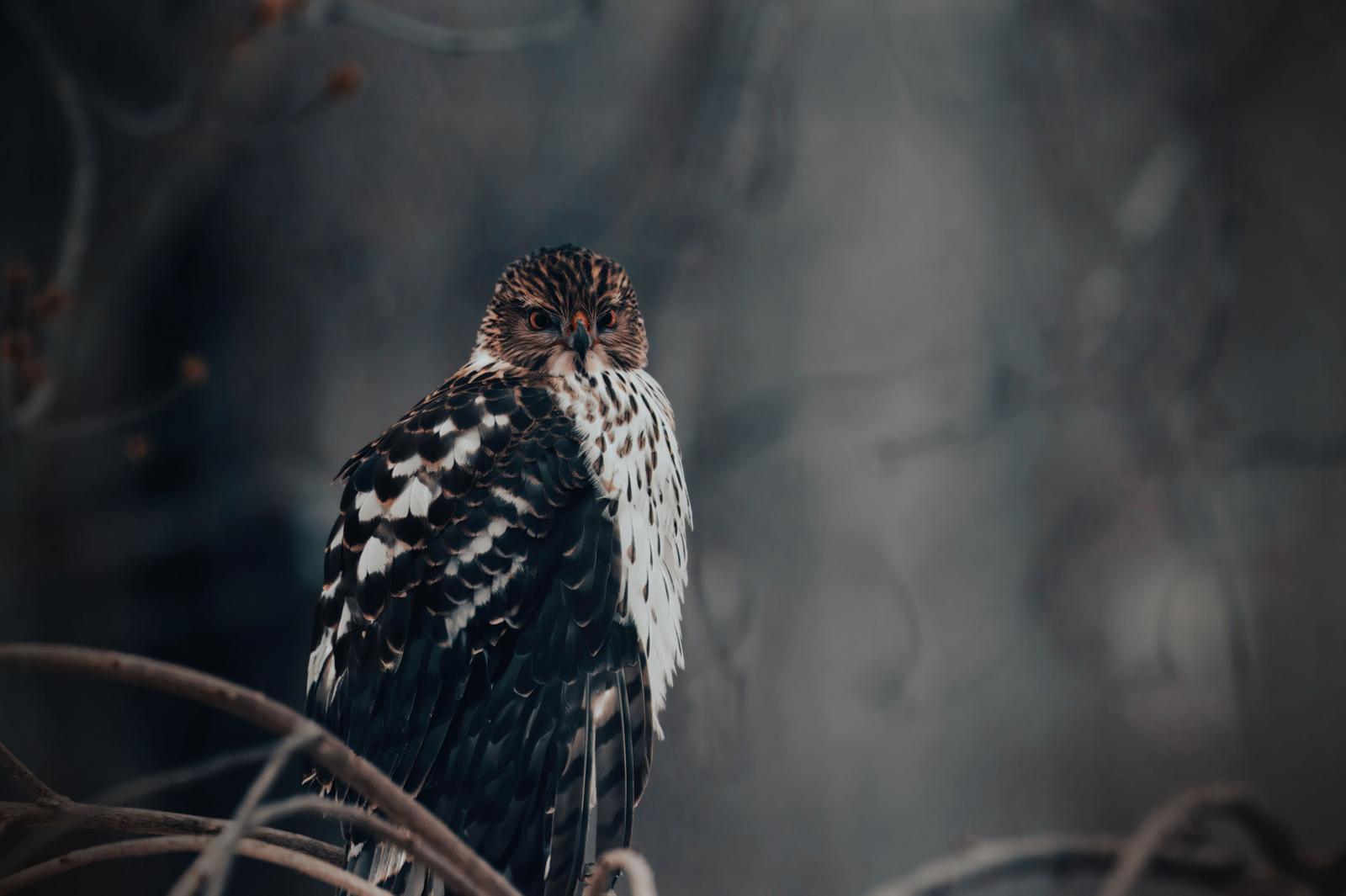
A poised hawk, cleanly isolated against a moody woodland wash.
You did achieve a lovely, creamy background — that long lens and the working distance have paid off. This reads as wildlife portraiture, and the image’s strongest qualities are the calm posture, direct gaze and the restrained colour palette. The exposure holds the white breast feathers without clipping, and the subdued tones feel honest to the light. Where the frame wobbles a little is the clutter of soft branches along the bottom; they half‑frame the bird but also pull attention from that excellent plumage detail. If you’d had the chance, would a slight step or lower stance have separated the head from those twigs and placed it against the smoothest part of the backdrop?
TECHNICAL EXECUTION ★★★★
The file looks clean and well handled — no obvious noise, halos or heavy processing. Focus appears good on the head, and feather detail is strong, though not quite “needle‑sharp” on the eye at this resolution. Exposure is nicely balanced: whites on the chest retain texture and the darker mantle still carries detail. Colour is neutral‑cool, which suits the scene. If this was at the long end of the 200–500, a faster shutter (around 1/1000–1/1600s) would guard against micro‑blur from subject twitch or hand movement.
COMPOSITION ★★★
The hawk sits well left of centre with ample breathing room to the right, which gives the portrait dignity. The big arcs of out‑of‑focus branches at the bottom and lower left, however, compete with the bird and form a busy frame line. They’re close enough to act like barriers rather than helpful leading lines. A modest crop from the bottom or a small shift to avoid those loops would simplify the read and make the plumage the undisputed anchor. Consider a slightly tighter vertical framing to emphasise the bird’s height and reduce empty, non‑descriptive space.
LIGHTING ★★★
Soft, overcast light renders the feathers evenly and avoids harsh contrast — a sensible, natural look. What’s missing is a brighter catchlight to lift the eye and a touch more directional shaping on the face. A half‑step to change the angle to the sky or waiting for a head turn could have put a clean glint in the eye without changing the ethics of the encounter. The overall tone skews cool and slightly dark; a gentle lift of midtones on the face and breast would add life without losing mood.
STORY ★★★
This is a solid, respectful portrait — calm bird, fixed gaze, and a clear sense of place. The frame stops short of behaviour or tension; it’s not hunting, calling or taking off, so the narrative remains simple. Even a small gesture — a feather ruffle, a head tilt, a foot shift — would add that extra beat of moment. Did you stay with the bird to anticipate a pre‑flight lean or a look into the distance?
IMPACT ★★★★
The moody palette and clean separation give the image presence, and raptors always draw attention. It’s memorable for the quiet intensity rather than drama. To reach the next tier, you’d need either more distinctive light (a rim or a low sun kiss) or a stronger behavioural moment. As presented, it’s a handsome, publishable portrait that reflects good fieldcraft and restraint.
CONSTRUCTIVE NEXT STEPS
✓ On similar perches, shift a half‑step or lower your viewpoint to clear the head from busy twigs and place it against the smoothest background; if possible, crop a little from the bottom here to remove the looping branch that competes with the subject.
✓ Aim for 1/1000–1/1600s at f/5.6–f/6.3 and ISO as needed on the 200–500mm; this keeps micro‑blur at bay and still gives you that pleasant background blur.
✓ In post, add a subtle dodge to the eye and cere, a touch of local contrast on the head, and lift midtones by about 0.2–0.3 stops; keep it natural and avoid global clarity that can roughen the bokeh.
✓ Stay with the bird to anticipate behaviour — a pre‑flight lean, a yawn, or a feather shake — and shoot short bursts to nail the peak micro‑gesture without overwhelming the scene.
AI Version 2.1