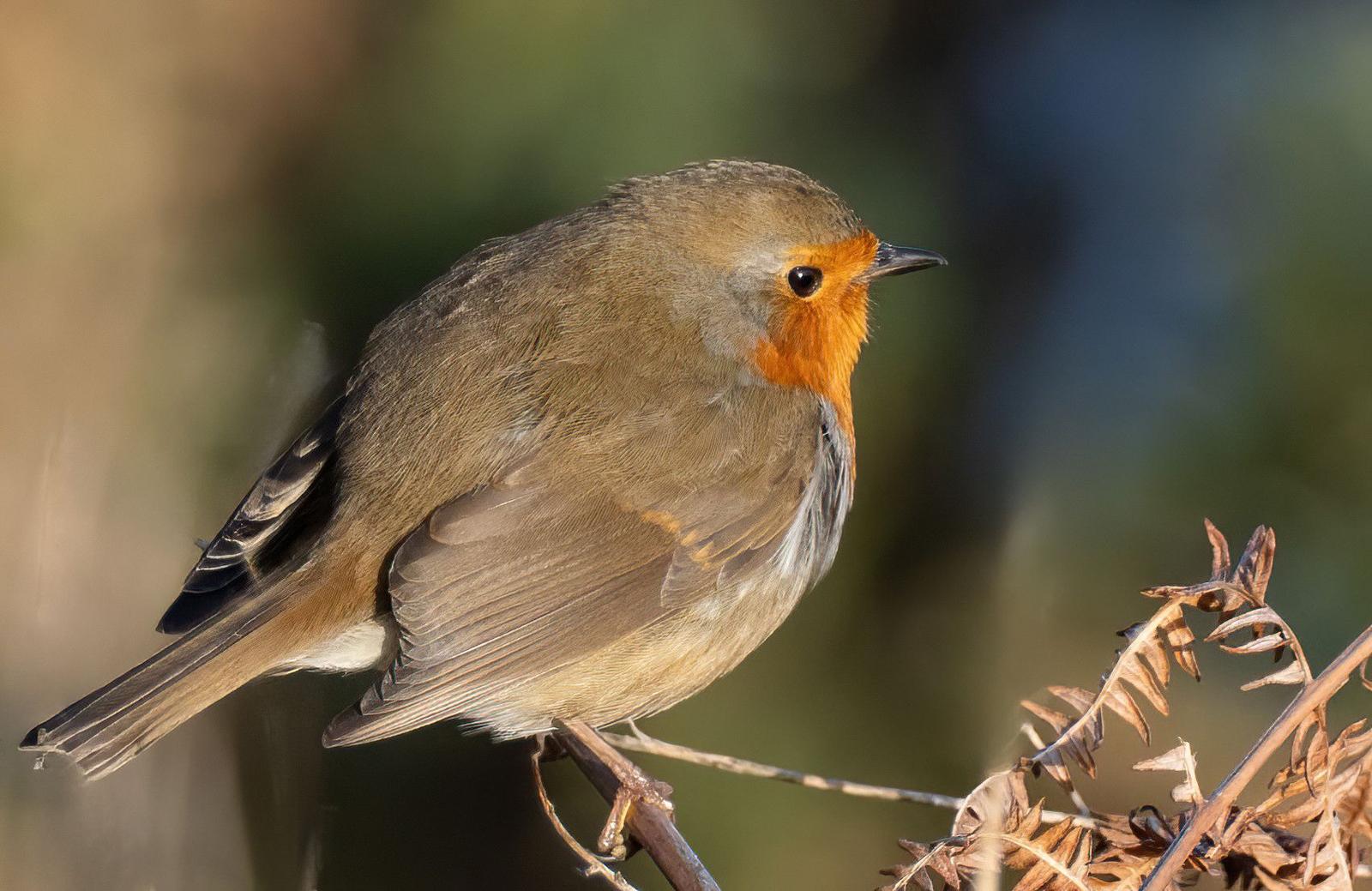
A warm, well‑detailed robin portrait let down a touch by crowded framing and a busy perch.
You’re right to question the composition, Alan. This is a wildlife portrait: the bird is cleanly isolated with lovely feather detail and a soft background, so your fieldcraft and timing are solid. The main friction comes from the tail sitting very close to the left edge while the busy, bright bracken on the right tugs the eye away from the robin’s face. The profile, catchlight and earthy palette are strong foundations; the frame just needs cleaner balance and a little more breathing room. When you shot this, could you have shuffled a step left or opened the aperture to throw that bracken further out of focus? Small choices like that make a big difference to how calm the frame feels.
TECHNICAL EXECUTION ★★★★
Focus looks crisp on the eye and head, with fine feather detail holding up well. Exposure is balanced—no blown whites in the breast and respectable shadow detail on the flank. Colours are natural and not over‑pushed, which suits the subject. Background blur is smooth and free from obvious artefacts. To reach five stars I’d want absolute pin‑sharpness at the eye with zero hint of noise in the darker plumage and the perch, and perhaps a touch more micro‑contrast around the head via careful local sharpening.
COMPOSITION ★★★
The bird is angled nicely into the open space to the right, which is good, but the tail is uncomfortably close to the left edge—this creates tension that doesn’t help a quiet portrait. The bright, complex bracken at the lower right competes with the robin’s head for attention and adds visual weight on that side. The perch cuts diagonally through the frame, which is fine, but it leads the eye straight into the bracken cluster rather than back to the subject. A cleaner perch or a slight shift in position to place the head against the smoothest background would simplify the read. Consider how a looser frame or a crop that trims a sliver from the right and bottom might rebalance the bird without cramping it.
LIGHTING ★★★★
Warm, low‑angle light shapes the bird beautifully and brings out the orange breast without garish saturation. There’s a tidy catchlight in the eye, and the tonal roll‑off across the flank gives pleasing roundness. Shadows are present but not clogged; the light feels natural and gentle. The background falls off into a pleasant duskiness that supports the subject. For five stars I’d hope for slightly more separation between the lit head and the background tone, or a moment of backlit rim to give that extra bit of sparkle.
STORY ★★★
This is an honest, calm portrait that shows the robin at rest in its habitat—clear and pleasant, if not especially revealing. The dry bracken hints at seasonality, which adds a little context. What’s missing is a moment: a beak‑open song, a head tilt, or a small hop that gives personality. Behaviour elevates wildlife images from “pretty bird” to “memorable encounter.” Next time, could you wait for a call or feeding action to layer a stronger narrative into the frame?
IMPACT ★★★
It’s a clean, likeable image with the classic charisma of a robin, and the warm tones make it immediately approachable. However, similar portraits are common, and the busy perch prevents the photo from feeling iconic. The picture holds attention for its craft but doesn’t quite land a lasting imprint. Refining the frame and catching a more characterful gesture would push it into the “stop and stare” category.
CONSTRUCTIVE NEXT STEPS
✓ In the field, give the tail more room or, if you can’t, trim a little from the right and bottom in post to reduce the pull of the bright bracken while keeping space in front of the beak. Aim to position the eye near the upper‑right third.
✓ Change your angle slightly (a small step left and a touch lower) so the head sits against the smooth, dark background rather than near bright bracken; shoot wide (e.g. f/4–f/5.6) to blur the perch further.
✓ Wait for behaviour—a song, head cock, or feather ruffle—and use continuous AF with around 1/1000s and short bursts to catch the peak moment without motion blur.
✓ Post‑processing: lightly darken/desaturate the bracken highlights, add a gentle local dodge to the eye and cheek, and apply subtle selective sharpening only to the face to draw attention where it matters.
AI Version 2.1