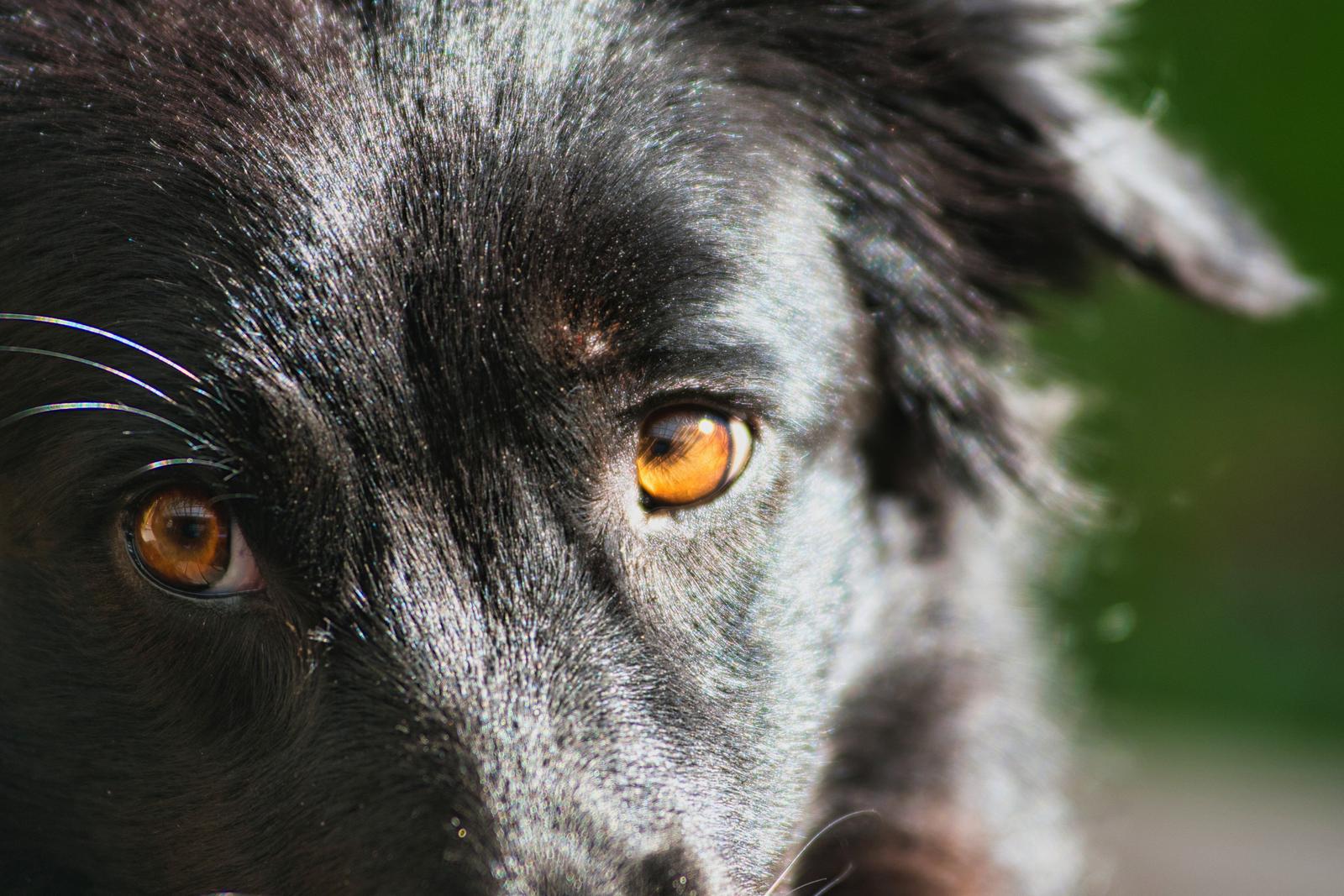
A bold, eye-led portrait that leans hard into texture and gaze.
Thanks Peter. You’ve gone all-in on the eyes, which is the strongest choice here—the amber irises against the black coat immediately hook the viewer. This sits between pet portrait and wildlife study, and the tight crop turns it into an almost abstract character piece. The file looks clean and confident, with plenty of detail in the fur and a punchy catchlight. What drew you to crop this tight—were you chasing intensity over context?
TECHNICAL EXECUTION ★★★★
Focus is solid, particularly on the right eye, giving that essential connection; the left eye looks fractionally softer, likely from shallow depth of field. Exposure is well managed for a black dog in bright light—there’s readable texture across most of the coat with only small specular hotspots. Colours are natural and not overcooked; the warm eyes feel true. I do see slight rainbowing on the whiskers and edges, a hint of chromatic aberration from hard sun, but it’s minor. Noise is controlled and the file holds up. To reach five stars, ensure both eyes are within the focus plane and tame the bright highlight specks.
COMPOSITION ★★★
The aggressive crop creates tension and immediacy, which suits the gaze. However, the left eye sits very close to the bottom-left edge while a broad green area on the right feels empty; this imbalance steals attention from the eyes. The diagonal sweep of fur is strong but the frame doesn’t quite resolve—either commit to a single eye with purposeful negative space, or include more of the face to balance the pair. A square or tighter right-side crop would concentrate the viewer where you want them. Consider how a slight shift to place the sharp eye on an upper third would cleanly anchor the frame.
LIGHTING ★★★
The light is punchy and directional, giving life to the eyes and crisp texture in the fur. At the same time, the hard sun produces glittery hotspots and emphasises colour fringing on the whiskers, which can look messy. Open shade or soft window light would flatten the specular highlights while keeping those rich eyes bright. A simple diffuser or scrim over the dog outdoors would achieve similar softness without losing contrast. Reach for gentler light and you’ll gain control and depth without the shiny distractions.
STORY ★★★
The stare hints at alertness and curiosity, and the closeness suggests trust. Because we’re so tight, we lose any behaviour or context that could add character—no ear perk, tongue flick, or interaction with a person or environment. As a result, it reads more as a study of colour and texture than a moment. Consider what small gesture could lift this beyond “close-up”: a glance to something off-frame, a paw in light, or a tilted ear. What tiny behaviour would best describe Lisa’s personality?
IMPACT ★★★★
The amber-on-black contrast delivers instant punch, and the unusual crop makes you pause. It stands out in a feed and would print well. The lack of compositional resolution and the harsh highlights keep it just shy of unforgettable. Resolve those and this could be a striking, minimalist pet portrait.
CONSTRUCTIVE NEXT STEPS
✓ Stop down slightly and align the sensor plane with the eyes: aim for f/4–f/5.6 at a shutter fast enough to freeze micro‑movement (1/250–1/500s), single‑point AF on the nearer eye to keep both eyes crisp.
✓ Rebalance the frame: crop 15–25% from the right to reduce the empty green block, or go square and place the sharper eye on an upper third; avoid letting the left eye sit so close to the edge.
✓ Soften the light: shoot in open shade or by a north‑facing window; outdoors, hold a small diffuser above the head to kill the glittery highlights while keeping catchlights.
✓ In post, use a gentle highlights reduction on the fur, remove the brightest stray whisker glints with the healing brush, and add a very subtle, broad vignette to guide the eye without looking processed.
AI Version 2.1