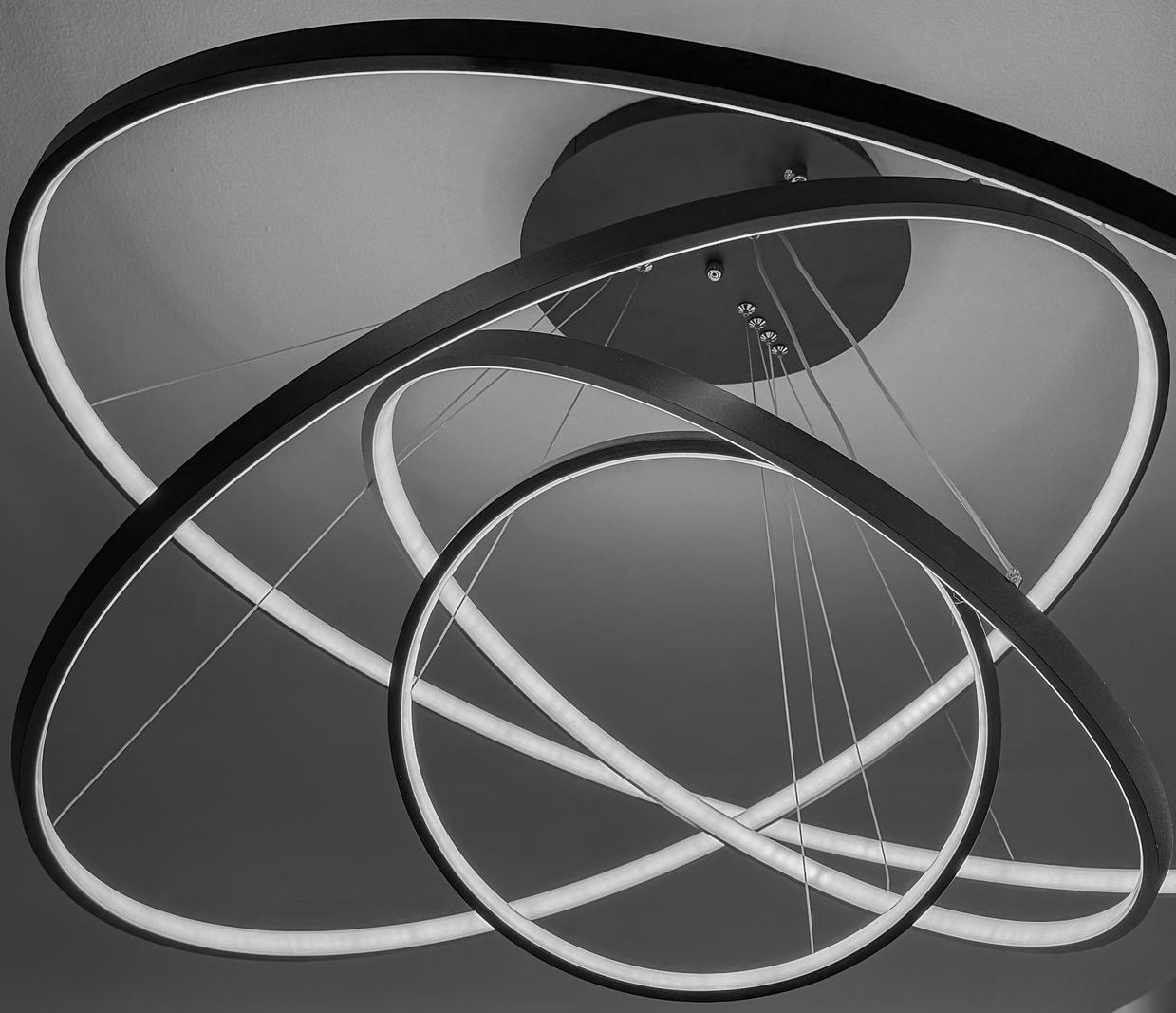
A clean, graphic study of curves that’s nearly a strong abstract but needs firmer intent.
Thanks Gordon. You’ve made a bold black‑and‑white study of a modern ceiling light; it sits closest to fine‑art/architectural abstraction. The conversion is tasteful and the overlapping rings create pleasing geometry. To improve it, decide what the photograph is really about: pure geometry and rhythm, or a depiction of the fixture itself. Right now it sits between those two ideas — the bright rings feel abstract while the off‑centre ceiling plate and cluster of cables pull it back to product documentation. Which do you want the viewer to notice first: the crossing of the two largest rings, or the cable cluster by the hub?
TECHNICAL EXECUTION ★★★★
Sharpness looks good across the frame and the tonal range is clean; there’s no heavy noise or sloppy sharpening. The LED strips are close to clipping but still hold some texture, which keeps the glow believable. The monochrome treatment suits the subject and avoids colour casts from the LEDs. I can see mild ceiling texture and a hint of banding/unevenness in the mid‑tones — nothing major, but it does flatten the background. A lower ISO with tripod and a slightly darker base exposure would preserve even more detail in the diffusers and give you purer blacks. Five stars would require completely controlled highlights, perfectly smooth background tonality, and invisible retouching on the small screws and specks around the hub.
COMPOSITION ★★★
The rings create strong arcs that sweep the eye, and the overlapping gives energy. However, compositionally it feels undecided: the ceiling plate is off‑centre and the cable bundle is prominent, yet the outer ring is cropped at several edges, so we neither commit to symmetry nor to full abstraction. Some arcs sit very close to the frame edge, creating tension that feels accidental rather than designed. The cable lines also compete with the ring geometry; they add clutter where negative space would strengthen the graphic feel. To reach a higher level, either centre yourself directly under the hub for a deliberate, balanced radial design, or crop/position to remove the hub entirely and let the luminous rings dominate as pure shapes.
LIGHTING ★★★
The piece lights itself, which is neat, but the overall effect is a bit flat. The ceiling is evenly lit so the rings don’t separate as much as they could. Exposing a touch darker for the strips (or dimming them if possible) would retain more texture in the diffusers and allow deeper blacks in the ring frames. A slight fall‑off or vignette created in camera by shooting from a lower angle and further away, then compressing with a longer focal length, could add depth. Consider whether switching off other room lights or isolating the fixture would help the glow feel cleaner. Masterful lighting here would sculpt the forms and give the rings more three‑dimensional bite without clipping them.
STORY ★★★
There’s a readable concept — engineered orbits crossing in space — and it’s pleasant to look at. Yet the frame isn’t fully committed to a singular idea. Including the hub and screws hints at a documentary product image; cropping them would lean into abstraction and a more purposeful statement. Alternatively, placing the hub dead centre could suggest order and design intent. What feeling do you want: precision and control, or flowing motion and mystery? Clarifying that will give the photo stronger presence.
IMPACT ★★★
The graphic curves catch the eye and the monochrome is tasteful, so the image reads well on first pass. Its impact fades a little because the framing choices feel hesitant and the background tone is quite similar throughout. A bolder decision — perfectly symmetrical geometry or a ruthless abstract crop — would make it more memorable. Small clean‑ups around the hub and richer blacks would also lift the print. Five‑star impact would come from a decisive viewpoint that makes the viewer say “of course it had to be framed exactly like that.”
CONSTRUCTIVE NEXT STEPS
✓ Commit to a direction. For pure abstraction, crop out the ceiling plate and most cables so only the glowing rings remain; for a designed graphic, shoot directly beneath the hub and centre it, letting the cables radiate evenly.
✓ Reduce perspective distortion by getting directly under the fixture (use a step ladder) and using a longer focal length around 70–100mm; keep the sensor parallel to the ceiling so the rings stay circular rather than stretched ellipses.
✓ Expose for the strips: use ISO 100 on a tripod and dial in −0.7 to −1 EV to hold texture in the diffusers, then lift the ceiling mid‑tones gently in post.
✓ Post‑processing: add a subtle S‑curve for deeper blacks, dodge/burn to separate overlapping rings, smooth the ceiling with low‑luminance noise reduction, and clone small screws/hot spots near the hub if you keep it in the frame.
AI Version 2.1