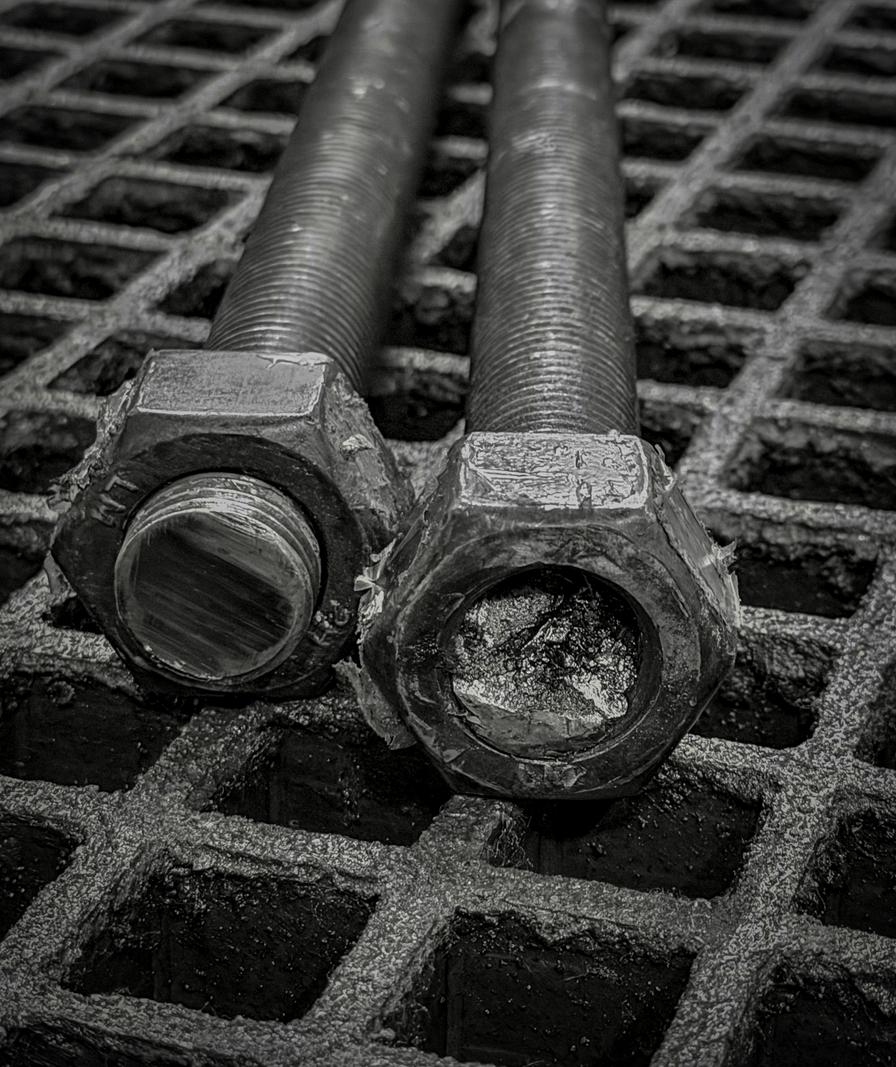
A gritty, tactile study of metal and wear that fits your project well.
You’re clearly chasing texture and heft, and this frame delivers both. The twin bolts on a rough grid have a strong graphic pull, and the contrast between the sealed end on the left and the chewed-out cavity on the right gives you a useful “intact vs. spent” theme. This sits between macro and still life, and for that hybrid it’s a solid execution. To push it further, think about how angle, depth of field and side light could intensify the differences between the two bolts and simplify the background. What aspect of “grunge” are you most interested in showing here — decay, labour, or sheer material force?
TECHNICAL EXECUTION ★★★★
Focus is crisp where it matters: the nut faces and nearby threads show fine detail without obvious sharpening haloes. Exposure is controlled; highlights on the polished left face hold detail and the darker recess of the right nut retains texture. The monochrome conversion feels natural, with a believable tonal range and no heavy HDR look. There’s some mid‑tone muddiness in the background grid that slightly flattens separation, but it’s not fatal. For a five‑star technical showing, control the background tonality more tightly and consider a few-frame focus stack to keep both nut faces tack-sharp edge to edge.
COMPOSITION ★★★
The pairing of two bolts is a clear subject, and the repeating squares of the grate set up a pleasing geometry. However, the bolts run almost straight up the frame; a stronger diagonal from corner to corner would inject more energy. The nuts sit very close to the bottom edge, creating tension that feels accidental rather than deliberate. The upper length of both bolts adds repetition without adding much story; a tighter crop around the two nut faces could concentrate the message. Ask yourself: if the “conversation” is between those two ends, do you need as much of the shafts?
LIGHTING ★★★
The light is even enough to show texture, with a gentle sheen on the left nut and readable grit inside the right. That said, it’s a little flat; the bolts merge tonally with the grid in places. A low, raking side light would carve the thread detail and pop the hex shapes from the background, while flagged fill could keep the grid from competing. Watch the specular reflection on the left end — it’s close to dominant; a slight rotation or diffusion would tame it. With more directional shaping and selective control, the metal would feel more three‑dimensional.
STORY ★★★
There is a clear idea: the contrast between a complete bolt and a damaged or hollow one on a work surface. The grime, chips and debris hint at use and time, which suits the project. Still, it stops short of a memorable moment; it’s an artefact study rather than a scene that suggests action or human presence. Consider whether a trace of the worker (glove marks, a spanner, swarf curls) or a more dramatic “before/after” pairing would deepen the narrative. What specific tension do you want the viewer to feel when they look at these two ends?
IMPACT ★★★
The textures and monochrome treatment make this immediately readable and on-brand for “industrial grunge.” It’s visually satisfying but not yet a standout; similar images are common in the genre. A bolder angle, stronger light direction and a more decisive crop would add bite. Refining those choices will turn a good study into a print‑worthy hero image. Aim for a single, unmistakable hook — the scar of the right nut, or the polished face of the left — and let everything else support it.
CONSTRUCTIVE NEXT STEPS
✓ Reframe with intent: try a 45‑degree diagonal from bottom‑left to top‑right and give the nut faces a touch more breathing room, or commit to a tight square crop centred on the two ends to concentrate the “intact vs. damaged” dialogue.
✓ Shape the light: position a small diffused light or reflector low and to the side to rake across the threads, and use black flags to darken the grid so the bolts separate cleanly; keep speculars on the left end controlled by slightly angling it.
✓ Depth of field for control: at tripod height, shoot around f/8–f/11 and, if needed, capture 4–6 focus‑stack frames to keep both nut faces and nearest threads pin‑sharp while allowing the grid to fall away.
✓ Post tidy-up: selectively burn the brightest specks on the grid and inside the right nut, and clone any small, bright flecks that pull the eye; add subtle dodge/burn to sculpt the hex edges and thread ridges.
AI Version 2.1