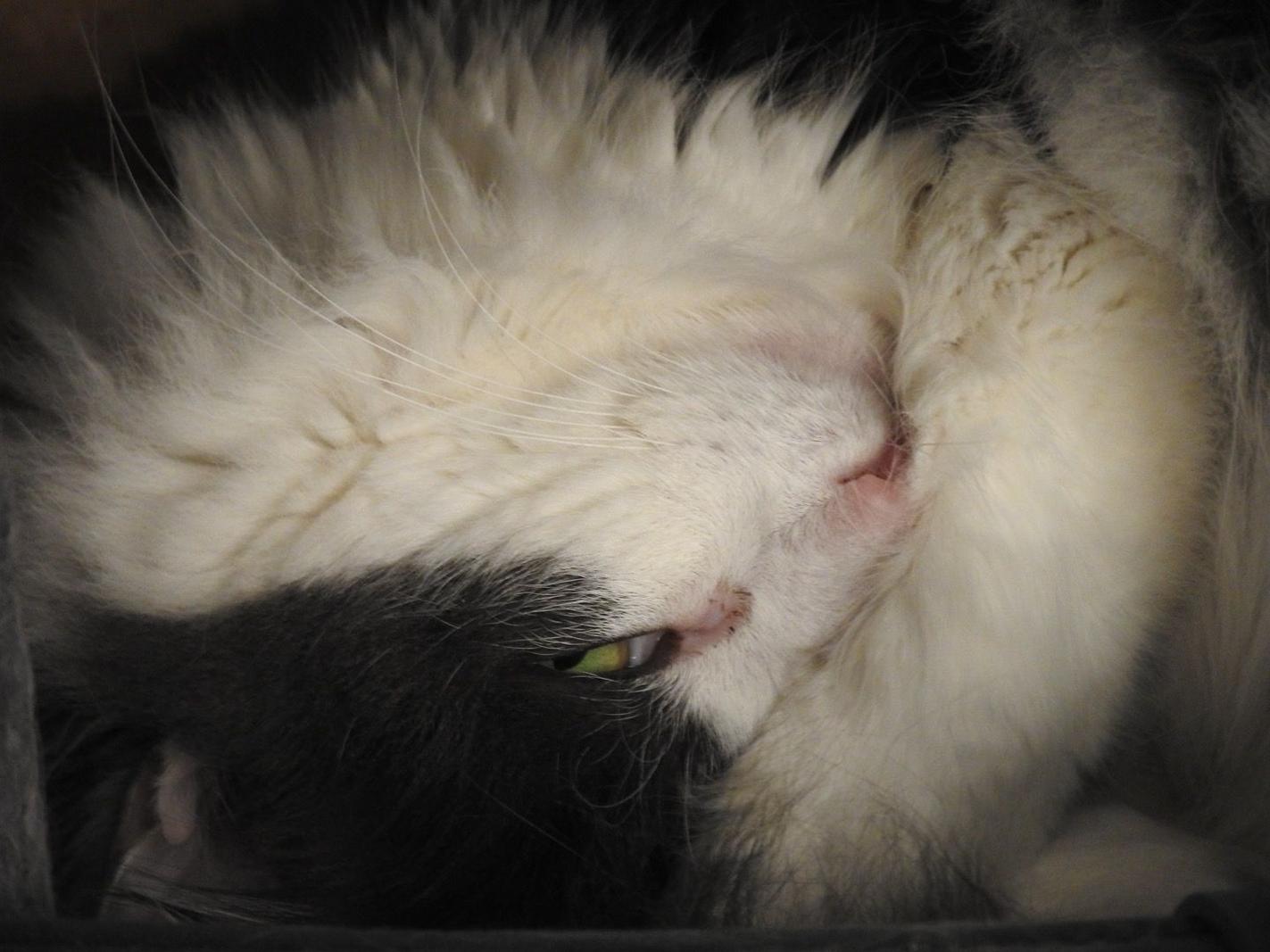
Lovely feline textures, but the eye isn’t commanding the frame yet.
This reads as an intimate animal portrait: you’ve gone in close to a curled cat, letting the white fur fill the frame with a single green eye peeking through. The closeness gives warmth, and the soft, low light suits a sleepy subject. To improve shots like this, make the eye the unambiguous anchor and simplify the frame around it. Right now focus feels a touch behind the eye and the crop is so tight that the viewer works to understand the orientation. Were you aiming mainly for the plush texture, or the quiet moment? Your answer will guide how much face you include and where you place that sliver of eye.
TECHNICAL EXECUTION ★★
Focus appears a little soft on the visible eye, with crisper detail on nearby fur and whiskers—costly for an animal portrait where the eye should be the sharpest point. Exposure is mostly controlled, but the deep blacks in the lower left feel slightly muddy and the white fur risks losing texture in places. Noise looks fine, suggesting a moderate ISO, but the overall micro‑contrast is low, likely from the dim light and close focus. If hand‑held, a faster shutter (around 1/200s) would help nail sharpness on tiny movements. To reach five stars you’d need tack‑sharp focus on the eye, richer midtones, and cleaner separation in the whites and blacks without crushing or clipping.
COMPOSITION ★★
The frame is extremely tight and rotated, which makes the cat’s form hard to read; the mouth and ear are cropped mid‑edge and the eye sits near the border. Tight can be good, but here it crowds the subject rather than heightening tension. A little more breathing room around the muzzle and ear would clarify the shape and give the eye space to lead. Consider placing the eye on an upper third with the fur sweeping diagonally to guide the viewer in. What would happen if you stepped back to include both eyes or the paw tucked in—would that strengthen the sense of a curled rest?
LIGHTING ★★★
The light is soft and gentle, appropriate for a sleeping cat and kind to the white fur. However, it’s a little flat on the eye, which lacks a catchlight and therefore presence. Side window light would sculpt the fur while giving a bright pin of life in the eye. Be mindful of the white fur near the top—keep detail by exposing slightly lower and lifting midtones later. For a top score, aim for directional soft light that gives shape and a clean catchlight without blowing highlights.
STORY ★★
We sense a cosy nap, but the moment is vague because the orientation is confusing and the eye is half hidden. A small gesture—a slow blink, a yawn, or a paw curl—would add character. The crop also removes cues that tell us how the cat is lying, dulling the tenderness you were likely after. Ask yourself: what single moment best shows this cat’s personality, and how can you wait for that micro‑gesture rather than just the form?
IMPACT ★★
The soft textures are pleasant, but the lack of a crisp focal point and the cramped framing reduce memorability. Without a clear anchor, viewers don’t settle; they scan fur rather than connect with the animal. A sharper, brighter eye and a deliberate orientation would lift the image immediately. To reach higher impact, simplify the frame around a decisive little moment and let light and focus make the connection.
CONSTRUCTIVE NEXT STEPS
- Prioritise the eye: use single‑point AF on the visible eye, around f/4–f/5.6, 1/200s or faster, ISO 800–1600 if needed; shoot a short burst and check focus at 100%.
- Shape the light: place the cat near a side window and shoot from the shadow side so the light skims the fur and puts a small catchlight in the eye; avoid overhead light.
- Reframe with intent: rotate to a natural orientation and give a bit more space to the ear and muzzle; place the eye on a third and use the fur’s curve as a leading line.
- Post‑process lightly: lift midtones and whites while pulling highlights back to preserve fur detail; add a subtle eye‑selective clarity and remove tiny distractions around the mouth with a healing brush.
AI Version 2.12