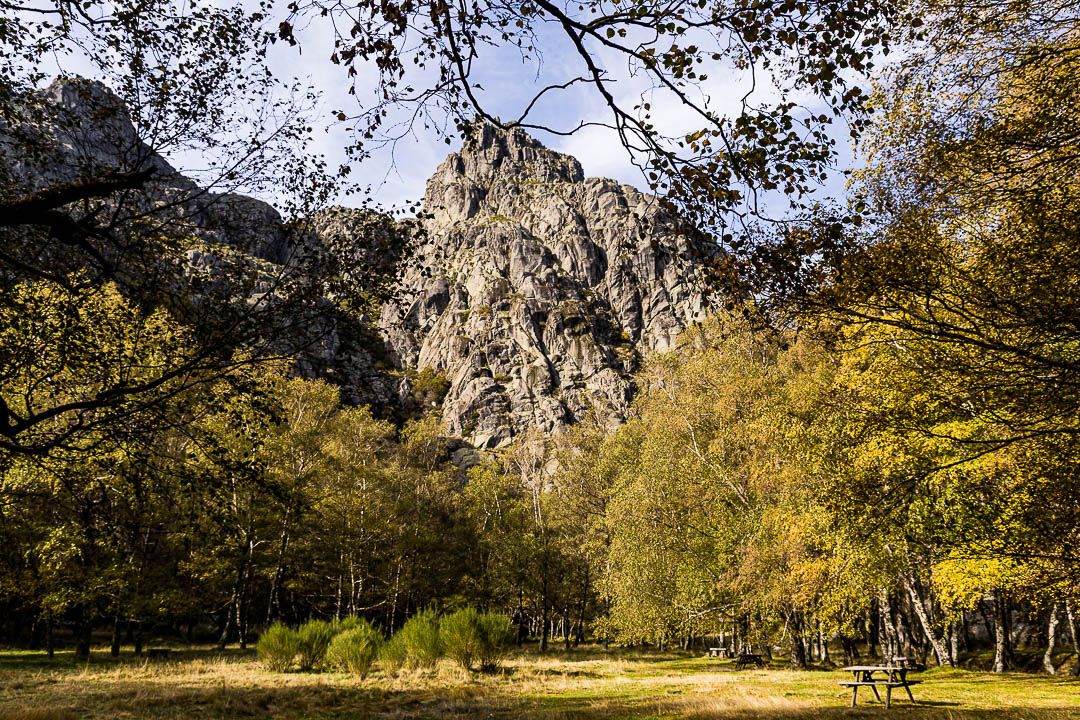
A strong mountain scene framed by autumn trees, but the frame is a little busier than the moment deserves.
Thanks João. Technically, this is solid and the colours are handled with restraint, which suits the rugged rock and muted autumn palette. Aesthetically, you’re aiming for a classic landscape: the granite peak centred, cradle-framed by birch canopy with a meadow foreground. The two picnic tables on the right introduce a human note that could either support the story (a place to pause beneath a cliff) or distract from the mountain, depending on your intent. Would you prefer this to read as pristine wilderness or as a shared recreational spot? It’s firmly a landscape image with a hint of travel sensibility.
TECHNICAL EXECUTION ★★★★
Focus and detail look good from the foreground shrubs through to the cliff face; you’ve likely used a mid‑aperture that keeps things acceptably sharp. Exposure is well managed with no heavy clipping despite the bright sky peeking through the canopy and the darker branches overhead. Colours are natural and not over‑saturated, which keeps the scene believable. There’s a touch of crunch in the darkest twigs at the top, suggesting shadows could be lifted a fraction to avoid pure black patches. I don’t see artefacts or obvious over‑processing. To reach five stars, I’d want slightly cleaner micro‑contrast on the rock (local contrast rather than global clarity) and tidier shadow control in the top frame.
COMPOSITION ★★★
The central peak is a clear subject, and the woodland provides a natural frame, giving the scene depth across foreground, midground, and background. However, the tangle of dark branches along the top border is heavy and messy; they pull attention away from the peak rather than leading toward it. The picnic tables on the right edge draw the eye laterally and compete with the mountain—either feature one table as a deliberate foreground anchor or exclude them entirely. The small green shrubs in the meadow could have been used as a strong foreground element by moving closer or lowering the viewpoint. How might a step left or a tighter crop remove the clutter while keeping the “window” to the peak? A cleaner edge treatment would lift this from pleasant to purposeful.
LIGHTING ★★★
The light is serviceable—soft autumn sun with a bit of dapple across the meadow and decent modelling on the rock face. It doesn’t harm the scene, but it doesn’t add drama either; mid‑dayish conditions flatten the trees and make the top branches go to near‑black. A lower sun angle would carve texture into the cliff and add separation in the canopy. Consider how a brief burst of side light or a patch of light in the meadow could act as a visual cue to the peak. As it stands, the light is even and safe rather than expressive.
STORY ★★★
There’s a gentle narrative of a picnic clearing beneath an imposing cliff—calm leisure under something monumental. The empty tables hint at recent or future presence, but without a person or an elemental moment (weather, wildlife), the story remains descriptive rather than compelling. If your intent was wilderness, the man‑made elements dilute that message; if your intent was a place to rest with a view, bringing one table forward as a hero element would clarify it. What specific mood did you want the viewer to feel—solitude, scale, or hospitality of the landscape? Right now it sits between those options.
IMPACT ★★★
The scene is attractive and well-rendered, but the busy top border and edge distractions soften the “wow”. The mountain has presence, yet the frame doesn’t funnel energy towards it in a memorable way. Cleaner edges, stronger foreground intent, and more expressive light would move this into striking territory. As is, it’s a good record of a beautiful place rather than an image that lingers.
CONSTRUCTIVE NEXT STEPS
- Refine the frame: crop 10–15% from the top to remove the messiest canopy silhouettes, and either crop out the far-right picnic table or commit to one table as a foreground anchor by moving closer and placing it on a third.
- Fieldcraft for depth: get lower and closer to the green shrubs in the meadow to create a purposeful foreground that leads into the birches and up to the peak; a focal length around 24–35mm with the shrubs touching a lower third would add punch.
- Time and micro-contrast: return in low side light (golden hour) to sculpt the cliff; in post, add subtle local contrast/dodge on the rock’s ridges and lift the darkest canopy shadows slightly to avoid empty blacks.
- Control sky and foliage: a circular polariser at 30–60° to the sun will tame sky glare between branches and deepen autumn leaves without oversaturation; watch for uneven polarisation if very wide.
AI Version 2.12