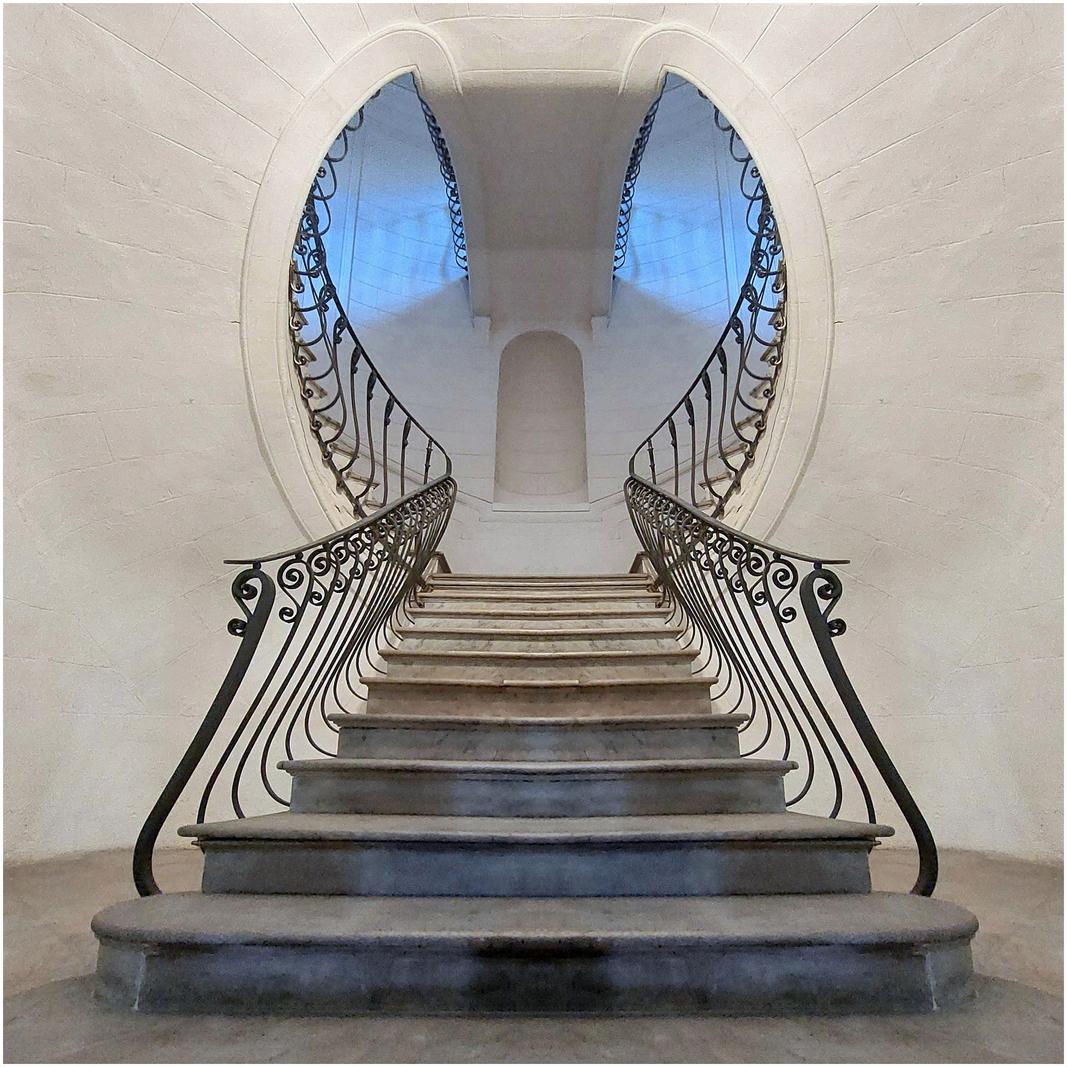
A graceful, symmetrical study of an Italian staircase with a quiet touch of colour pulling the eye upward.
You’re working in architectural territory here, and your framing shows clear intent: symmetry, rhythm in the steps, and those elegant iron rails. The soft blue at the top does add a small lift; it guides the gaze through the oval opening and stops the scene feeling too clinical. If you prefer a pure study of shape and texture, a black‑and‑white conversion would also work well, but keep the tones gentle and let the railings carry the contrast. Personally, I’d keep the colour and simply tame the blue a touch so it doesn’t steal the show. What drew you to this exact height on the stairs, and did you try a step higher or lower to balance the weight of the bottom step against the opening above?
TECHNICAL EXECUTION ★★★★
Overall exposure is clean, with good detail in the stone and walls and no problem highlights. The file looks sharp where it needs to be—on the railings and stair edges—without crunchy oversharpening. There’s likely slight wide‑angle distortion bowing the edges, visible in the gentle outward curve of the wall and the slight asymmetry of the ironwork near the frame edges; it’s minor but fixable. White balance is neutral, letting the blue sit naturally rather than glow. To reach five stars, correct the remaining geometry and remove small distractions on the steps so the finish matches the strength of the lines.
COMPOSITION ★★★★
The centred, symmetrical approach suits this staircase perfectly, and the oval opening creates a strong frame within a frame. The rails lead cleanly to the niche at the top, giving the eye a clear destination. Two things hold it from perfection: the rail ends feel a touch cramped against the side edges, and the dark scuff on the lowest step pulls attention at the very front of the frame. A fraction more breathing room left and right (or a slightly tighter crop that hides the nipped rail ends) would tidy the borders. Precision is everything with symmetry—tiny shifts matter.
LIGHTING ★★★
The light is soft and even, which keeps detail intact but gives a rather flat overall feel. The cool blue from above adds separation and a gentle sense of depth, but the rest of the scene lacks modelling on the stone. A touch more contrast or local dodging and burning on the rail curves and stair treads would give shape without looking processed. If you revisit, aim for light with a little direction—early or late daylight through the opening would carve subtle shadows and lift the texture. That sculpting would move this category up a notch.
STORY ★★★
This is primarily a study of form and craft rather than a narrative moment. The “story” here is the invitation to ascend—the visual journey from the heavy base to the luminous opening. It’s clear and pleasant, but it stops short of offering a distinct sense of place or scale. One carefully placed figure, even as a small silhouette near the top, could transform the scene into a moment without undermining the architecture. What mood did you want a viewer to feel at the top—serenity, grandeur, mystery—and how might you reinforce that with timing or framing?
IMPACT ★★★★
The strong geometry and the elliptical “window” give this image solid presence. It’s tidy, confident, and immediately readable, which makes it memorable compared to a standard staircase shot. The flat light and minor edge tensions keep it from being truly striking on first glance, but the design still holds attention. With precise symmetry, a cleaner base, and slightly livelier tonal separation, this could be exhibition‑ready.
CONSTRUCTIVE NEXT STEPS
- Keep the colour but reduce the blue’s saturation by roughly 20–30% in HSL, and lift midtone contrast locally on the railings; if you try B&W, use a soft S‑curve and selective dodging on stair edges to keep the metalwork crisp.
- Use Transform/Guided Upright (or Photoshop’s Warp with guides) to fine‑tune symmetry and correct the slight bowing; set vertical and horizontal guides through the niche and rail starts.
- Clone out the dark scuff on the lowest step and any small chips that catch the eye; these petty marks are louder than you think in a symmetrical frame.
- If allowed, revisit with a tripod and shoot a touch longer focal length (around 35–50mm full‑frame) from slightly farther back to reduce wide‑angle exaggeration and give the side rails breathing room; or step one tread higher to lessen the dominance of the front step.
AI Version 2.12