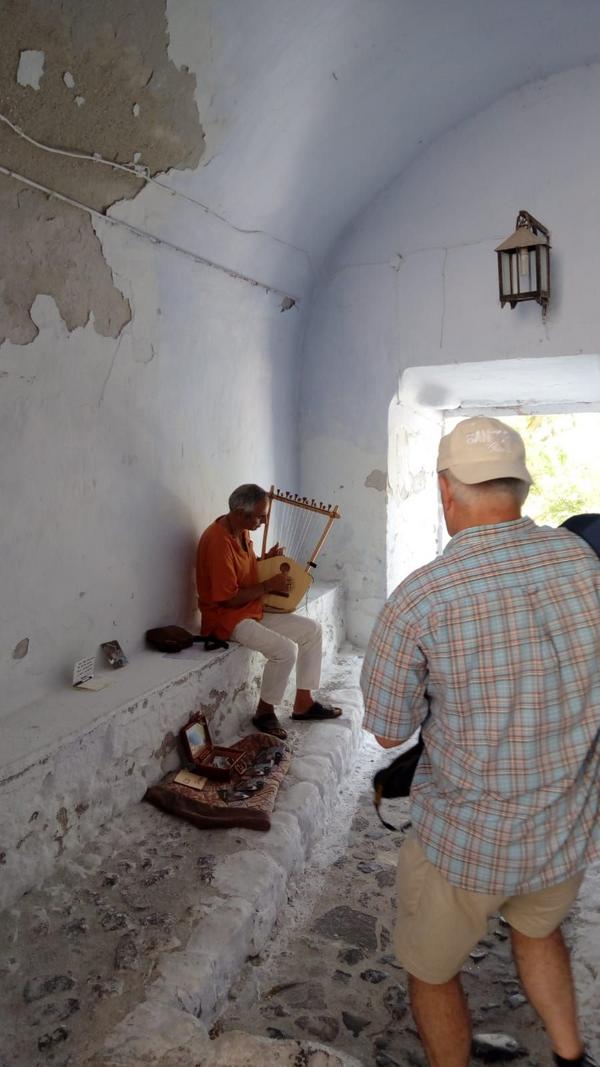
A soulful scene with a busker in a cool white tunnel, but the passer‑by grabs the spotlight.
¡Todo bien, Enrique! This reads as travel/street: a musician on a stone bench plucking a lyre‑like instrument in a whitewashed archway while a tourist steps in from the right. The location has character and the musician is a strong subject, supported by the open case and coins on the floor. However, the nearest figure dominates the frame and the brightest doorway pulls attention away from the player. I’ll break down what’s working and what’s holding it back, and how you could shape the same moment into a cleaner, more intentional photograph. As you look back at this frame, ask yourself: who did you want the viewer to meet first—the musician or the passer‑by—and how could your position have made that choice clear?
TECHNICAL EXECUTION ★★
The interior exposure is acceptable and the colours are natural, but detail clips around the sunlit doorway, which becomes a bright distraction. Focus appears a touch soft on the musician while the nearer figure is sharper, suggesting the AF locked to the foreground. There’s mild noise/texture in the shadows and a general “phone snapshot” feel—nothing fatal, but not publication‑grade. A faster shutter (around 1/200–1/250s) and a single AF point placed on the musician’s head or hands would help keep the anchor sharp as people move through. Consider a small negative exposure compensation (‑0.3 to ‑0.7 EV) to protect the highlights and recover the shadows later.
COMPOSITION ★★
The musician is nicely tucked into the left third, and the tunnel’s curve and bench give you natural lines—good instincts. But the man in the cap occupies a huge chunk of the right side and blocks the eye’s path to the player. The brightest patch—the doorway—sits mid‑right and competes as the main subject, so the viewer ping‑pongs between glare and passer‑by while the musician gets lost. The hanging lamp, flaking plaster and cable along the top left add small but cumulative distractions. A step left and slightly lower would let the arch frame the musician and reduce the dominance of the doorway; alternatively, wait for a clean gap with no figure crossing, or include a listener fully and deliberately rather than half‑cut.
LIGHTING ★★★
The shade inside the passage gives gentle, flattering light on the musician, which suits the quiet mood. The problem is the strong backlight from outside; it’s several stops brighter and drags the eye away. Exposing a little darker to keep the doorway under control would create richer tones in the walls and make the player stand out, especially if you then lift the subject locally in post. If possible, angle yourself so a wall, not the void of the doorway, sits behind the musician—same light, far less glare. A small dodge on the musician’s face and hands would help the viewer read the performance.
STORY ★★
There’s the seed of a story: a street musician and a tourist passing through a cool, old passage. But the moment hasn’t quite landed—there’s no clear interaction, no exchange of glance or coin, and the nearest figure’s back closes the scene rather than opening it. We can see the player’s concentration, yet the framing keeps us at a distance. Waiting a beat for the passer‑by to either leave the frame or to turn and listen would add the human link this needs. What specific gesture—a coin drop, a smile, the musician’s hand mid‑pluck—would have been your trigger to press the shutter?
IMPACT ★★
The setting and instrument are interesting, but the mix of a dominant foreground figure and a blown doorway dilutes the presence of your subject. As a result, the image feels more like a passing snapshot than a shaped moment of place. With a cleaner frame and a decisive interaction, this could be memorable travel work. Think in terms of hierarchy: make the musician unmistakably first, environment second, bystanders third. Push for that one beat where attention and light converge.
CONSTRUCTIVE NEXT STEPS
- Control the frame: take one step left and drop your height so the arch and bench lead to the musician; either exclude the passer‑by or include them fully as a listener.
- Expose for the highlights: dial in ‑0.3 to ‑0.7 EV and use single‑point AF on the musician; aim for 1/200–1/250s to keep people sharp as they move through.
- Wait for the moment: hold position until there’s interaction (a coin drop, eye contact, or a pause in the doorway) that gives you a clear narrative hook.
- Post‑processing: crop some of the bright doorway and right edge, lift the musician locally (dodge/contrast), and clone the small cable near the top left if it doesn’t serve the scene.
AI Version 2.12