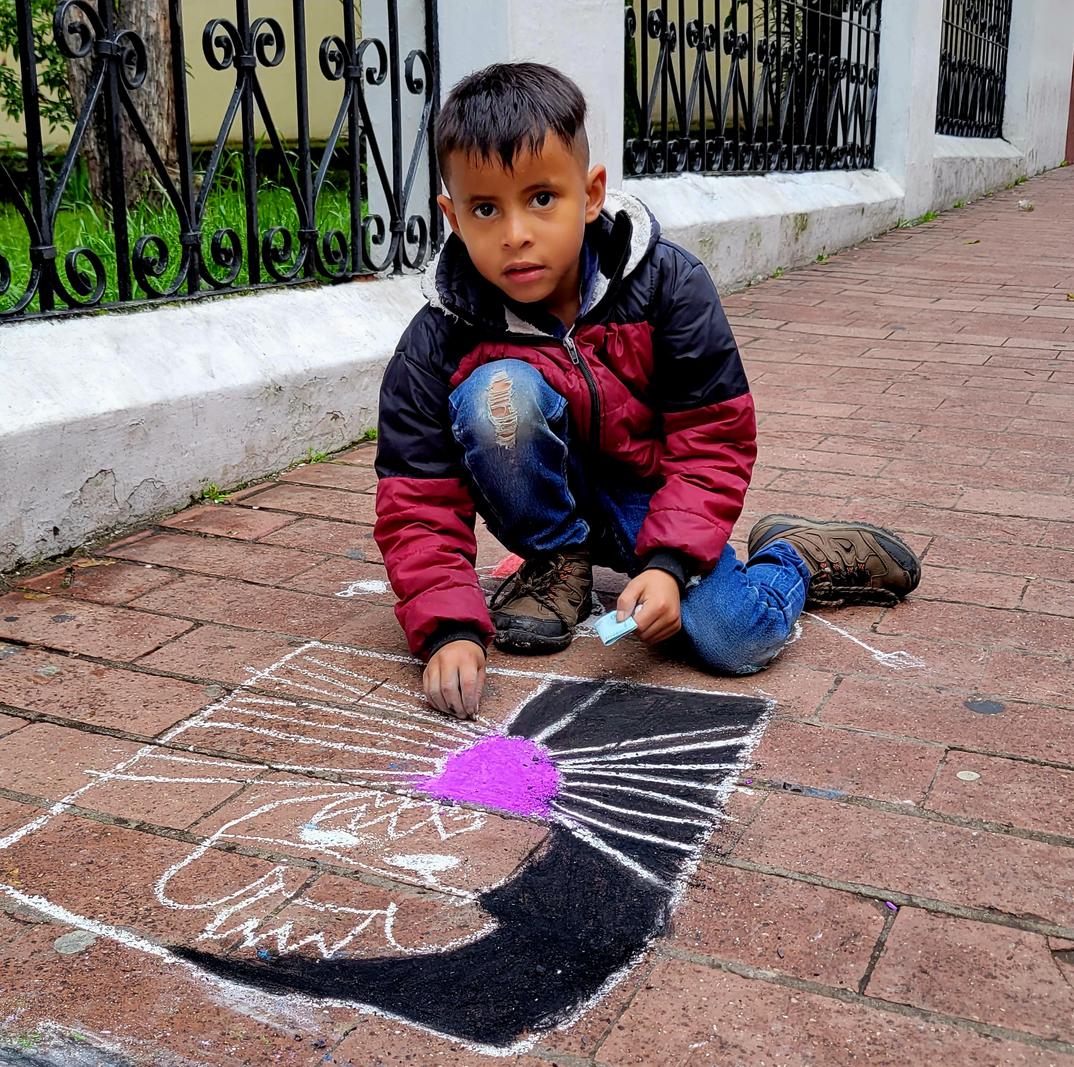
A tender, grounded moment of a child absorbed in making art, nicely seen and respectfully approached.
Thanks for sharing this, Kit. You’ve caught a real moment: a boy mid‑drawing, eyes up to you, chalk in hand. This sits between street and documentary portraiture. The connection is strong and, importantly, the child looks dignified and engaged rather than paraded. One note on language: captions shape how viewers read a picture—“street kid” can carry baggage. Consider describing the action you witnessed (“boy drawing on a Bogotá pavement”) unless a subject’s situation is known and consented to share. Now to the picture: the expression, the chalk piece in the foreground, and that long run of black railings give you good ingredients; here’s how to tighten them.
TECHNICAL EXECUTION ★★★★
The file looks clean with natural colour and no heavy processing—good call. Focus is where it counts (his eyes), and exposure is well balanced under soft, overcast light. There’s a hint of motion softness in the drawing hand which isn’t fatal but does read as unintentional. Next time, nudge shutter speed up around 1/250–1/400s and, if needed, open the aperture a stop to keep ISO modest. White balance feels neutral; the magenta chalk is punchy without clipping. With a touch more crispness on the hand this would be publish‑ready.
COMPOSITION ★★★
The relationship between boy and chalk drawing is the heart of the frame and it’s clear. The receding fence adds depth, but there’s a lot of empty pavement on the right that weakens the focus. The lower-left chalk piece is cropped a little awkwardly, while bright scuffs and dots on the ground pull the eye. A lower viewpoint, closer and slightly left, would align his face and the artwork, include the whole drawing, and use the fence as a leading line rather than a distraction. Did you consider a vertical frame to stack face–hand–drawing in one column?
LIGHTING ★★★
Soft daylight is kind to skin and keeps the mood honest. The hood and jacket create a natural frame around his face, but the light is fairly flat, so the eyes don’t quite pop. A subtle step so he faces a little more open sky would add a catchlight and shape. In post, a restrained dodge on the eyes and cheekbones would help without looking artificial. This isn’t bad light—just functional rather than characterful.
STORY ★★★★
There’s a clear narrative: a child creating, momentarily pausing to acknowledge you. The chalk in his hand, the partially finished drawing, and the scuffed knee all speak to time spent on the ground. It feels respectful and present. To push it further, catch a micro‑gesture—the chalk touching down, dust lifting, or his tongue peeking in concentration. How might the story change if you’d stayed with him through another drawing or a passer‑by reacting to his work?
IMPACT ★★★
The image is warm and human, but the loose right side and high viewpoint soften its punch. A tighter, lower frame that commits to the boy–and–art relationship would elevate it from a good encounter to a memorable photograph. The elements are there; they just need firmer control. What feeling did you most want—his intensity, or the environment of the street—and how might you simplify the frame to serve that?
CONSTRUCTIVE NEXT STEPS
- Reframe in the moment: crouch lower and move half a step left to place his face and the full chalk drawing on the same plane; try a vertical crop that stacks face–hand–art and trims the empty right side.
- Settings for candids like this: aim for 1/250–1/400s at f/2.8–f/4; let ISO float. This keeps the hand sharp and softens the busy railings.
- Post: crop 15–20% from the right and a little from the top; heal the small bright dots and scuffs on the pavement; add a very gentle dodge to the eyes and a touch of clarity on the drawing’s edge.
- Ethics and captioning: if you engage, consider noting that consent or simply describe the scene without labels—your respectful framing already does the right thing.
AI Version 2.12