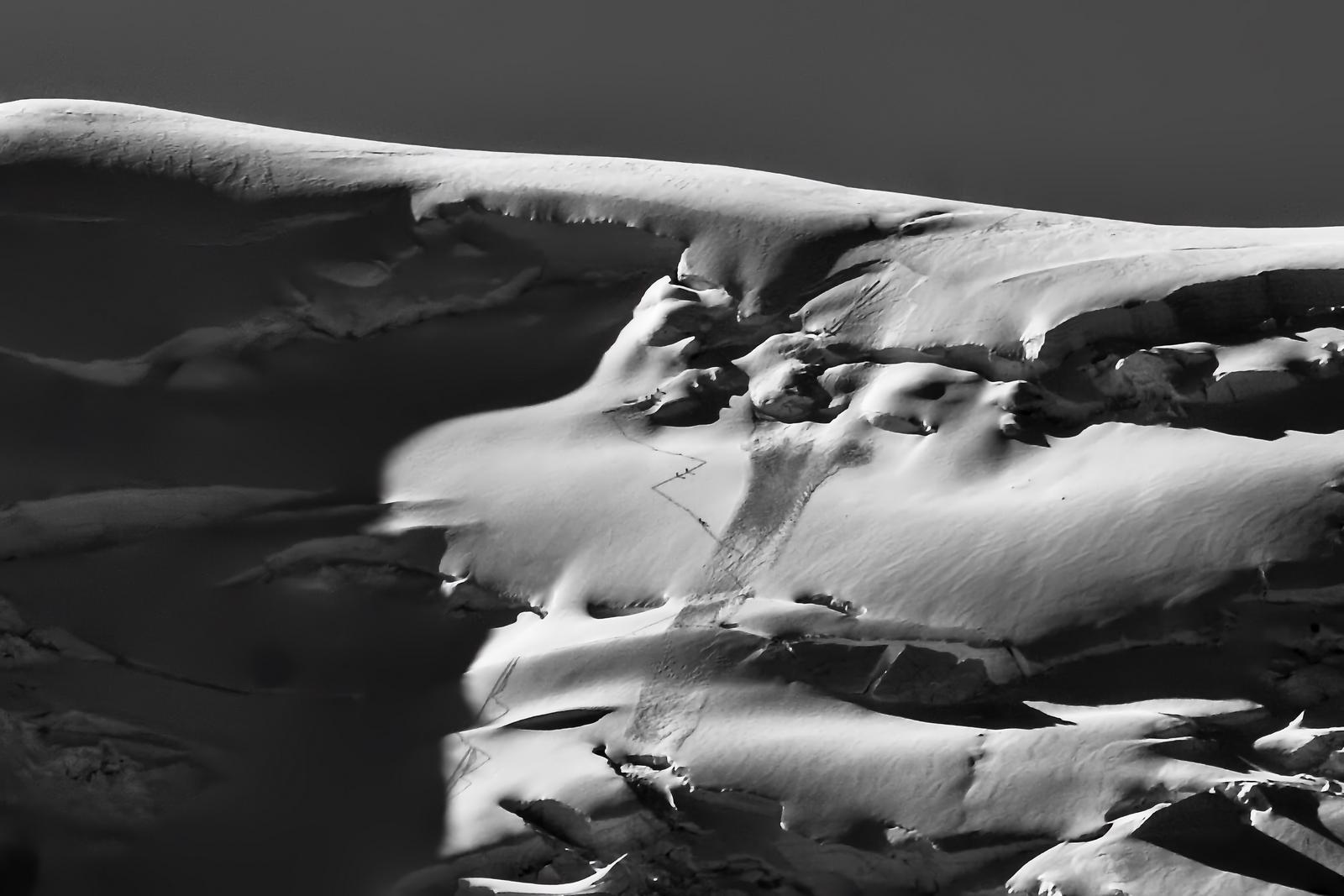
A stark, graphic slice of winter carved by a single zig‑zag track — minimal but striking.
On depth and focus: the image looks acceptably sharp across the critical snow textures and cornices, and the depth of field suits this distant scene — nothing important falls out of focus. What you’ve made here sits between landscape and fine‑art abstraction: a telephoto study of ridges, crevasses and that crucial zig‑zag trail. The strongest elements are the diagonal track slicing the mid‑slope and the hard shadow band on the left that creates a dramatic divide. If your intention was to render the mountain as sculpted form rather than a grand vista, you’ve largely succeeded. Do you want this to read as pure shape and texture, or as a story about human scale and risk? Your answer to that will guide the next refinements.
TECHNICAL EXECUTION ★★★★
The file appears clean and detailed; snow crystals and fracture lines hold together well, which tells me shutter speed and stability were solid. The monochrome conversion is tasteful with no heavy haloes or crunchy sharpening. Highlights on the top cornice are close to clipping but still believable for snow in hard light; shadows on the left verge on blocked, which slightly flattens nuance in that area. There’s no visible noise or artefacts at this size. To hit five stars, preserve a touch more detail in the deepest shadows and protect the brightest ridge with a gentler curve or a soft‑shoulder highlight roll‑off.
COMPOSITION ★★★★
The diagonal track gives the eye a clear path and injects scale into an otherwise abstract field of white. Stacked horizontal ridges create a strong rhythm from bottom‑right to top‑left, and the large dark mass on the left acts as counterweight. The crop is tight at the right edge where the ridge line feels abruptly cut; a little breathing room there would reduce tension that doesn’t serve the picture. This is a bold, simplified frame with intention. For a five‑star design, either embrace a panoramic crop to commit to the diagonal sweep, or include more of the ridge to complete the implied line and settle the balance.
LIGHTING ★★★★
The raking light is doing excellent work, chiselling texture in the snow and revealing the fracture lips and wind‑scoured surfaces. Contrast is high but coherent, and the shadow of the adjacent ridge adds drama. That said, the left third slips into near‑featureless darkness, which reduces the sense of depth there. A touch more shadow lift would show micro‑detail without losing the graphic bite. To reach five stars, aim for a tonal balance where both bright cornice and dark pocket retain readable texture.
STORY ★★★
There is a clear suggestion of human presence and risk through the lone zig‑zag track crossing avalanche‑scarred terrain, which gives the frame tension. However, with no figure or destination, the narrative stays conceptual rather than urgent. The scene feels like a beautiful study of form first and a tale of passage second. If your goal is story, a wider view showing where the trail leads, or waiting for a climber on the line, would deepen the narrative. What emotion did you want the track to carry — solitude, danger, or triumph?
IMPACT ★★★★
The image hits hard at first glance thanks to its clean geometry and monochrome austerity. The minimal palette and strong diagonals make it memorable compared with many generic mountain scenes. It stops short of iconic because the frame feels slightly cramped on the right and the shadow block on the left eats into the depth. Still, the restraint and graphic strength are commendable. Refine the edge control and tonal separation and this could comfortably sit in a print series of alpine abstracts.
CONSTRUCTIVE NEXT STEPS
- Rebalance tones: lift the deep left shadow by 10–20 points and apply a gentle highlights roll‑off on the top cornice (curves or luminance mask) to retain texture without losing contrast.
- Re‑crop with intent: consider a slightly wider frame on the right, or commit to a panoramic crop that emphasises the diagonal track and removes the large dark block on the far left.
- Strengthen the subject: lightly dodge along the zig‑zag track so it reads as the clear anchor, and clone any small, stray pits or dots that distract along the slope.
- On location, bracket two exposures (tripod or braced telephoto) for static terrain; a subtle blend can rescue ridge detail in extremes while keeping the natural look.
AI Version 2.12