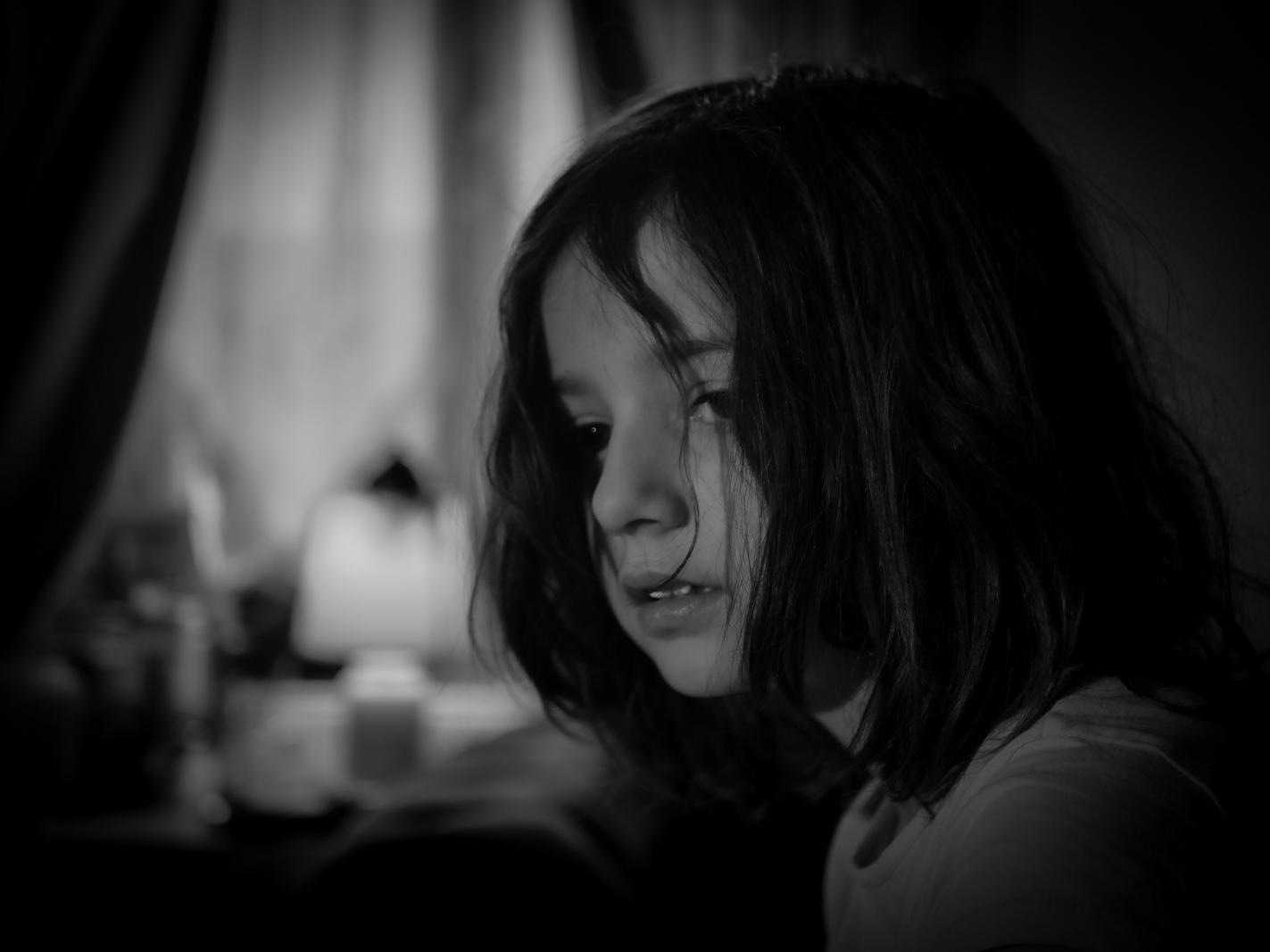
Moody and intimate, this feels close to a film still—but the light and focus hold it back from fully landing the “cinematic” brief.
You’re on the right track with the cinematic idea: the low‑key black‑and‑white, shallow depth of field, and the soft “practical” lamp in the background all nod to film language. This is a portrait, and the subject’s tired, sideways glance gives us a moment rather than a pose—which is exactly what sells a frame like this. Where it falls short is in the precision: the eye nearest camera is soft and mostly in shadow, so the connection slips. If you keep the motivated lamp and shape the light so one eye carries a clean highlight, the shot would feel far more deliberate. What emotion did you want us to read here—quietness, worry, exhaustion—and how could the light position reinforce that?
TECHNICAL EXECUTION ★★★
Exposure is generally well controlled for a low‑key scene and the tonal roll‑off looks natural. Grain/noise is modest and suits the mood. The main technical issue is focus and micro‑contrast on the eyes; the nearer eye is soft and falls into deep shadow, which weakens the portrait. It looks like you shot fairly wide open—the shallow depth of field is pleasant, but critical focus needs to be pinned on the eye. A slightly faster shutter (to avoid minor subject movement) and single‑point eye AF would help. To reach five stars, we’d need crisp eye detail with clean mid‑tones on the face and no competing hotspots.
COMPOSITION ★★★
The subject is nicely set to the right with breathing room to the left, which suits the pensive mood. However, the bright lamp bokeh behind her head and the white T‑shirt in the lower right pull the eye away from her face. The hair crossing the eye adds texture but also blocks your strongest anchor point; at least one eye needs to read clearly. Consider a tighter crop from the left and bottom to reduce the lamp and shirt, letting the face become the brightest, sharpest element. Watch proximity to the top frame—there’s just enough space, but a little more would avoid the slight “pressed” feeling. For five stars, every bright element should serve the face and nothing else should compete.
LIGHTING ★★★
The motivated source (lamp/window glow) gives a film look and pleasant falloff on hair and cheek. Yet the key problem is eye visibility—there’s no catchlight and the eye is buried in shadow, reducing connection. Rotating her a touch towards the light or bouncing a little fill from camera‑left (even a white card) would have lifted the eye sockets without killing the mood. A subtle rim or edge light on the far side would also separate her hair from the dark background. Think “one key, one fill, one separation,” even when you’re using only available light. With a readable eye and controlled highlights on the shirt and lamp, this lighting could be excellent.
STORY ★★★★
There’s a clear, quiet moment here—the loose hair, slightly parted lips, and the soft slump of her shoulders read as late‑night or early‑morning fatigue. The out‑of‑focus room and lamp hint at a private space, which supports the mood. Because the eye isn’t clearly seen, we lose a layer of connection that would make the emotion hit harder. Still, the frame feels honest rather than staged, and that authenticity is your strongest card. If you had timed for a micro‑gesture—an exhale, the hand brushing hair aside—it could elevate the narrative further. What tiny action could you wait for next time that says the same feeling in a clearer way?
IMPACT ★★★
The mood is engaging and the black‑and‑white treatment suits it, but the lack of a sharp, lit eye and the competing bright elements reduce the punch. It’s a frame I linger on for a moment, not one that stays with me. Clean up the visual hierarchy—face first, everything else subordinate—and the image will gain presence. Strengthen the lighting on the eye and control the background glow and this could feel truly cinematic. For five stars I’d want decisive clarity in the subject’s gaze or gesture and zero hotspots stealing attention.
CONSTRUCTIVE NEXT STEPS
- Move your subject 30–60 cm towards the light and angle her face 10–20° to camera so the nearer eye catches a small highlight; add a simple bounce (A4 white card) from camera‑left to open the eye socket.
- Lock focus on the nearer eye (single point or eye‑AF), shoot around f/2–f/2.8, 1/160–1/250s, ISO as needed; take a short burst to beat micro‑movement.
- In post, burn down the lamp blob and the bright T‑shirt (–0.5 to –1 EV local adjustments), and lightly dodge the nearer eye and iris to restore prominence; add a touch of local contrast/clarity on the face only.
- Consider a tighter 4:5 crop from left and bottom to remove distractions and keep the face as the primary bright, sharp anchor.
AI Version 2.12