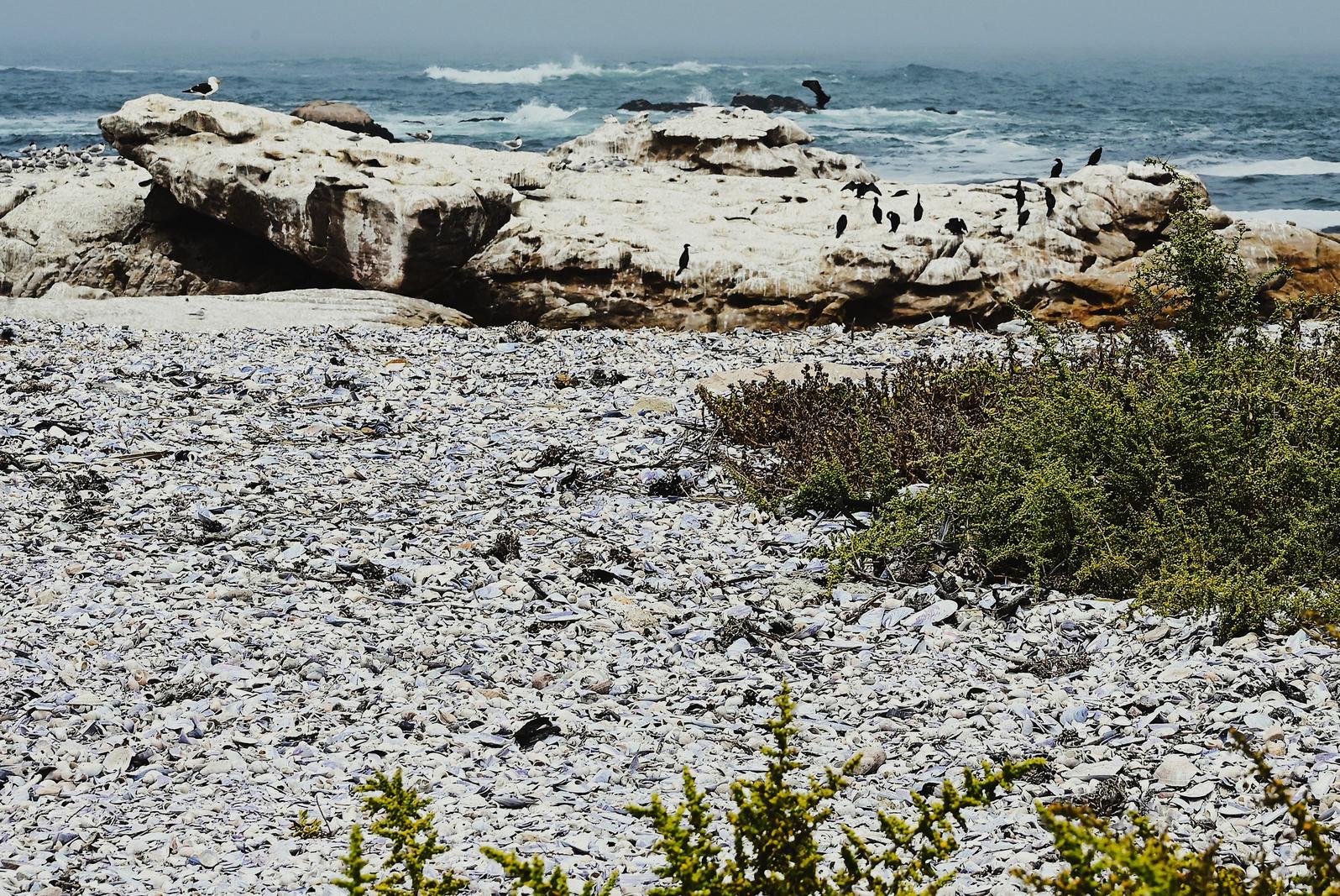
Your scene has the ingredients for layered depth, but the layers aren’t pulling their weight yet.
You’ve definitely built a series of planes: scrub in the foreground, a broad band of shell-strewn beach, the guano-stained rock with birds, and the sea beyond. As a coastal landscape this is a sound idea. Right now, though, the mid‑section of pale shells dominates so much of the frame that the strongest layer—the rock with birds—feels distant and small. Ask yourself: what did you want the viewer to notice first—the cormorants on the rock, or the texture of the shells—and does this framing make that happen? With a lower viewpoint, stronger light direction, or a tighter crop you could turn those layers into a clear story rather than parallel bands.
TECHNICAL EXECUTION ★★★
Exposure is broadly controlled; the pale rocks and shells hold detail with only slight clipping in the brightest guano streaks. There’s some atmospheric haze softening the ocean and distant rocks, which is natural but flattens separation. Colours are restrained and not over‑processed, which suits the subject. Overall sharpness is fine across the frame, though the distant birds lack bite due to distance rather than focus. A modest dehaze and a touch of local contrast on the rock would add clarity without pushing it into a crunchy look. To reach five stars, I’d want cleaner micro‑contrast, crisper detail on the key layer, and more tonal separation between bands.
COMPOSITION ★★
The frame reads as three almost equal horizontal stripes, with the shell field occupying too much real estate and giving the eye nowhere to land. The most interesting elements—the birds congregating on the top rock and the waves—sit high and small, so they don’t command attention. The bush at right crowds the edge and adds weight without purpose, while the rock at upper left pulls the eye out of the picture. A lower position to enlarge the foreground bush as a deliberate anchor, or moving closer/longer to let the bird‑covered rock dominate, would strengthen the layering you aimed for. Five stars would require a clear focal anchor and intentional balance between layers that guide the viewer through the scene.
LIGHTING ★★
This looks like bright midday light, which bleaches subtle colour from the shells and sea and compresses depth. Shadows are short and don’t sculpt the rock, so the “layers” read as flat areas of tone. Early or late light across the scene would carve texture into the shells, put rim light on the birds, and separate rock from ocean haze. A polariser would also tame glare off the water and shells, adding richness. To hit top marks, the scene needs directional, lower‑angle light that shapes and separates each plane.
STORY ★★
There’s a gentle sense of place—rocky shore, seabirds resting—but no decisive moment to hold attention. The birds are too small to communicate behaviour, and the huge middle band of shells feels like filler rather than context. If the narrative is “a living shore”, we need either clearer wildlife behaviour on the rock or a strong human or natural gesture (a crashing wave, a bird taking off) to animate the frame. What was the moment you were hoping to catch on that rock, and how long did you wait for it?
IMPACT ★★
The scene is pleasant, but it doesn’t demand a second look because the subject is distant and the light is flat. The textures promise interest, yet the eye drifts across the shells without a hook. A tighter, more intentional arrangement with stronger light would lift memorability significantly. As it stands, it feels more like a location note than a finished photograph.
CONSTRUCTIVE NEXT STEPS
- Return in golden hour and shoot cross‑light from the left or right; use a polariser and modest Dehaze (10–20) in post to cut glare and separate sea from rock.
- Reframe to make the rock with birds the main layer: either move closer or use a longer focal length (e.g., 150–300mm), and crop away the bottom third of shells so the eye lands where you intend.
- In post, add subtle local contrast/dodge on the birds and the face of the rock, and burn down the bright shell band to reduce dominance; clone a few edge distractions on the right bush if you keep it.
AI Version 2.12