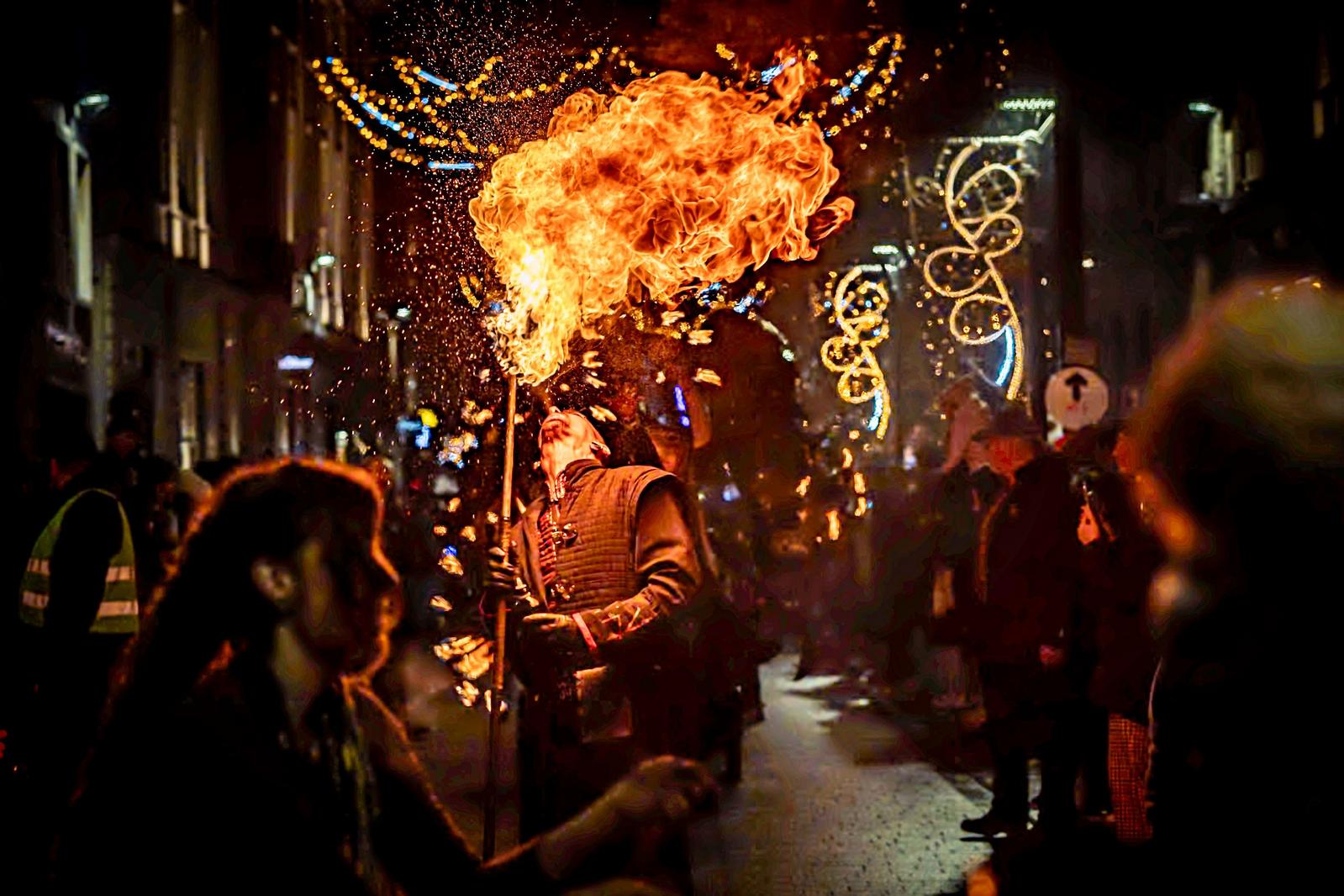
A blazing moment well-caught, with strong flame texture and festive night energy.
On that goal you’ve done well — the flame has crisp edges and internal structure rather than a featureless white blob. For work like this I read it as street/event photography: a performer mid‑breath, crowds and fairy lights setting the scene. To consistently hold flame detail, set exposure for the highlights and let the scene fall to shadow; shooting RAW and underexposing by roughly one stop often protects the curl and texture you’re after. Here, the fireball is rich and three‑dimensional, with flying droplets adding grit. The frame is busy though, and the large out‑of‑focus figure on the left competes with your star attraction; consider whether that foreground adds depth or simply steals attention. What shutter speed did you choose, and did you pre‑meter for the flame or ride exposure compensation on the fly?
TECHNICAL EXECUTION ★★★★
The fire shows excellent detail and the exposure holds together despite brutal contrast — that’s the hardest part and you’ve managed it. Grain looks controlled for a night scene and white balance leans warm without going nuclear. There is some softness on the performer’s face and coat, likely from motion and a slower shutter; a slightly faster speed (around 1/500–1/800 at ISO 3200, f/2.8–f/4) would lock in more texture without smearing the embers. Blacks appear a touch crushed, especially on the crowd edges, which costs peripheral detail. Processing is punchy but not garish; a gentler curve in the shadows would breathe a bit more life into the environment. To reach five stars, aim for tack-sharp detail on the performer as well as the flame and maintain a fuller tonal range in the darks.
COMPOSITION ★★★
The central performer and upward thrust of the flame give a clear anchor, and the street’s receding lights form a nice channel. However, the large, dark silhouette on the left foreground dominates the bottom third and pulls attention away from the fireball; it feels more obstruction than layer. The right edge also holds a soft head that clips into frame, adding clutter. A half‑step to your right or a tighter crop from the left would have separated the flame from the curly light decorations and reduced that heavy silhouette. Consider raising the camera slightly so the fire clears the brightest background shapes, letting it float in cleaner space. Five stars would need cleaner edges and a deliberate use of foreground that supports, not competes.
LIGHTING ★★★★
Using the flame as key light works beautifully — it models the performer’s face and armour with believable warmth, and the fairy lights add a festive backdrop. The colour contrast between warm fire and cooler city lights gives atmosphere without weird casts. Highlights in the flame are bright but retain texture; that’s crucial. Some areas of the crowd fall to near‑black, which suits the mood but slightly reduces spatial context. A subtle lift of deep shadows and a touch of selective dodging on the performer’s face would increase readability without flattening the night. For five stars I’d want a touch more fill or reflected light on the subject while preserving the moody streetscape.
STORY ★★★★
The decisive instant is here — the breath leaves the mouth and ignites, droplets sparkle, and the crowd frames the action. We understand the place and event immediately. What’s missing is a clearer human beat: the performer’s expression is half‑lost in the shadows and the nearest audience reactions are obscured, so the emotion is implied rather than felt. If you’d waited for a spectator’s face lit by the flame or positioned to see the performer’s eyes, the narrative would jump a level. Still, it’s a lively slice of a night parade that rewards a second look. Could you have anticipated a repeat breath and shifted a metre to reveal a child’s reaction or a cleaner profile?
IMPACT ★★★★
The fireball provides strong immediate punch and the rain of sparks adds drama. The atmosphere of celebration reads clearly and the colour palette suits the subject. The busy edges and foreground figure hold it back from being unforgettable — there’s a slight fight for attention around the frame. A cleaner foreground and sharper subject would crystallise the image into something competition‑ready. As it stands, it’s a striking, publishable frame with room to refine the bite.
CONSTRUCTIVE NEXT STEPS
- Expose for the flame: set manual exposure about −1 to −1.7 EV from a test burst and then let the scene fall darker; aim for 1/500–1/800s, f/2.8–f/4, ISO 3200 as a starting point to freeze droplets and keep detail.
- Clean the frame edges: step a pace to your right and forward to drop the large left‑hand silhouette and separate the fireball from the bright curly lights; alternatively crop 10–15% off the left to reduce that dominance.
- Prioritise the human beat: position where you can see the performer’s profile/eyes or an audience face lit by the flame; wait for the repeat breath and shoot a short burst at peak expansion.
- Post‑processing: lift shadows by ~10–15, add gentle midtone contrast, and selectively dodge the performer’s face and hands; keep saturation in check and use a small, soft brush to heal the brightest stray spark trails that distract near the edges.
AI Version 2.12