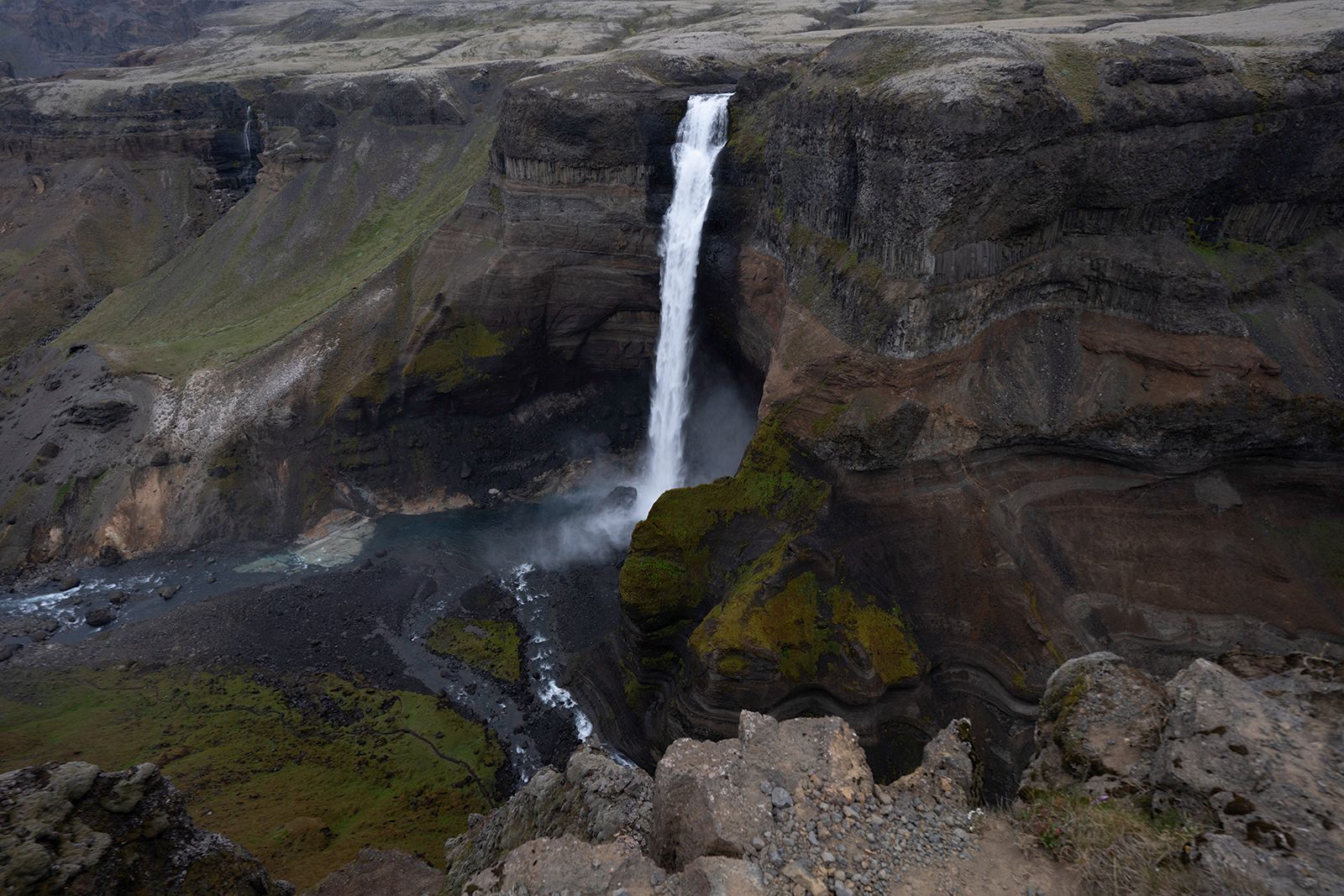
A striking canyon and a powerful fall, but the frame feels undecided — refine the viewpoint and nudge the colours and it will sing.
Thanks, Emiliya. You’re dealing with a landscape: a tall waterfall plunging into a bowl of dark rock, edged by a cliff in the foreground and a flat plateau across the top. To answer your question directly: compositionally, the image sits between two ideas — showing the height of the fall or the sweep of the river — and the current centring plus the messy foreground rock weakens both. Choose one: either go tighter and isolate the waterfall and the layered rock, or go wider/cleaner and use the river as a lead‑in, with the falls on a third. Colour-wise, the file reads cool and slightly green; a warmer white balance with a touch of magenta, plus local contrast, will bring the moss and water to life without going gaudy. What do you most want the viewer to feel here — the vertical drop, the scale of the canyon, or the movement of water? Let that decision dictate your framing and processing.
TECHNICAL EXECUTION ★★★
Exposure is safe: the waterfall retains texture and the shadows aren’t crushed, though they’re a little murky. Global colour is slightly cool with a green bias, which flattens the rock tones and mutes the moss. Detail looks acceptable for a wide scene, but atmospheric softness and low micro‑contrast reduce bite in the midtones. There are no obvious artefacts or heavy processing issues, which is good. To reach five stars you’d need a cleaner, more deliberate white balance, stronger midtone contrast (local, not global), and a bit more edge‑to‑edge crispness, ideally from tripod use and low ISO in the field.
COMPOSITION ★★
The waterfall sits near the centre and the bright, broken rock at the bottom edge pulls the eye out of the frame. The top half is a large slab of flat plateau that adds weight without reward; the real action is lower. The river’s leading line is promising but truncated by the crop and the foreground jumble. A portrait orientation with the fall placed on the right third, giving space to the outflow as a lead‑in, would emphasise height and flow; alternatively a longer lens to isolate the fall and those horizontal strata would simplify the scene. Did you try stepping a little left to keep the river’s bend in-frame and lose the messy foreground edge?
LIGHTING ★★★
Overcast light is kind to detail but it leaves the scene a touch flat. The water, dark walls and moss would benefit from some directional light or mist catching a shaft of sun. In the current conditions, local dodging on the water and a gentle burn on the grey plateau would shape the frame without looking processed. Timing this spot for early or late light, or for low cloud drifting through the canyon, would add depth and mood. That extra texture in the light is what would push this higher.
STORY ★★★
The image communicates a sense of rugged geology and the power of the drop. The precarious cliff edge hints at risk, but because it’s only a slice at the bottom it feels accidental rather than intentional. Without a human or scale marker, the fall’s size is guessed at rather than felt. Weather isn’t adding drama either, so the narrative rests on form alone. A clearer choice—either bold cliff‑edge foreground as an anchor, or a clean, simplified study of the fall—would strengthen the story.
IMPACT ★★★
It’s a compelling location, and the geology is impressive, but the safe viewpoint and cool tonality hold it back from being memorable. The eye bounces between the central fall and the bright bottom edge rather than being led through the frame. With a stronger compositional decision and a subtle colour lift, this could jump a level. To hit four or five stars you’d need either more purposeful framing (portrait orientation or tight graphic study) or moodier light/weather that adds tension.
CONSTRUCTIVE NEXT STEPS
- Recompose decisively: shoot a portrait frame from a step or two left, placing the waterfall on the right third and giving the river room as a lead‑in; or switch to a longer focal length and exclude the foreground entirely for a clean, graphic study of the fall and strata.
- Crop this file now: remove ~20–25% from the top to lose the flat plateau and trim the bright, broken rock along the bottom-right edge; consider a 4:5 or vertical crop to emphasise height.
- Colour and tone: warm WB by roughly +300–500K and add +5–8 magenta tint; reduce blue/cyan saturation by about 10; lift midtone contrast and clarity locally on the waterfall and moss; burn the top plateau with a gentle linear gradient.
- Edge hygiene: clone or crop out small bright stones and the partial cliff at the very bottom to keep attention on the fall; add a light dehaze (+5–10) to cut atmospheric softness without over‑crunching.
AI Version 2.12