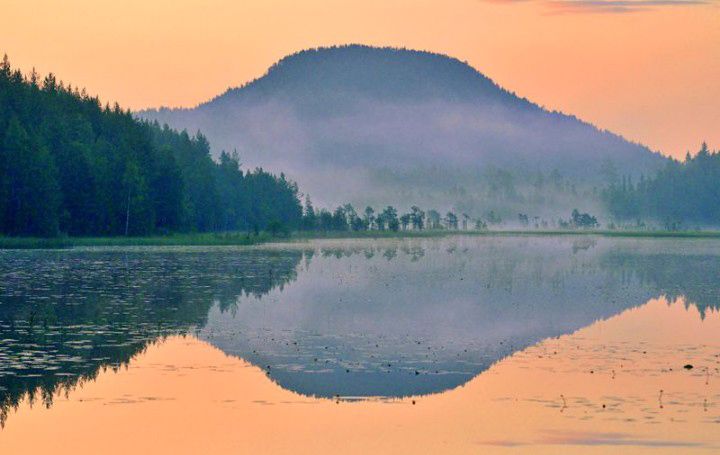
Quiet, pastel dawn with a perfect mirror—peaceful, but playing it a little safe.
The colour looks slightly pushed towards warm/magenta, but not wildly so. The peach sky and its reflection feel pleasant; however, the global warmth spills into the fog and water, giving them a uniform pink cast that tips the scene away from natural. If your aim is a true-to-life landscape, I’d cool the white balance a touch and back off saturation in the oranges/magentas—think subtle, not dramatic. The scene itself—a calm lake, mist, and hill—sits firmly in landscape territory and your strongest asset is the still water creating a clean reflection. The question for you: did you want a faithful, quiet dawn or a stylised, colour‑led image? Deciding that will guide both processing and framing choices.
TECHNICAL EXECUTION ★★★★
Exposure is well controlled; there are no blown highlights in the pale sky and the shadows in the treeline retain usable detail. Sharpness looks adequate across the frame for a serene scene like this, with the mist softening contrast naturally. I don’t see obvious artefacts or HDR halos, which is good. The main technical concern is colour balance—the entire frame leans warm/magenta, which flattens the separation between fog and mountain and makes the water feel a bit synthetic. A slight cool shift (–300 to –500 K and –5 to –10 on tint in Lightroom) plus a small reduction in orange/magenta saturation would read more natural. To reach five stars, refine colour neutrality while maintaining the delicate tonal transitions in the mist.
COMPOSITION ★★★
The perfectly centred horizon commits to symmetry, which suits a mirror reflection, but the frame lacks a foreground anchor to pull the viewer in. The dense treeline on the left outweighs the right side, creating a slight imbalance that a step to the right or a tighter, more symmetrical crop could solve. The hill is a gentle shape, yet with nothing in the foreground—no reeds, rock, or ripple—the scene feels static. Trimming a little of the empty top sky would concentrate attention on the fog band and reflection where the interest lies. Consider whether a lower viewpoint at the water’s edge could have introduced texture in the foreground surface. For a five‑star layout, add a considered foreground element or refine the symmetry so everything in the frame supports that choice.
LIGHTING ★★★★
The light is gentle and early, giving you that soft mist layer that’s the photograph’s best feature. There’s pleasing gradation from warm sky to cool shadows, though the current white balance compresses that warm–cool relationship. The fog is nicely illuminated but could stand a touch more mid‑tone contrast to separate it from the dark hill. Importantly, nothing appears harsh or clipped; you chose the right time of day. A local adjustment increasing clarity or dehaze 5–10 on the fog band would add depth without breaking the mood. To reach five stars, preserve the softness while carving just a bit more tonal structure between hill, fog and reflection.
STORY ★★
It’s a pleasant view, but it stops at “pretty.” The mist hints at calm, yet there’s no moment—no bird skimming the surface, no passing ripple, no weather change—to give the scene a heartbeat. Without a foreground detail or a small subject for scale, the viewer isn’t invited to linger beyond the symmetry. Ask yourself: what single element could you have waited for or introduced ethically (a drifting log, a canoe at distance) to make this a specific moment rather than a generic sunrise? The atmosphere is there; the narrative is not. A decisive detail would lift this score substantially.
IMPACT ★★
The image is soothing but blends into the countless pastel reflection scenes we’ve all seen. The slightly heavy warmth and centred horizon make it feel safe rather than striking. Because the scene lacks a focal moment, the “wow” factor is muted despite the lovely setting. Pulling back the colour cast and either tightening the symmetry or adding a foreground lead would give the viewer more to hold onto. Right now it’s likable, not memorable. A stronger gesture or weather event would push it higher.
CONSTRUCTIVE NEXT STEPS
- Colour tune for realism: in Lightroom, reduce Saturation for Orange and Magenta by ~10–20, shift Tint –5 to –10 towards green, and cool WB by ~300–500 K; apply a graduated filter to the sky to keep warmth subtle while leaving the land neutral.
- Add separation in the mist: a local Dehaze/Clarity of +5 to +10 on the fog band, and a gentle S‑curve to lift midtones on the hill while holding blacks, will enhance depth without crunching the scene.
- Commit to either symmetry or depth: if going symmetrical, crop/align so left and right treelines balance perfectly; if going for depth, include a clean foreground element (reeds, a rock, or shoreline pattern) from a lower vantage at the water’s edge.
- Wait for a small moment: a bird crossing the reflection, a drifting patch of fog, or a single ripple will give you a story anchor—plan to stay 10–15 minutes longer for that change.
AI Version 2.12