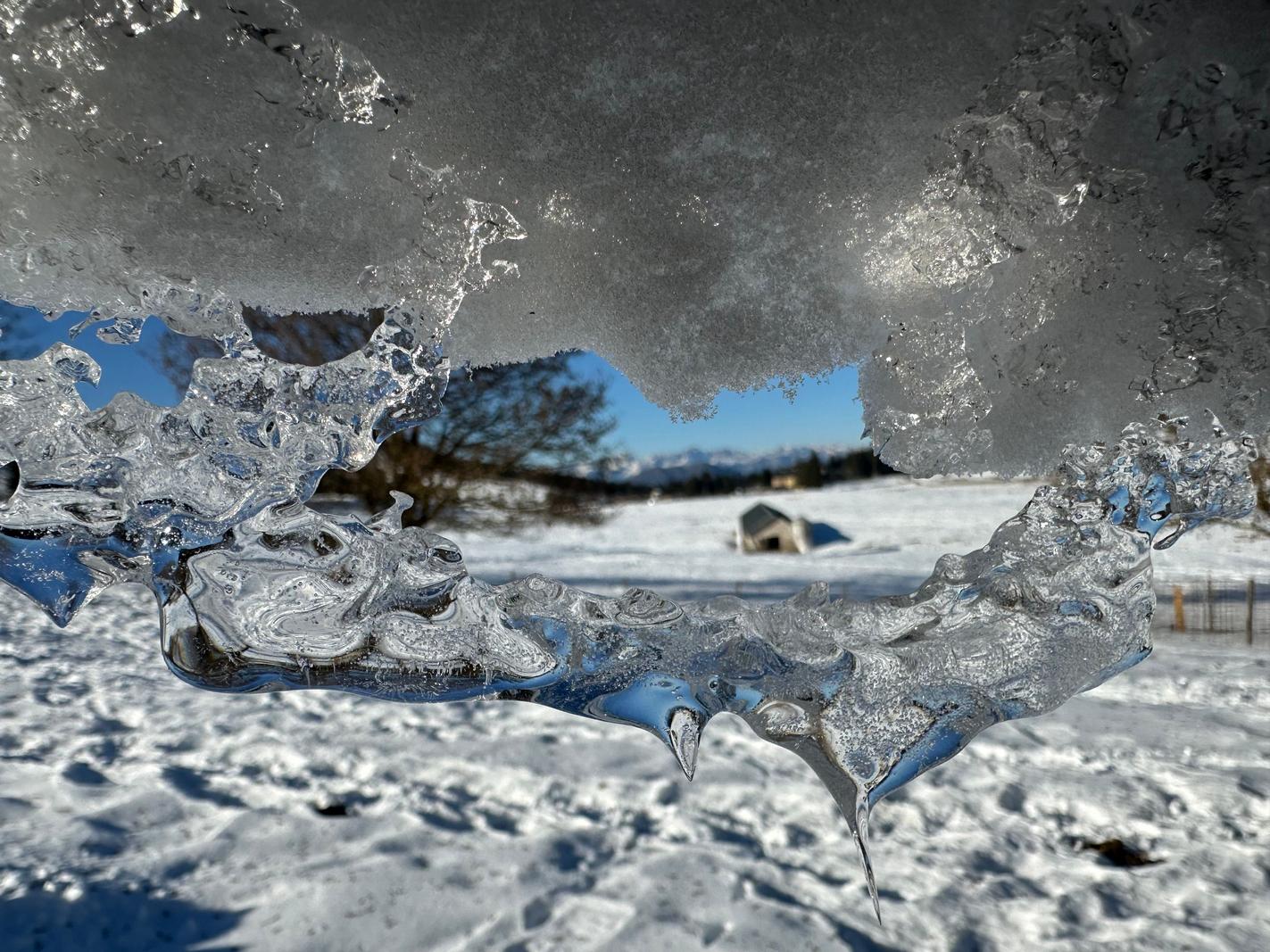
A clever winter “window” — the melting ice becomes your frame and subject.
Thanks for sharing, Gregorio. This reads as a landscape with a strong abstract foreground: a jagged arch of ice forms a natural frame for the snowy field, a small hut, and the distant mountains. The idea is strong and you’ve handled the bright conditions well. Do you see this more as a study of ice textures or as a view of place? Deciding that up front will help you fine‑tune depth of field and placement of the hut within the opening.
TECHNICAL EXECUTION ★★★★
Focus on the ice is crisp, revealing fine bubbles and swirls, and the exposure holds tricky snow highlights without turning them to a flat white. The background is intentionally soft from a shallow aperture, which supports the abstract foreground, though it does sacrifice a little context in the mountains and hut. Colour feels natural and not overcooked; the cool blue sky suits the scene. A few specular hotspots on the ice are bright but not destructive. To reach five stars, I’d want either a touch more depth-of-field or a second frame for focus stacking so the hut reads a bit more clearly while keeping the ice tack-sharp.
COMPOSITION ★★★★
The ice creates a strong arching frame with two downward “teeth” that add tension and guide the eye to the gap. Placing the hut just right of centre inside that opening is a smart anchor, and the distant ridge gives scale. The heavy snow mass at the very top feels a touch dominant, slightly crowding the window; a small step back or lower vantage might have opened the gap and given the hut more breathing room. The darker tree left of the hut competes a little with the main window. Would shifting your position a half‑metre left to separate the hut from that tree have cleaned the read? Overall, bold and mostly controlled.
LIGHTING ★★★★
Hard winter sun usually punishes, but here it works: the ice catches light beautifully and the micro‑textures sparkle without turning garish. Shadows on the field are gentle enough to keep detail, and white balance feels honest and cool. The specular glare on some ice ridges is close to clipping; a polariser would have given you the option to dial reflections up or down. A slightly lower sun or thinner cloud would add more modelling and depth, but you’ve handled midday conditions well.
STORY ★★★
The picture hints at thaw and shelter — a glimpse of a hut through a brittle edge of winter. It’s more an aesthetic study than a moment, with the landscape playing second fiddle to form and texture. If your aim is sense of place, the soft hut and mountains leave me wanting a clearer read. If your aim is abstraction, the background becomes slightly distracting. What would the frame say if a breath of wind set a droplet falling, or if a person crossed the field to add scale and a beat of life?
IMPACT ★★★★
The concept is fresh and eye‑catching; people will pause for the glassy ice “portal.” The restrained colour and clean handling help it feel refined rather than gimmicky. It stops short of unforgettable only because the small hut lacks clarity and the composition isn’t quite at its most distilled. Sharpen those two elements and this could be a standout portfolio piece.
CONSTRUCTIVE NEXT STEPS
- Reposition to separate the hut from the dark tree and open the central gap — even 30–50 cm left or a lower stance would likely place the hut cleanly in the brightest part of the “window.”
- Increase depth-of-field to around f/8–f/11, or make two frames (one focused on the ice, one on the hut) and blend carefully for subtle focus stacking; tripod recommended.
- Carry a circular polariser to control glare on ice and deepen the sky; rotate for a version with richer texture and one with sparkle, then choose the stronger read.
- In post, use a gentle local adjustment: lift structure/clarity on the ice only, and slightly darken the upper snow shelf to keep attention on the opening; clone the small dark blob bottom right and consider a light crop to remove the faint fence on the far right.
AI Version 2.12