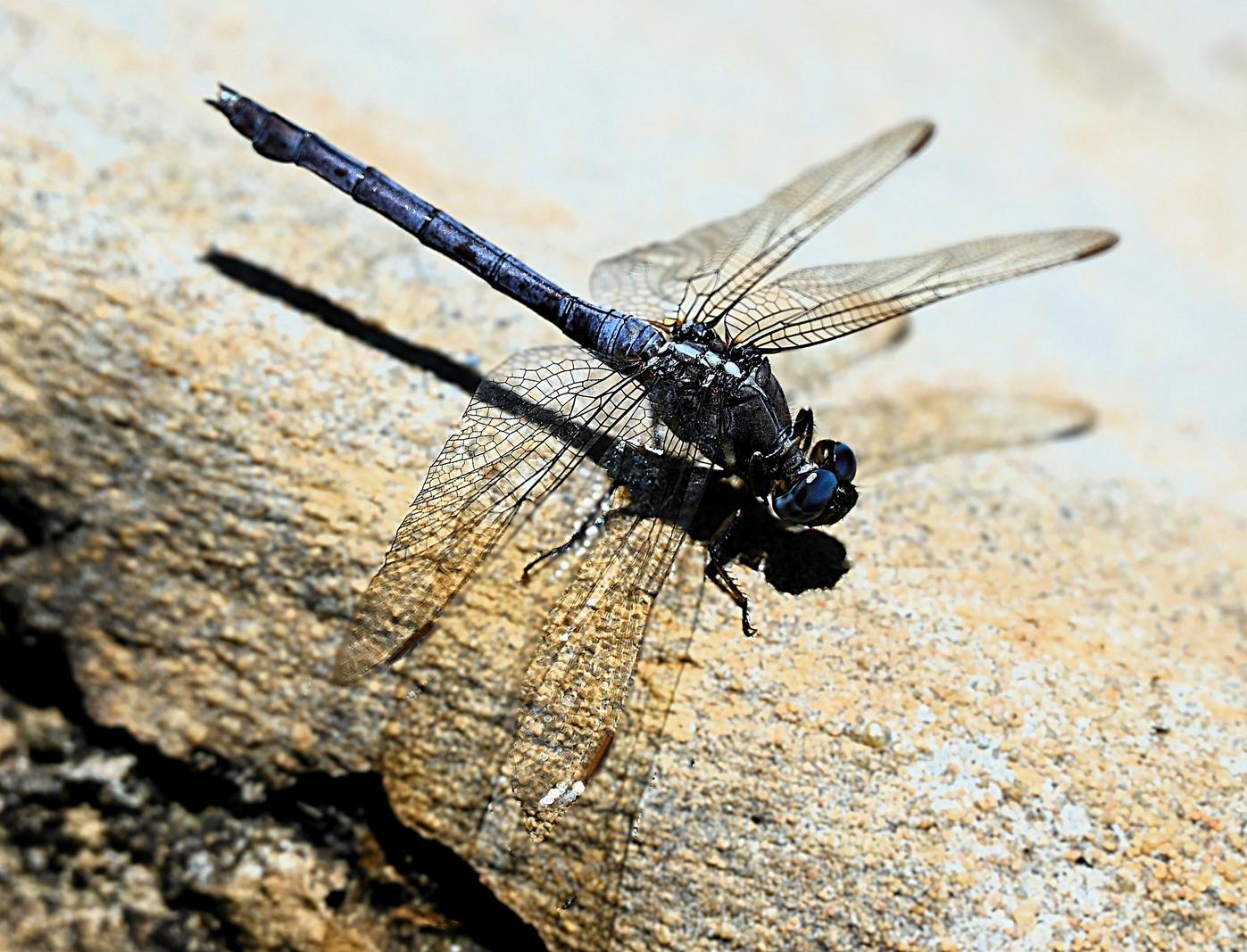
Crisp detail on the dragonfly with a bold diagonal pose, but the light and processing feel a bit heavy.
Your edit gives the insect a striking, high‑contrast presence and reveals plenty of wing structure — this sits between wildlife and macro. The image lives or dies on three things here: critical sharpness on the head, separation from the background, and gentle light on those delicate wings. The detail is strong, but the rock texture and hard midday sun make the scene look crunchy and a touch over‑processed. If you pushed clarity, texture or sharpening, that’s what I’m seeing around the wing edges and on the stone. Consider whether the tight crop and high contrast serve the subject or the edit more than the moment. What were you aiming for with the edit — a clinical, high‑definition look, or something softer and more natural?
TECHNICAL EXECUTION ★★★
Focus looks solid through the thorax and near eye, with good micro‑detail in the wings — the crucial box for macro. However, contrast and clarity appear pushed, giving the rock a gritty, almost HDR feel and creating slight halos along wing edges. Shadows on the body are crushed, losing texture that is likely present in the RAW. The background texture is rendered sharp enough to compete, suggesting either a smaller aperture than needed or an edit that increased perceived sharpness across the frame. Pulling back sharpening/clarity and selectively lifting shadows on the thorax would yield a more refined file. To hit five stars I’d expect cleaner, more natural processing and a subtler rendering of fine detail without halos.
COMPOSITION ★★★
The diagonal body line is a good choice and the insect is clearly the subject. The tail sits very close to the left edge and the front wing tips are close to the top edge, which adds tension but also feels cramped; a touch more breathing space would help. The dragonfly sits over a busy patch of stone, and its shadow creates a second, darker diagonal that pulls the eye away. A lower or slightly different angle to place the subject against a smoother area would simplify the frame. Did you consider rotating the camera so the body ran corner‑to‑corner, giving the wings more room? For a higher rating I’d like cleaner separation and more deliberate negative space around wings and tail.
LIGHTING ★★
This looks like hard midday sun: high contrast, sharp shadows, and specular highlights on the wings. While it freezes detail, it flattens colour and makes the body look inky, especially under the thorax. The wing glare steals attention from the eye and reduces subtle textures. Open shade, early/late light, or a small diffused flash would give shape without glare and add a clean catchlight. Even a simple handheld diffuser or stepping into the insect’s shadow can cut the harshness. Softer light would push this category up immediately.
STORY ★★★
As a macro wildlife portrait it’s a clear record of a dragonfly at rest, and the diagonal pose suggests readiness to launch. There’s limited behavioural information — no prey, flight, or interaction — so the frame leans on form and detail rather than moment. The gritty rock adds environment but not meaning. Could waiting for wing cleaning, a head turn, or lift‑off have given you that extra beat of life? A small gesture would deepen the narrative without needing a new location.
IMPACT ★★
The subject is inherently interesting and the diagonal stance has presence, but the harsh light and aggressive edit dampen elegance and subtlety. The busy background keeps pulling attention, making the image easier to admire than to love. Toning down processing and simplifying the field would elevate the wow factor considerably. For four to five stars I’d want softer light, cleaner separation, and a moment or gesture that gives the insect character.
CONSTRUCTIVE NEXT STEPS
- Shoot in open shade or with a small diffuser; aim for f/5.6–f/8, ISO 400–800, 1/500s+ and focus on the near eye to keep the head crisp while softening the stone.
- Reposition a few inches to place the dragonfly over a smoother patch of background; leave extra space ahead of the head and at the tail/wings to avoid cramped edges.
- In post, reduce global clarity/texture and apply sharpening only to the head and thorax; gently lift shadows on the body and tame wing highlights with a local highlights reduction.
- Clone out tiny bright specks on the rock and the small white fleck on the lower wing to remove eye‑catching distractions.
AI Version 2.12